Video Transcript
You're watching Power Nation.
Bro,
what in the hell is that?
Anthony isn't completely sold on the shop's newest project vehicle,
but Mike lays out his vision for the build and reveals the one big surprise that makes it the perfect truck for his plans.
This thing has a 62 in it. Somebody's already swapped it over.
Then it's time.
To put our Chevy on a strict diet as we tear into the interior and shed every pound possible to make the avalanche light as it can be.
After that, we visit a unique shop where the art of old school neon sign making gets a modern day twist.
All that and more today on Music City Trucks.
There it is.
Well
hey everybody, we have been on the hunt for a new project vehicle for a while now, and I saw this one online a couple of days ago,
went and checked it out and thought,
man, that's a great deal. And next thing you know, here we are, the owners of this
Chevrolet Avalanche, and I think it'll be perfect for my plan, my vision I've got in mind
as the next build on Munich City trucks here. Now the hard part, I think is gonna be convincing Anthony
that this is perfect for us, but you know,
here we go, let's give it a shot.
All right, we got in here now let's give him a call and get him outside here.
Yo yo, Mikey, what's going on,
brother?
Hey, what are you doing?
I'm putting old Cream Puff to bed, getting the cover on her.
What are you doing? Yeah,
well,
you know,
now that Cream Puff is done, we need a new project. I got one for you. It's outside. Come,
come out here and check it out.
You already got one?
Yeah, man,
right on. Well, I'll be right out.
Sounds good.
What do you think,
bro,
what in the hell is that?
An avalanche? It's an avalanche.
I have a list of the most hideous trucks ever created.
This is high up there with only two beating them, the Honda Ridge Line
and the Pontiac Aztec, and you, this is what we're doing.
Those are pretty ugly, but man, this one is, this one's nice. This one's
cream of the crop.
You got a vision for it?
I do. I do.
Jump in. We'll go down the road and I'll tell you all about it. Oh, I hope it's a good one.
Hey, well, at least it starts.
What have you done,
Michael?
Well,
Mike,
what's your first impression so far?
Well,
uh,
it's everything I thought it would be
on the inside and the out.
It has like a mountain.
You can't ever see over the hood.
There's a mountain range in front of it, so I get why they call it the avalanche. Yeah, it's got a little,
little shape to, a little bulge, I think they call it the power bulge,
Power bulge,
on the hood right there. Yeah,
I see why you liked it.
Tell me about your vision for this thing because I don't see it yet.
Nowadays,
you know,
something that catches my eye are the dragon drives.
You loved the drag racing so much we did a couple of years ago with a 632.
I said, hey, how can we get back to the drag strip there?
So
we're gonna turn this into
a drag race machine.
All right, now you're speaking my language
now
I would.
Have been my first choice for the ultimate drag drag and drive rig?
Probably not.
I, it's just so flexible. I mean, the people in the back,
you can,
the, the back seat folds down if you need to haul more stuff in the back you get more bed space. Yeah, so this is on the same platform as like the Tahoes and Suburbans. It's a little bit more smoother ride there for that year model,
um,
obviously drag racing, it's about going from start line to finish line
and the quickest.
You know, the quickest time so to start out on a build like that, you would typically want to start with the smallest,
lightest vehicle to help you
get there quicker,
right?
That's why you chose it.
Yes,
no,
yeah,
smallest vehicle.
No,
no,
no,
no, this thing, this thing's pretty big. This thing
is not small,
it is not quick right now.
How quick? Well,
if we can get
in a quarter mile, 11, 12th.
Range, I think that would be respectable.
Yeah, I mean if we can get this thing in the 10s, I think that would be pretty,
you know, there's nothing wrong about going
slower if that's what happens with it,
but the,
the, the unique thing I wanna do with this is it's 4 wheel drive, so we're gonna keep it 4 wheel drive
and put 4
radial tires all the way around. So we're gonna have 4 wheel drive drag
vehicles so it's gonna be
the
way for it.
I thought about this now
avalanche drag racing,
the dragon.
And
you've put some thought into that name, haven't you?
The whole
every stoplight you came to in that thing,
you,
you heard Dragonl just
echoing and that was a starting line.
You call it the stoplight. I call it the starting line for the next race right there. I like that. I think,
I think your idea, I think I like where your head's at,
and
anytime we can go to the drag strip,
I'm all for it.
So,
so you might be thinking,
well, why this specific one?
Why this specific avalanche? Is it because it's the black?
It is a black diamond. All right,
I don't even know what that means,
but I know it's gotta be the fancy one. It sounds like it's, it's, you know,
uh, rare.
Speaking of sound, this thing kind of sounds
different.
It sounds throaty,
you know. This obviously it is a used vehicle.
Someone has messed with it before,
uh, but in the listing on the, the dealer website, it said swap 6.2 L. That's what caught my eye.
I said, What's
that's got a 6.2,
so somebody obviously knew,
hey.
The engine either blew up, it went away.
They're like, OK,
you know what? I'm gonna put a 6-2 in it and
score for us,
right?
You know what I mean?
It's gonna be a unique combination.
I'm like,
I'm really pumped about this. It's gonna be a cool build.
Yeah,
I think it'll be so unique that
you won't see another one, and that's what's gonna make it cool,
right,
right.
Well,
enough talking about it. Let's get back to the shop and
start stripping this thing down.
Well,
let's get to it.
All right.
If Project Dragonan is going to be a serious contender,
it's gotta slim down.
We're putting this truck on a strict diet and ditching anything that can hold it back.
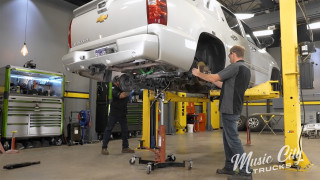
Got that last scale under there?
Yep,
they're all there, right on.
So
we barely made it back to the shop in this old peach of an avalanche,
but I think it's time we need to see what this thing weighs.
Yeah,
you know, I'm thinking somewhere around 6000 pounds,
uh,
but we'll see, we'll find out and get a good baseline.
Yeah,
hopefully not heavier than that, but we'll see where we're at. I'm gonna go ahead and zero this thing out and we'll get her set down.
All right,
we're 0.
All right, let her rip.
Go down.
And survey says
we're almost there.
All right.
So what'd you say?
I was thinking somewhere around 6000 pounds.
6.
Well,
you're gonna be pleasantly surprised.
5680. Yeah, the balance isn't too bad either.
So I honestly thought it was gonna be a little bit over 6000.
So, right,
right.
Well,
weight is horsepower, and we gotta get all the weight off that we can, put as much horsepower in the engine as we can
to get this thing to go down the track really quick.
So
with that,
that gives us a good foundation for some modifications.
Let's show you what else we got in planned for this avalanche. I'm gonna get this thing in the air.
Yeah, we'll get him back off the scales.
A big problem with this avalanche is its weight,
so to help shed some pounds, we're gonna strip out the whole interior.
Then to add safety, we'll install a full roll cage, plus install some custom seats with provisions
for safety harnesses
and keep us comfortable going down the road.
Up next we'll tackle the power train by removing the engine and completely rebuilding it for more power.
To top it off, we'll add a Holly Hiram intake manifold
and a shot of nitrous oxide
to push us faster to the finish line.
We'll back that up with a 4080 transmission and a heavy duty transfer case.
We'll ditch the factory rear axle for a beefier Ford 9 inch with a custom 4 length set up for drag racing.
To plant all that power to the pavement,
we'll put a set of bead-lock wheels and drag radial tires on all four corners,
then finish it all off by replacing the stock front bumper for a more aggressive look
and slap on some custom graphics.
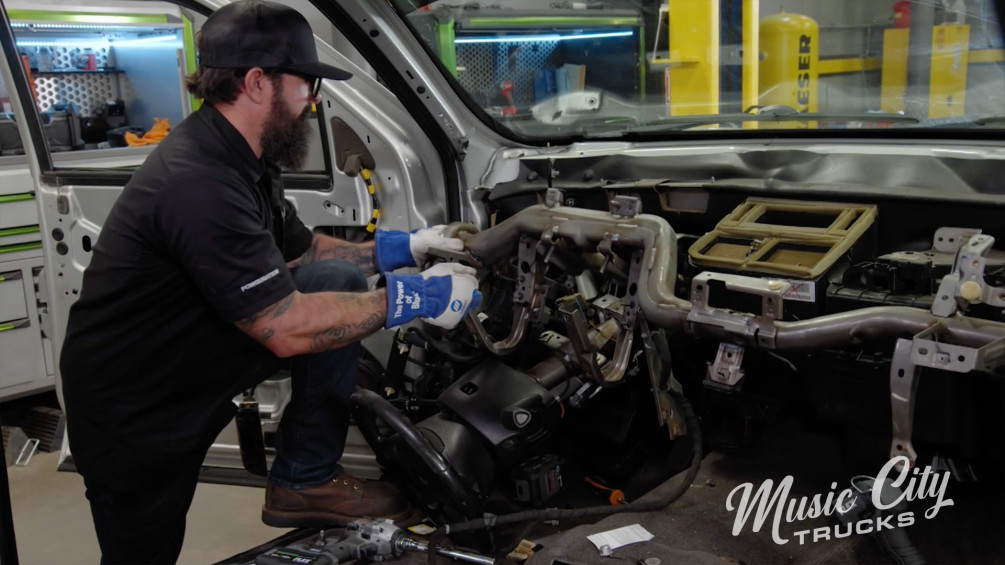
All right, now the fun part, gutting this thing of everything that, well,
doesn't really matter,
right?
None of it really matters, so we could be violent with this too.
So I'm excited.
Another key point,
make sure you disconnect the battery. You got a lot of airbags in these newer vehicles, so you don't want them blowing up in your face.
Don't wanna get punched by an airbag. I don't think that's gonna be a good time.
I like how each fastener is a different size.
Is it?
Yeah, I'm enjoying that so far. That's nice.
An 11 should get it.
No, it's working.
There's a lot of scents in here.
Like you,
I, every time I,
I unveil a piece of plastic, I get a different smell out of it.
Come on,
baby.
Oh, excuse me,
it couldn't smell much worse than the carpet
stuck on something.
It's probably one of them plastic connectors. Let me see if I can be careful with it.
Oh,
yep,
there we go,
got it.
Let's see what kind of treasures we have on my side,
holy mackerel.
Yee,
where are we going this way.
It looks a little tight.
What if we go like this, lift it up.
The math ain't mathing over here.
I don't look like
if we can fold it, if we can.
Do like this number,
tilt it.
What if we go
like that,
tilt it.
Yeah,
yeah,
yeah.
That's a problem.
Here,
let me see if I can.
I'm gonna wiggle back.
See if I can make this seat go down.
How did Chevy do it? That's what we need to answer.
They probably put it together in here. You think they constructed it inside?
Should we get the plasma cutter?
Some type of combination here.
What?
Oh, that might be,
that might be, it's like a Rubik's cube.
What if we do it that way?
OK.
Which way? Oh, this thing chose woke up and chose violence this morning.
Hey, I think we got a combination.
Never thought I'd be working on an avalanche, so I caught on the carpet.
All right, now go.
You gotta pivot, pivot
pivot your side that way.
There we go, all right.
It's all yours.
I don't know if it helps us, but I'm just hitting every,
every screw I see them.
If that's not a top fuel mechanic, I've,
I've seen one before.
It's quite the unit right there.
I hear that a lot.
I get that every day.
Cheers.
This is what they do to your car at the dealership when they say they have to take the dash out
and you're wondering why is it so expensive?
Well,
look,
look behind there, that's,
that's a good indication of why it's so expensive.
Are you ready to yank this thing out here.
Hey.
All right,
that's, that's 30 pounds right there.
I'm telling you,
getting there.
All right,
that's the last big piece.
Get it out of here.
Well,
I think we saved some weight.
Next, we step inside a shop where the art of making neon signs is evolving,
blending traditional techniques with a modern twist.
Whether you're hanging out with your buddies at a bar or turning wrenches in your garage,
there's one form of Americana that connects the two, and that's neon signs.
Recently we drove up to Illinois
to check out a shop
that's continuing that tradition with these modern works of art,
Garrett.
Mike,
hey man,
how you doing, man?
Good.
Nice to meet you, sir.
You find it all right?
Yeah,
great,
great. Perfect.
Uh, the home of Neon Road right here. This is it,
man.
Neon Road. Absolutely.
Wow. I'll tell you what, these signs are super cool,
you know,
the automotive history like that is just perfect. It fits right in.
So you do a lot of the work here. I,
I see what exactly goes on in this,
this building right here with your signs to build a neon sign,
there's. There's a number of processes that, that takes place and, uh,
actually I've got several different buildings where we, where we build our pieces. But in this particular shop,
I, I do some assembly work here and then I also build, um,
every neon sign I build, you know,
they all get lifting lugs
and
they also get,
as you can see,
we weld in these 3/8 nuts. So, you know, a lot of times the customer wants to mount their, their sign on the wall,
right?
So I.
these and this is,
this is a really slick way to be able to mount a very heavy fragile neon sign on a sixteen-inch center stud wall.
So every sign we build,
we weld these in on
16-inch centers, 32 inch centers,
48 inch centers, whatever,
it'll still go on a 16-inch stud wall.
Well,
and this looks like, uh, I guess one of the starting points for a future sign you guys is,
yeah.
So every neon road sign starts out with a fabricated steel can
and a fabricated steel trim ring.
Cool deal. So that's the starting point right there, but I guess you're saying you have different buildings there.
So
what, what do we have in another building?
Well,
I'm glad you asked again.
Well,
you wanna go see something pretty cool?
Oh,
let's go to my, let's go to my laser shop.
I'll show you how we, uh,
kind of build out the sign face lasers. That's already cool,
yep.
Looks like we got a big old machine here, yes sir,
where it all starts.
So, um,
you know,
if you remember I was telling you that,
you know, we draw everything in CD, right?
So for example,
roadster shop,
I'm, I'm getting ready to build another little roadster shop wallhaer. So,
um, I've got to cut a number of parts and pieces.
To be able to assemble that sign out,
so this is a
piece that I need to cut out.
So you stack them all on top of the piece here. You got them all designed out, assemble it all out
as you can see,
I have lots of substrate material in here.
So, uh,
I got a part that I need to cut it right now. So if you wanna check it out, I'll show you.
All right,
so
now we hurry up and wait.
Just let the laser do its thing and we'll have us part here in a little bit.
All right man,
part's done.
Perfect. Let's check it out. All right, let's do it.
This is for
a wallhaer.
That's just one part
of a bunch of parts stacked on top of each other and, and they all assemble together to basically comprise the artwork and the graphics.
Perfect.
So once you get them all cut right here,
then you have to assemble them.
Where does that? Where does that take place at in my other assembly shop.
So again, that's in another separate building. So let's go check this out. Lets go check it out.
Might as well.
All right.
All right, Mike,
this is the neon shop,
Judy.
Hi Judy. Mike.
Hi Mike.
Nice to meet you.
Nice to meet you.
What do you got going on in here?
I'm making a little glass. It looks that looks like engine stuff, like a rod heater, but you're using glass.
Let's, let's see what you got going on.
Well, we're gonna make a couple bends here for your sign,
OK.
This is where the magic happens right here. I tell you what,
you know,
you, you, you picture this stuff,
you know,
up and down the road, but
the stuff that it goes into making it work,
well,
here we are, and there's a lot going on here.
So
I get this hot enough to bend.
Miss Judy has been.
Creating art with glass and neon for more than 30 years.
Working with neon is truly in her blood,
but mastering the craft requires exceptional skill,
patience, and precision.
Bending and manipulating glass into stunning works of art is a process built on years of trial and error.
A single incorrect bend can ruin an entire piece,
forcing the artist to start over from scratch.
She just twisted it just like that,
so that'll make the bottom part of your tee on the sign.
Now, is that pretty forgiving to where if you go back to the pattern, you may want to make an adjustment?
No, it,
that's it.
You're done moving it, yeah.
So if you, if you miss it,
you gotta start all over again.
Yeah,
you gotta know where you're going and have your.
Table clear so you can get there. Yeah.
Yeah, that's it.
That's why careful planning,
accurate designs, and precise patterns are essential to transforming fragile glass into the vibrant glowing masterpieces that have become neon Road's signature art form.
Well, I'll tell you what,
seeing you make this stuff here,
I mean, it, it brings to light, really,
a whole new,
you know,
perspective.
of these neon signs. So like you're going down the road, you get an idea of what it takes and the craftsmanship to make one of these things work.
There's a lot,
a lot that goes into it,
right?
And, uh,
I'm gonna get, well,
you know, with that said,
I'm excited to see our sign. You bet.
Welcome to the neon Road Assembly shop. I see that, yeah.
This is where we marry everything together and we end up with a finished product.
Once the framework is complete,
the sign is placed into protective shipping crate, so the glass installation process can begin.
Handling the delicate neon glass requires an exceptionally gentle touch,
a responsibility entrusted solely to Ms. Judy.
With years of experience and craftsmanship,
she carefully positions each glass tube into place,
ensuring every bend and curve aligns perfectly with the design.
After the glass is laid into position, it is secured to the tube supports using copper wire.
Each connection is inspected to ensure both stability and visual precision.
With the installation complete,
the neon sign stands as a finished work of art,
ready to be shipped to its final home where it's vibrant glow can be enjoyed for years to come.
The 6.2 is on the loose as we get our LS plucked from its perch, making way for bigger and better upgrades down the road.
Well, we've done quite the job on getting this thing stripped down from the dash to the tailgate.
Anything that wasn't necessary is now a pile of parts in the back of the shop.
Now my next goal is get the engine out and anything else we don't need up front,
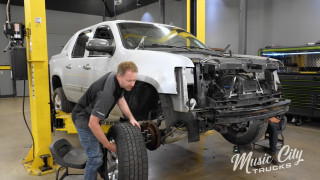
and that's gonna start with getting this old tired bumper off of here. The headlights, we'll get it ripped out
and get rocking and rolling.
Fix the knoll post.
All right, we'll try to keep as much of this in here intact.
Don't take off too much,
and I have to.
I'll go ahead and get this
intake
tracked off of here,
all this factory stuff.
Well,
it's not even attached.
Wow,
that was easy.
Fans off of here.
All right, so we know this thing's already been swapped and been worked on before,
but little
telltale signs that,
you know,
show you some of the stuff going on. Like,
for instance, they got the zip tie right here
around this connectors. Obviously they busted that connector there instead of like replacing that. I put a zip tie around. Hey,
it works, right?
So I'm gonna go ahead and, uh, get some electrical connectors off, get the intake manifold off, and then we'll jump on the bottom side.
All right,
let's get this baby off here.
Way we go.
All right. Down here on the bottom side of the truck here
now, the two main things very disconnected, the exhaust
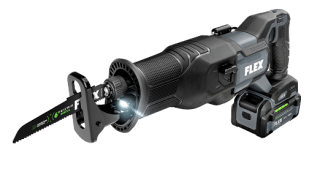
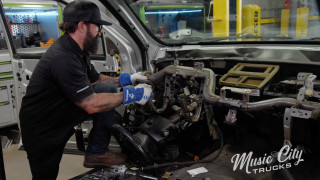
and the transmission from the engine. I thought this was a perfect opportunity to break out the reciprocating saw here.
This one from Flex Tools to get them cut.
This 24 volt brushless reciprocating saw and aggressive orbital cutting action that makes quick work of our exhaust while the vibration suppression reduces fatigue,
making work more comfortable.
The keyless blade eject makes swaps quick and easy.
Plus, with a built-in LED light, brightens your work area,
helping you make accurate cuts even in low light conditions.
Oh,
got it.
With the starter removed, now I have access to the torque converter bolts. We'll get those out and get it separated.
All right,
we'll go ahead and separate the bell housing
from the engine block here.
Got a couple of bolts on the bottom,
and we'll get the rest from the top.
Yeah,
there we go.
Yeah,
mhm,
one more and we'll go to the top.
Alright,
alright, got the bolts in the back of the
bell housing out up to the engine at the top
and the motor mounts in the bottom
out.
Let's see if we can yard this thing out.
Not making too much of a mess
of movement.
There she goes.
Oh,
looks like the rest of that coolant's coming out.
All right,
we'll clean that up later.
Come on out,
maybe,
yeah,
OK, that's the way you wanna do it.
That's fine.
Let's do that.
I think we're almost home.
Whoa,
easy.
Just settle down now.
All right.
Now,
come this way.
Well, we've really lightened the load on our avalanche today and next time we'll tear into the engine.
Show Full Transcript
Bro,
what in the hell is that?
Anthony isn't completely sold on the shop's newest project vehicle,
but Mike lays out his vision for the build and reveals the one big surprise that makes it the perfect truck for his plans.
This thing has a 62 in it. Somebody's already swapped it over.
Then it's time.
To put our Chevy on a strict diet as we tear into the interior and shed every pound possible to make the avalanche light as it can be.
After that, we visit a unique shop where the art of old school neon sign making gets a modern day twist.
All that and more today on Music City Trucks.
There it is.
Well
hey everybody, we have been on the hunt for a new project vehicle for a while now, and I saw this one online a couple of days ago,
went and checked it out and thought,
man, that's a great deal. And next thing you know, here we are, the owners of this
Chevrolet Avalanche, and I think it'll be perfect for my plan, my vision I've got in mind
as the next build on Munich City trucks here. Now the hard part, I think is gonna be convincing Anthony
that this is perfect for us, but you know,
here we go, let's give it a shot.
All right, we got in here now let's give him a call and get him outside here.
Yo yo, Mikey, what's going on,
brother?
Hey, what are you doing?
I'm putting old Cream Puff to bed, getting the cover on her.
What are you doing? Yeah,
well,
you know,
now that Cream Puff is done, we need a new project. I got one for you. It's outside. Come,
come out here and check it out.
You already got one?
Yeah, man,
right on. Well, I'll be right out.
Sounds good.
What do you think,
bro,
what in the hell is that?
An avalanche? It's an avalanche.
I have a list of the most hideous trucks ever created.
This is high up there with only two beating them, the Honda Ridge Line
and the Pontiac Aztec, and you, this is what we're doing.
Those are pretty ugly, but man, this one is, this one's nice. This one's
cream of the crop.
You got a vision for it?
I do. I do.
Jump in. We'll go down the road and I'll tell you all about it. Oh, I hope it's a good one.
Hey, well, at least it starts.
What have you done,
Michael?
Well,
Mike,
what's your first impression so far?
Well,
uh,
it's everything I thought it would be
on the inside and the out.
It has like a mountain.
You can't ever see over the hood.
There's a mountain range in front of it, so I get why they call it the avalanche. Yeah, it's got a little,
little shape to, a little bulge, I think they call it the power bulge,
Power bulge,
on the hood right there. Yeah,
I see why you liked it.
Tell me about your vision for this thing because I don't see it yet.
Nowadays,
you know,
something that catches my eye are the dragon drives.
You loved the drag racing so much we did a couple of years ago with a 632.
I said, hey, how can we get back to the drag strip there?
So
we're gonna turn this into
a drag race machine.
All right, now you're speaking my language
now
I would.
Have been my first choice for the ultimate drag drag and drive rig?
Probably not.
I, it's just so flexible. I mean, the people in the back,
you can,
the, the back seat folds down if you need to haul more stuff in the back you get more bed space. Yeah, so this is on the same platform as like the Tahoes and Suburbans. It's a little bit more smoother ride there for that year model,
um,
obviously drag racing, it's about going from start line to finish line
and the quickest.
You know, the quickest time so to start out on a build like that, you would typically want to start with the smallest,
lightest vehicle to help you
get there quicker,
right?
That's why you chose it.
Yes,
no,
yeah,
smallest vehicle.
No,
no,
no,
no, this thing, this thing's pretty big. This thing
is not small,
it is not quick right now.
How quick? Well,
if we can get
in a quarter mile, 11, 12th.
Range, I think that would be respectable.
Yeah, I mean if we can get this thing in the 10s, I think that would be pretty,
you know, there's nothing wrong about going
slower if that's what happens with it,
but the,
the, the unique thing I wanna do with this is it's 4 wheel drive, so we're gonna keep it 4 wheel drive
and put 4
radial tires all the way around. So we're gonna have 4 wheel drive drag
vehicles so it's gonna be
the
way for it.
I thought about this now
avalanche drag racing,
the dragon.
And
you've put some thought into that name, haven't you?
The whole
every stoplight you came to in that thing,
you,
you heard Dragonl just
echoing and that was a starting line.
You call it the stoplight. I call it the starting line for the next race right there. I like that. I think,
I think your idea, I think I like where your head's at,
and
anytime we can go to the drag strip,
I'm all for it.
So,
so you might be thinking,
well, why this specific one?
Why this specific avalanche? Is it because it's the black?
It is a black diamond. All right,
I don't even know what that means,
but I know it's gotta be the fancy one. It sounds like it's, it's, you know,
uh, rare.
Speaking of sound, this thing kind of sounds
different.
It sounds throaty,
you know. This obviously it is a used vehicle.
Someone has messed with it before,
uh, but in the listing on the, the dealer website, it said swap 6.2 L. That's what caught my eye.
I said, What's
that's got a 6.2,
so somebody obviously knew,
hey.
The engine either blew up, it went away.
They're like, OK,
you know what? I'm gonna put a 6-2 in it and
score for us,
right?
You know what I mean?
It's gonna be a unique combination.
I'm like,
I'm really pumped about this. It's gonna be a cool build.
Yeah,
I think it'll be so unique that
you won't see another one, and that's what's gonna make it cool,
right,
right.
Well,
enough talking about it. Let's get back to the shop and
start stripping this thing down.
Well,
let's get to it.
All right.
If Project Dragonan is going to be a serious contender,
it's gotta slim down.
We're putting this truck on a strict diet and ditching anything that can hold it back.
Got that last scale under there?
Yep,
they're all there, right on.
So
we barely made it back to the shop in this old peach of an avalanche,
but I think it's time we need to see what this thing weighs.
Yeah,
you know, I'm thinking somewhere around 6000 pounds,
uh,
but we'll see, we'll find out and get a good baseline.
Yeah,
hopefully not heavier than that, but we'll see where we're at. I'm gonna go ahead and zero this thing out and we'll get her set down.
All right,
we're 0.
All right, let her rip.
Go down.
And survey says
we're almost there.
All right.
So what'd you say?
I was thinking somewhere around 6000 pounds.
6.
Well,
you're gonna be pleasantly surprised.
5680. Yeah, the balance isn't too bad either.
So I honestly thought it was gonna be a little bit over 6000.
So, right,
right.
Well,
weight is horsepower, and we gotta get all the weight off that we can, put as much horsepower in the engine as we can
to get this thing to go down the track really quick.
So
with that,
that gives us a good foundation for some modifications.
Let's show you what else we got in planned for this avalanche. I'm gonna get this thing in the air.
Yeah, we'll get him back off the scales.
A big problem with this avalanche is its weight,
so to help shed some pounds, we're gonna strip out the whole interior.
Then to add safety, we'll install a full roll cage, plus install some custom seats with provisions
for safety harnesses
and keep us comfortable going down the road.
Up next we'll tackle the power train by removing the engine and completely rebuilding it for more power.
To top it off, we'll add a Holly Hiram intake manifold
and a shot of nitrous oxide
to push us faster to the finish line.
We'll back that up with a 4080 transmission and a heavy duty transfer case.
We'll ditch the factory rear axle for a beefier Ford 9 inch with a custom 4 length set up for drag racing.
To plant all that power to the pavement,
we'll put a set of bead-lock wheels and drag radial tires on all four corners,
then finish it all off by replacing the stock front bumper for a more aggressive look
and slap on some custom graphics.
All right, now the fun part, gutting this thing of everything that, well,
doesn't really matter,
right?
None of it really matters, so we could be violent with this too.
So I'm excited.
Another key point,
make sure you disconnect the battery. You got a lot of airbags in these newer vehicles, so you don't want them blowing up in your face.
Don't wanna get punched by an airbag. I don't think that's gonna be a good time.
I like how each fastener is a different size.
Is it?
Yeah, I'm enjoying that so far. That's nice.
An 11 should get it.
No, it's working.
There's a lot of scents in here.
Like you,
I, every time I,
I unveil a piece of plastic, I get a different smell out of it.
Come on,
baby.
Oh, excuse me,
it couldn't smell much worse than the carpet
stuck on something.
It's probably one of them plastic connectors. Let me see if I can be careful with it.
Oh,
yep,
there we go,
got it.
Let's see what kind of treasures we have on my side,
holy mackerel.
Yee,
where are we going this way.
It looks a little tight.
What if we go like this, lift it up.
The math ain't mathing over here.
I don't look like
if we can fold it, if we can.
Do like this number,
tilt it.
What if we go
like that,
tilt it.
Yeah,
yeah,
yeah.
That's a problem.
Here,
let me see if I can.
I'm gonna wiggle back.
See if I can make this seat go down.
How did Chevy do it? That's what we need to answer.
They probably put it together in here. You think they constructed it inside?
Should we get the plasma cutter?
Some type of combination here.
What?
Oh, that might be,
that might be, it's like a Rubik's cube.
What if we do it that way?
OK.
Which way? Oh, this thing chose woke up and chose violence this morning.
Hey, I think we got a combination.
Never thought I'd be working on an avalanche, so I caught on the carpet.
All right, now go.
You gotta pivot, pivot
pivot your side that way.
There we go, all right.
It's all yours.
I don't know if it helps us, but I'm just hitting every,
every screw I see them.
If that's not a top fuel mechanic, I've,
I've seen one before.
It's quite the unit right there.
I hear that a lot.
I get that every day.
Cheers.
This is what they do to your car at the dealership when they say they have to take the dash out
and you're wondering why is it so expensive?
Well,
look,
look behind there, that's,
that's a good indication of why it's so expensive.
Are you ready to yank this thing out here.
Hey.
All right,
that's, that's 30 pounds right there.
I'm telling you,
getting there.
All right,
that's the last big piece.
Get it out of here.
Well,
I think we saved some weight.
Next, we step inside a shop where the art of making neon signs is evolving,
blending traditional techniques with a modern twist.
Whether you're hanging out with your buddies at a bar or turning wrenches in your garage,
there's one form of Americana that connects the two, and that's neon signs.
Recently we drove up to Illinois
to check out a shop
that's continuing that tradition with these modern works of art,
Garrett.
Mike,
hey man,
how you doing, man?
Good.
Nice to meet you, sir.
You find it all right?
Yeah,
great,
great. Perfect.
Uh, the home of Neon Road right here. This is it,
man.
Neon Road. Absolutely.
Wow. I'll tell you what, these signs are super cool,
you know,
the automotive history like that is just perfect. It fits right in.
So you do a lot of the work here. I,
I see what exactly goes on in this,
this building right here with your signs to build a neon sign,
there's. There's a number of processes that, that takes place and, uh,
actually I've got several different buildings where we, where we build our pieces. But in this particular shop,
I, I do some assembly work here and then I also build, um,
every neon sign I build, you know,
they all get lifting lugs
and
they also get,
as you can see,
we weld in these 3/8 nuts. So, you know, a lot of times the customer wants to mount their, their sign on the wall,
right?
So I.
these and this is,
this is a really slick way to be able to mount a very heavy fragile neon sign on a sixteen-inch center stud wall.
So every sign we build,
we weld these in on
16-inch centers, 32 inch centers,
48 inch centers, whatever,
it'll still go on a 16-inch stud wall.
Well,
and this looks like, uh, I guess one of the starting points for a future sign you guys is,
yeah.
So every neon road sign starts out with a fabricated steel can
and a fabricated steel trim ring.
Cool deal. So that's the starting point right there, but I guess you're saying you have different buildings there.
So
what, what do we have in another building?
Well,
I'm glad you asked again.
Well,
you wanna go see something pretty cool?
Oh,
let's go to my, let's go to my laser shop.
I'll show you how we, uh,
kind of build out the sign face lasers. That's already cool,
yep.
Looks like we got a big old machine here, yes sir,
where it all starts.
So, um,
you know,
if you remember I was telling you that,
you know, we draw everything in CD, right?
So for example,
roadster shop,
I'm, I'm getting ready to build another little roadster shop wallhaer. So,
um, I've got to cut a number of parts and pieces.
To be able to assemble that sign out,
so this is a
piece that I need to cut out.
So you stack them all on top of the piece here. You got them all designed out, assemble it all out
as you can see,
I have lots of substrate material in here.
So, uh,
I got a part that I need to cut it right now. So if you wanna check it out, I'll show you.
All right,
so
now we hurry up and wait.
Just let the laser do its thing and we'll have us part here in a little bit.
All right man,
part's done.
Perfect. Let's check it out. All right, let's do it.
This is for
a wallhaer.
That's just one part
of a bunch of parts stacked on top of each other and, and they all assemble together to basically comprise the artwork and the graphics.
Perfect.
So once you get them all cut right here,
then you have to assemble them.
Where does that? Where does that take place at in my other assembly shop.
So again, that's in another separate building. So let's go check this out. Lets go check it out.
Might as well.
All right.
All right, Mike,
this is the neon shop,
Judy.
Hi Judy. Mike.
Hi Mike.
Nice to meet you.
Nice to meet you.
What do you got going on in here?
I'm making a little glass. It looks that looks like engine stuff, like a rod heater, but you're using glass.
Let's, let's see what you got going on.
Well, we're gonna make a couple bends here for your sign,
OK.
This is where the magic happens right here. I tell you what,
you know,
you, you, you picture this stuff,
you know,
up and down the road, but
the stuff that it goes into making it work,
well,
here we are, and there's a lot going on here.
So
I get this hot enough to bend.
Miss Judy has been.
Creating art with glass and neon for more than 30 years.
Working with neon is truly in her blood,
but mastering the craft requires exceptional skill,
patience, and precision.
Bending and manipulating glass into stunning works of art is a process built on years of trial and error.
A single incorrect bend can ruin an entire piece,
forcing the artist to start over from scratch.
She just twisted it just like that,
so that'll make the bottom part of your tee on the sign.
Now, is that pretty forgiving to where if you go back to the pattern, you may want to make an adjustment?
No, it,
that's it.
You're done moving it, yeah.
So if you, if you miss it,
you gotta start all over again.
Yeah,
you gotta know where you're going and have your.
Table clear so you can get there. Yeah.
Yeah, that's it.
That's why careful planning,
accurate designs, and precise patterns are essential to transforming fragile glass into the vibrant glowing masterpieces that have become neon Road's signature art form.
Well, I'll tell you what,
seeing you make this stuff here,
I mean, it, it brings to light, really,
a whole new,
you know,
perspective.
of these neon signs. So like you're going down the road, you get an idea of what it takes and the craftsmanship to make one of these things work.
There's a lot,
a lot that goes into it,
right?
And, uh,
I'm gonna get, well,
you know, with that said,
I'm excited to see our sign. You bet.
Welcome to the neon Road Assembly shop. I see that, yeah.
This is where we marry everything together and we end up with a finished product.
Once the framework is complete,
the sign is placed into protective shipping crate, so the glass installation process can begin.
Handling the delicate neon glass requires an exceptionally gentle touch,
a responsibility entrusted solely to Ms. Judy.
With years of experience and craftsmanship,
she carefully positions each glass tube into place,
ensuring every bend and curve aligns perfectly with the design.
After the glass is laid into position, it is secured to the tube supports using copper wire.
Each connection is inspected to ensure both stability and visual precision.
With the installation complete,
the neon sign stands as a finished work of art,
ready to be shipped to its final home where it's vibrant glow can be enjoyed for years to come.
The 6.2 is on the loose as we get our LS plucked from its perch, making way for bigger and better upgrades down the road.
Well, we've done quite the job on getting this thing stripped down from the dash to the tailgate.
Anything that wasn't necessary is now a pile of parts in the back of the shop.
Now my next goal is get the engine out and anything else we don't need up front,
and that's gonna start with getting this old tired bumper off of here. The headlights, we'll get it ripped out
and get rocking and rolling.
Fix the knoll post.
All right, we'll try to keep as much of this in here intact.
Don't take off too much,
and I have to.
I'll go ahead and get this
intake
tracked off of here,
all this factory stuff.
Well,
it's not even attached.
Wow,
that was easy.
Fans off of here.
All right, so we know this thing's already been swapped and been worked on before,
but little
telltale signs that,
you know,
show you some of the stuff going on. Like,
for instance, they got the zip tie right here
around this connectors. Obviously they busted that connector there instead of like replacing that. I put a zip tie around. Hey,
it works, right?
So I'm gonna go ahead and, uh, get some electrical connectors off, get the intake manifold off, and then we'll jump on the bottom side.
All right,
let's get this baby off here.
Way we go.
All right. Down here on the bottom side of the truck here
now, the two main things very disconnected, the exhaust
and the transmission from the engine. I thought this was a perfect opportunity to break out the reciprocating saw here.
This one from Flex Tools to get them cut.
This 24 volt brushless reciprocating saw and aggressive orbital cutting action that makes quick work of our exhaust while the vibration suppression reduces fatigue,
making work more comfortable.
The keyless blade eject makes swaps quick and easy.
Plus, with a built-in LED light, brightens your work area,
helping you make accurate cuts even in low light conditions.
Oh,
got it.
With the starter removed, now I have access to the torque converter bolts. We'll get those out and get it separated.
All right,
we'll go ahead and separate the bell housing
from the engine block here.
Got a couple of bolts on the bottom,
and we'll get the rest from the top.
Yeah,
there we go.
Yeah,
mhm,
one more and we'll go to the top.
Alright,
alright, got the bolts in the back of the
bell housing out up to the engine at the top
and the motor mounts in the bottom
out.
Let's see if we can yard this thing out.
Not making too much of a mess
of movement.
There she goes.
Oh,
looks like the rest of that coolant's coming out.
All right,
we'll clean that up later.
Come on out,
maybe,
yeah,
OK, that's the way you wanna do it.
That's fine.
Let's do that.
I think we're almost home.
Whoa,
easy.
Just settle down now.
All right.
Now,
come this way.
Well, we've really lightened the load on our avalanche today and next time we'll tear into the engine.