In This Episode
- 0:00 Introduction to Engine Power
- 0:29 Project Overview: Twin Turbo Setup
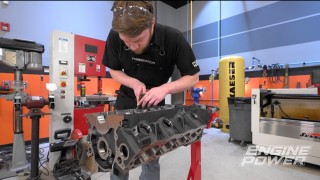
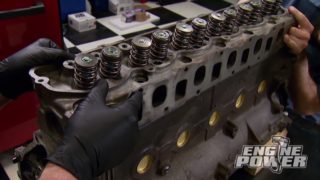
- 1:04 Engine Teardown and Inspection
- 2:20 Upgrade Process: Multi-Port Fuel Injection and EFI System
- 3:54 Painting and Air System Upgrade
- 5:00 Installation of Holley High Ram and Injectors
- 6:30 Exhaust System and Turbo Installation
- 8:23 Turbo Plumbing and EFI System Installation
- 9:46 Sensor Installation and ECU Setup
- 10:06 Outlaw Diesel Madness Event
- 14:57 ARP Fastener Preparation
- 16:47 Dyno Testing and Performance Tuning
Video Transcript
[Frankie] You're watching Powernation!
[Pat] Today on Engine Power it's twins. We bring back our baby blue 427 Gen-1 small block Chevy and tack on two turbos to make some serious boosted horsepower. [Frankie] Let's see here. -Yes! [ Music ]
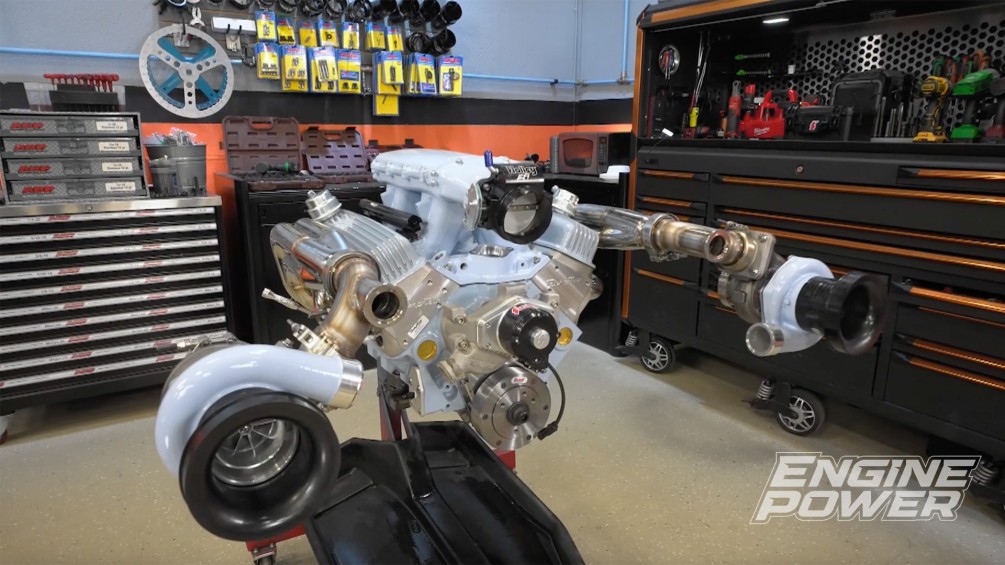
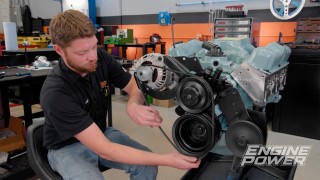
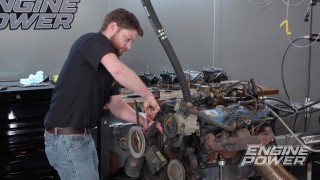
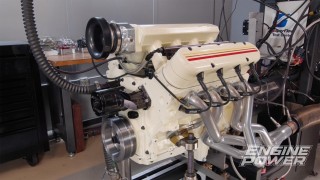
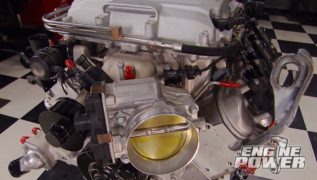
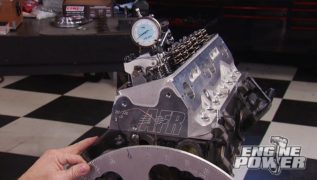
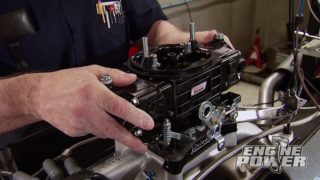
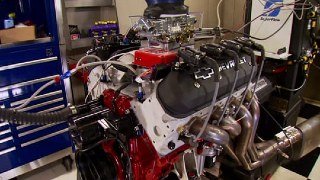
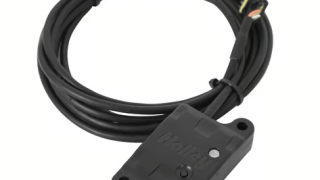
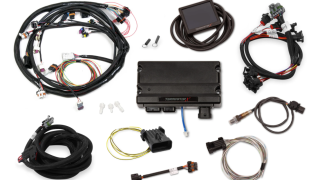
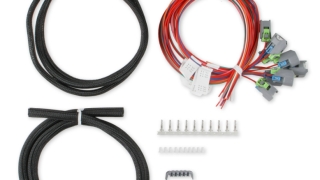
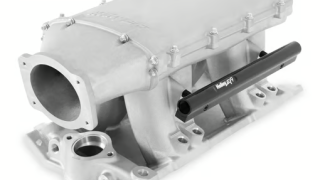
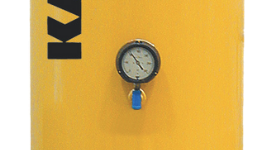
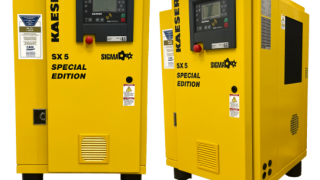
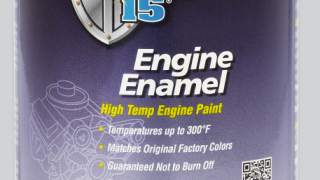
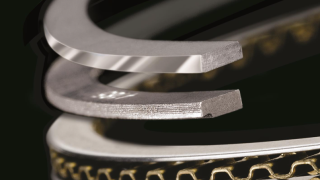
Hey everyone, welcome to Engine Power. Today we are going to do something extremely fun with something that you may recognize before because of its beautiful blue paint job. This is our Gen-1 427 inch small block we did earlier. And this thing made outstanding power naturally aspirated, over 600, but we always had in mind to turn up the wick. So today we are going to turn that wick up to 11 with. -Not one but two turbochargers. That's right. We're going to cram some boost down this engine's throat. We're going to make some big power. This project is so sick it gave me a stuffy nose but that's okay because we have a lot of work to do and we're going to be cranking the boost this thing to make some four digit horsepower. So we got some twin Summit Racing ceramic ball bearing turbos. We're going to start getting these on but first here's a look at this engine and what it made last time. -This build started out with using one of Summit Racing Equipment's new SPC engine blocks as a foundation and we set the final bore size and our Sunnen SV-15 to 4-125. A set of Total Seal rings with gas ported tops were ground and gapped for our Summit Pro SBC pistons and rods. They got bolted to a forged 43-40 4-inch stroke crank to complete the rotating assembly. Summit's LS firing order hydraulic roller cam and a Moroso oil pan finished out the short block. Then a set of Trick Flow 230cc heads with Jesel valvetrain and some nostalgic valve covers went together to crank out 609 horsepower and 530 pound feet of torque on the dyno. -That was great power but we want more. So we're getting right into it by removing the intake to inspect the top end. And as always, everything looks great. Looks great. Draining the oil revealed the bottom end was also in stellar condition. So the oil pan was carefully removed to complete our abbreviated teardown. [ Music ] Okay, that is as far as we're going to tear this engine down for our upgrades. There's really not much more to do. And although those turbos are going to add a bunch of power, the upgrade process is pretty simple. The other major improvement we're going to make is switching this engine over to multi-port fuel injection. And to do that we're going to be using one of Holley's brand new High Ram front feed small block Chevy intake manifolds. Holley's been making a higher ram for all kinds of applications for years and they have finally served the small box Chevy crowds. They have two different iterations. There is this iteration, which is nice and low for hood clearance and it has a 95 millimeter front facing throttle body. Now this comes set up basically ready to drop on. It has the correct fuel rails, a couple different locations for different injectors, has map sensor ports, intake fitting ports, all that stuff. We're going to be pairing it with a Terminator-X ECU and one of their universal multi-port fuel injection kits. So this comes with all the wiring that we need. It's set up for all their sensors. And these ecu's are really powerful for how affordable they are because not only do they have self-learning function, timing control, but they also have nitrous control. It has individual tables that you can set up for your application. And a lot, a lot of power to run an engine like this. The cool thing that we are going to be pairing this with is one of their brand new pieces. This is the Bluetooth module for the Terminator-X. So this pairs it with your phone. We've done this on the new Sniper-2 units, but they've come out with a Terminator-X one as well. So you can do all the setup, all the tuning and all the data logging straight from your phone. You don't need a handheld or a laptop computer. Finally, we are going to be using one of their dual sync distributors just to make it easy for plug and play crank and cam sync. Before we put this on there is one modification we're going to make and that is the most important one, color matching it to that baby blue color. Our 427 parts are all ready for paint. So we're going to be using POR-15 engine enamel. We're going to be mixing up our custom color and spraying it because we get a nice even coat that way. And besides just painting engines, we use all kinds of air tools on Engine Power. We got grinders, we got blow guns, all kinds of stuff. And we're not the only shop. We have three other shops that are running constantly as well. So we need a good air supply system that has quality, clean air and enough to feed everyone. We recently got a huge upgrade with a complete Kaser Air system for our shops. -We just had our 25 year old piston powered air compressor replaced. The team from Kaeser compressors arrived with their newest technology in air systems. They meticulously measured, cut for size and leveled, and put new air piping connections to all four of our shops. [Timothy] So we took a careful look at your former system and we designed a new system where a single SX5 compressor can handle the majority of your demand. If there's ever some peak demand, the second SX5 will turn on automatically to supply that extra demand needed. And both these units can turn on simultaneously, run at 100% duty cycle, producing 21 CFM at 125 psi continuously. So there's a misconception that you don't need a refrigerated dryer, but a quality refrigerator dryer is going to give you maximally clean and dry air, which helps prolong the longevity of your air tools and equipment. -And we all have a 120 gallon reserve tank installed with a space saving design with plentiful air that's quiet, which is important in television. And they're smart. They will tell you when it's time for maintenance. -Equipped with better airflow, we got to mixing our POR-15 engine enamel and use it in an 18 to 1 ratio of gloss white and Ford Corporate blue to get a color matched to our custom baby blue finish. From there it was right into the paint booth to give these twins and our EFI system the right amount of color to push some power. Next up, some custom fab pieces and trick EFI go on this mouse paving the way for twin snails and big horsepower.
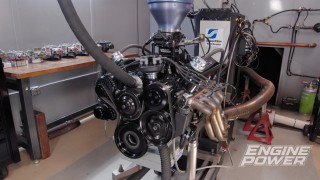
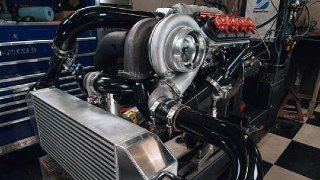
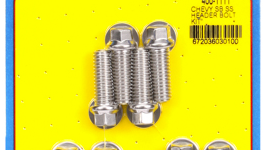
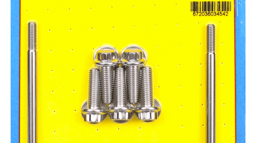
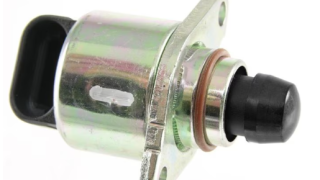
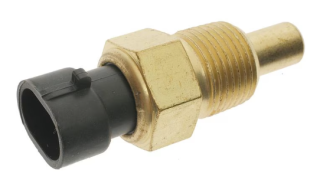
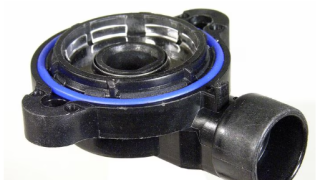
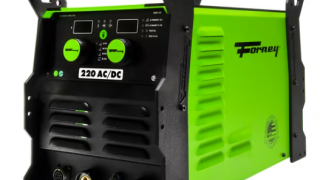
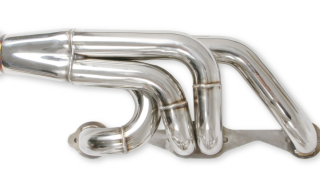
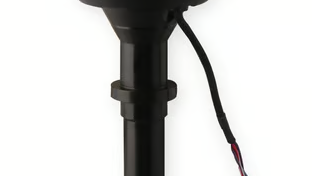
[Pat] With a little weather strip adhesive laid down to hold the new gaskets, our freshly beautified Holley high ram gets cinch down, followed by a fresh set of these new Trick Flow flow match 110 pound per hour EV-14 body high impedance injectors that are plugged into Holley billet fuel rails. All right, with the induction side all put together it's time to now concentrate on the exhaust side. Remember we are depending on how good the exhaust is sealed up to generate that boost. So we picked up a set of Flowtech headers to get the gases out. Now the important part of this is the fastener that's going to hook these things together. We are going to go with our favorite ARP stainless for this application. Now these come in several different lengths and different size heads for what you're using. And we are particularly going to be using the stainless fasteners for our application. Not only are these a very durable fastener with great tensile strength, around 180,000 psi, they are very resistant to corrosion. ARP is very good at doing things correct for the application because they work with engine builders to get the stuff right. Now if you have an application that they don't have something for they are more than happy to work with their engineers to get what you need no matter what it is. So we're going to get these on and get this thing sealed up. Our headers are some turbo specific up and forward Flowtechs with one and seven-eighths inch primaries and V-band connections. They are constructed from stainless steel and have thick tubes and flanges for excellent durability in high horsepower applications. Plus they go on fast because the bolts are easy to get to. [Frankie] We custom fabbed this turbo system specifically for the dyno, and that included these 90 degree elbows that also allow us to mount twin 44 millimeter Summit waste gates to control our boost level. Speaking of twins and boost these Summit ball bearing 66-62 turbo get mounted up. And then lastly, but certainly not least, we had to modify the oil pan to accept two dash ten drain backs from our turbos. In a pinch we could have done this without removing the oil pan from the engine, but doing it this way ensures a cleaner, leak free installation. They get smoked in using our Forney 220 ac/dc Tig welder. [Pat] We reinstall the Moroso oil pan and tighten up the stainless ARP fasteners and then it's off to the dyno room to finish up all the necessary turbo plumbing. [ Music ] The cold side is pretty straightforward using various silicone couplers and stainless band clamps. [ Music ] We have a lot of hardware here on the Super Flow dyno, and we're almost ready to get it running. Now it is time to get that EFI system installed. Now for that to function properly, we need proper information that it has to read to make our tuning changes. So luckily for us we have an auto zone right down the street. So we went and picked up some Duralast sensors. We have a throttle position sensor, a coolant temp sensor, and an IAC. These are all important for our setup. What I really love about Duralast sensors. They're equal to or even better than OEM quality. And that's because Duralast takes the time to reverse engineer every sensor to make it that kind of quality. It's a commitment to excellence that we really love. So we're going to get these installed and get this damn thing running. It kicks off with installing the new throttle position sensor, followed closely by the coolant temp sensor, and Rounding out the dual trifecta with the new idle air control. -Moving on to the ignition, a Holley Dual sync distributor gets properly indexed, and then it's new bolt down cap and some custom made MSD plug wires can go on. The Holley Terminator ECU gets mounted to the dyno, and then all of the critical connections are made to the new sensors with a satisfying click. [ Music ] Coming up, we race up to Bowling Green to check out some Outlaw diesel madness.
[Frankie] We love all forms of horsepower and recently we traveled up to Beach Bend Raceway Park in Bowling Green, Kentucky for The Outlaw Diesel Super Series drag race. [ engine revving ] [Pat] It was a chance to hang out with some of the Hot Shot Secrets crew and some of their successful racers. [Justin] I've always been a diesel guy my whole life. Just fascinated by it. Ever since a little kid. [ engine revving ] -Started building pulling trucks pretty early on. Ran the pulling truck competitively all around the country for a really long time. Started building fast stuff together and it just snowballed to this. Now it's a 2006 Dodge Ram 2500. It's four wheel drive. Wagner billet Cummins motor, based off a 6-7 Cummins. It's got a Rossler Turbo 400 transmission. Neal Chance bolt together converter. SCS billet transfer case. Basic race car stuff just in a very heavy package. The truck weighs right now with me strapped in it right around 4,100 pounds. I made 3,336 horsepower at the tire with an engine that was already making 13.5 pounds of crankcase pressure. Like it was blown up. [ engine revving ] Every fluid in this vehicle is Hot Sot Secrets. I was buying their Diesel Extreme and their Stiction Eliminator to work on our six liter stuff. Stuff back home. I was going to Tractor Supply and buying it. I didn't know who these guys were. Stuff was phenomenal. I end up running into them later that year at UCC. Walked up and threw my credit card at the guy and said I have to be a dealer. Whatever it cost to get it done. But everything that gets done at my shop at Zeigler Diesel Performance Hot Shots oil, all Hot Shots fluids, even their coolant. I had an engine that we had some coolant issues with that when it got hot it would dump all the engine coolant into the oil. We're running the Hot Shot oil at the time. Tore it down. Absolutely zero bearing wear. I was blown away like I was already a believer and that just cemented it. So best products on the market, hands down. [Mattie] Started with my dad. He raced way before I was ever a thought in this world. So we spent our childhood going to the racetrack with him on Friday nights and I wasn't always into it. I was okay with being his daughter on the door helping him before he went down the racetrack. And then I kind of just woke up one day and I was like, okay, I'm tired of being pit. I want to race. So I never started out in juniors or anything like that. I was very no non-traditional. I started at 16 when I got my driver's license. I actually ended up getting a 2016 F-350 Ford and I would take it to the racetrack on Friday nights and run it down to quarter mile just to get laps under my belt. And then we came across this for sale on Facebook Marketplace and the rest is history. We were having such bad issues with just fluid. And we started lock up and it just wasn't enough for the trans to work properly. So Kyle walked up to us at a race a couple of years ago and was like, try this. Let me know how it does for you. We tried it and it's been going in the car ever since then. So if something goes wrong, you know, we just go over to the trailer and we say, hey Kyle, I need this right now and he will bring it over in a heartbeat. [ engine revving ] [Pat] And as you can see from her dad's reaction, Mattie won the top diesel class. [Austin] We bought that crew cab sitting over there to pull a camper. It sat in the driveway like a year and the camper never moved and I started driving it. I went to Muncie Dragway on like a local test and tune Friday night. I made one pass and went like an 18 second quarter mile, and I was pretty much hooked after that. I raced that truck to the point they told me I need to put a cage in it. Man, I have a truck that's really figured out and competitive but I'm gonna go race two wheel drive and try to learn everything over again. My dad stepped up huge and purchased a $4,000 state highway single cab truck. We race 670. I race 590 with it, and now I went to running Pro Street, which is pretty much now Pro Truck. It's a Gary Taylor built pro model. It's a full tube chassis, chromoly chassis. It's had a bunch of tweaks done to it by Cody Fisher and a couple of other people. It's still cast block six liter punched out to a 6.3 liter. So not anything crazy. It's what we've been running for years. It's got a single GT-55 88 millimeter on it. So I would start a pass at 100 degrees. By the end, the track it would be 220. And that was with a 5-R-100 in it. Change the fluid. Just let me try my fluid in it. And magically we went from starting passes at 100 and it'd only 160 at the end of the track. We just kept using their tranny fluid and progressing and progressing. And Kyle says, do you want to try our oil? And now it's turned into we use engine oil, transmission fluid, gear oil, generators, side by side. Everything runs Hot Shot's Secret oil now, and we'll keep running it and keep putting it through its paces and keep trying to spin it as high as it'll go. -You've waited long enough. It's turbo time!
[Frankie] One of the most critical parts of your engine is the fasteners. And so we want to make sure we prep them properly. And there is a correct way to prep your ARP fasteners. So we're going to go over that really quickly. We'll apply ARP Ultra Torque directly to the threads and the under head of the bolt. When installing the washer it's important that the chamfer faces the under head of the bolt to clear the large radius. It's also critical that no ARP ultra torque gets on the bottom side of the washer as it can turn it into a bearing like surface, possibly damaging the threads or over stressing the fastener. So this is the proper way to prep an ARP fastener and hopefully you can use this in your next engine build. [ engine starting ] [Pat] Got some explaining to do here. What we did on this particular engine because it is so special. This is something that was existing naturally aspirated, but we are putting a big boost to it. Now that wasn't quite our intention when the engine was initially built. -Not really. It was more like a pipe dream, right, and now that pipe dream has come to reality. We actually have had this thing running on the dyno with the Terminator-X, letting it learn. So we have a lot of pulls on this engine and not low power pulls. Usually we will start at a low boost level and then kind of creep our way up. On this thing we are just going straight for it. So I've been running this thing basically around 15 psi. So that's where we're going to start. We're going to start at one atmosphere and then we'll work our way up from there. -We're going to start out here but we are going to get angry with this one. We have good fuel on it. So, enough talking. Let's get after it here. So first yank on her we're going to be going to 3,500 to 6,800. So at 600 a second. [ engine revving ]
-Wow was that mean! -It loads in at 3500, it loads in at 978 pounds. -We are talking some action there. 1,004 pound feet. -1,004.1 pound feet at 5,000 rpm. -That is an evil engine right there. -And 1,101.3 at 6,400. -Now these are street engines, right? This is a street size set of Turbos. I mean it's a relative term. But this thing is super safe. With the plugs as we're going through all our pulls this looks like grandma's station wagon. -Let's turn this thing up a little bit. You can do it. -Turn up the boost. That makes me feel kind of weird. -All right, we've added a little bit more. I like creeping up at it. I don't like, just like boom. Coming in and try to throw a bunch of boost at it because I want to make sure the fueling's right. Want to make sure the engine responds well. All that kind of stuff. -So everything's running this crisp and nice. You've got enough turbo on this thing to make 2,000 horse. -This is a relatively street setup. Other than the fact that right now we're running it on some really good fuel. -I'm happy if we stopped here but we're not stopping here. We're going to do one more. [ engine revving ]
-That made some good power I think. -1,108.8. -1,100 pound feet! -That's big. That's a lot. Power picked up not as much. 1,148.2, that's acceptable. I mean 1,100 pound feet, 1,148 horse, smooth graph. I mean, what more do you? -And that's for reals. Can we push it more? -Oh absolutely. You could change turbos. You could try to do some other stuff. You could change fuels. I mean there's more aggressive fuels. This is a nice easy C-12. -We're going to make some more pulls on it. Maybe we'll make some more, off camera, to make sure that it makes more power. On camera versus off camera. Do we do that? Maybe. Know what I call that? Great success! [Director] Cut! -Now that was pretty good. Nice job everyone. Nice job. I want to look at one thing here. [ fast forward sfx ] -Mo, you come back. -We got to show this. -This is one thing I want to show everybody. -This is too cool not to show. -We got the best jobs ever. -Absolutely. So, like we said, normally after we give you guys the safe tune-up. That's something that will never, ever hurt itself. Never get anybody in trouble. And then once all of our stuff is done we have a little bit more time to play with the engine and see if we can tweak it and get more out of it and just dial it in. Spend a little bit more time and dial it in. That's what we've been doing for the past couple hours and this is actually we've made some adjustments here. We're able to get this thing picked up quite a bit. So we want to show it because this is so cool. We've been making adjustments in the app, like just again just leaning this thing out a little bit at a time. We're gonna make a pull and show you what we're dealing with. -Here we go. [ engine revving ] -That is so mean. Pull that up, pull that up. -Let's see here. -Yes, 1,267 horsepower. -1,267.6 and see leaning this thing out a little bit got it to carry so good. It's really making at 6,800. We're not going to turn it any higher. It's a hydraulic roller. -We shut it down at 6,800 but it's still trending up. -1,113.3 pound feet. This is officially the most powerful engine that's ever been on this dyno. -That is true. I've been here 12 years and this is the highest horsepower and highest torque. Now that's mean. Greater success? -Yeah! [ engine revving ]
Show Full Transcript
[Pat] Today on Engine Power it's twins. We bring back our baby blue 427 Gen-1 small block Chevy and tack on two turbos to make some serious boosted horsepower. [Frankie] Let's see here. -Yes! [ Music ]
Hey everyone, welcome to Engine Power. Today we are going to do something extremely fun with something that you may recognize before because of its beautiful blue paint job. This is our Gen-1 427 inch small block we did earlier. And this thing made outstanding power naturally aspirated, over 600, but we always had in mind to turn up the wick. So today we are going to turn that wick up to 11 with. -Not one but two turbochargers. That's right. We're going to cram some boost down this engine's throat. We're going to make some big power. This project is so sick it gave me a stuffy nose but that's okay because we have a lot of work to do and we're going to be cranking the boost this thing to make some four digit horsepower. So we got some twin Summit Racing ceramic ball bearing turbos. We're going to start getting these on but first here's a look at this engine and what it made last time. -This build started out with using one of Summit Racing Equipment's new SPC engine blocks as a foundation and we set the final bore size and our Sunnen SV-15 to 4-125. A set of Total Seal rings with gas ported tops were ground and gapped for our Summit Pro SBC pistons and rods. They got bolted to a forged 43-40 4-inch stroke crank to complete the rotating assembly. Summit's LS firing order hydraulic roller cam and a Moroso oil pan finished out the short block. Then a set of Trick Flow 230cc heads with Jesel valvetrain and some nostalgic valve covers went together to crank out 609 horsepower and 530 pound feet of torque on the dyno. -That was great power but we want more. So we're getting right into it by removing the intake to inspect the top end. And as always, everything looks great. Looks great. Draining the oil revealed the bottom end was also in stellar condition. So the oil pan was carefully removed to complete our abbreviated teardown. [ Music ] Okay, that is as far as we're going to tear this engine down for our upgrades. There's really not much more to do. And although those turbos are going to add a bunch of power, the upgrade process is pretty simple. The other major improvement we're going to make is switching this engine over to multi-port fuel injection. And to do that we're going to be using one of Holley's brand new High Ram front feed small block Chevy intake manifolds. Holley's been making a higher ram for all kinds of applications for years and they have finally served the small box Chevy crowds. They have two different iterations. There is this iteration, which is nice and low for hood clearance and it has a 95 millimeter front facing throttle body. Now this comes set up basically ready to drop on. It has the correct fuel rails, a couple different locations for different injectors, has map sensor ports, intake fitting ports, all that stuff. We're going to be pairing it with a Terminator-X ECU and one of their universal multi-port fuel injection kits. So this comes with all the wiring that we need. It's set up for all their sensors. And these ecu's are really powerful for how affordable they are because not only do they have self-learning function, timing control, but they also have nitrous control. It has individual tables that you can set up for your application. And a lot, a lot of power to run an engine like this. The cool thing that we are going to be pairing this with is one of their brand new pieces. This is the Bluetooth module for the Terminator-X. So this pairs it with your phone. We've done this on the new Sniper-2 units, but they've come out with a Terminator-X one as well. So you can do all the setup, all the tuning and all the data logging straight from your phone. You don't need a handheld or a laptop computer. Finally, we are going to be using one of their dual sync distributors just to make it easy for plug and play crank and cam sync. Before we put this on there is one modification we're going to make and that is the most important one, color matching it to that baby blue color. Our 427 parts are all ready for paint. So we're going to be using POR-15 engine enamel. We're going to be mixing up our custom color and spraying it because we get a nice even coat that way. And besides just painting engines, we use all kinds of air tools on Engine Power. We got grinders, we got blow guns, all kinds of stuff. And we're not the only shop. We have three other shops that are running constantly as well. So we need a good air supply system that has quality, clean air and enough to feed everyone. We recently got a huge upgrade with a complete Kaser Air system for our shops. -We just had our 25 year old piston powered air compressor replaced. The team from Kaeser compressors arrived with their newest technology in air systems. They meticulously measured, cut for size and leveled, and put new air piping connections to all four of our shops. [Timothy] So we took a careful look at your former system and we designed a new system where a single SX5 compressor can handle the majority of your demand. If there's ever some peak demand, the second SX5 will turn on automatically to supply that extra demand needed. And both these units can turn on simultaneously, run at 100% duty cycle, producing 21 CFM at 125 psi continuously. So there's a misconception that you don't need a refrigerated dryer, but a quality refrigerator dryer is going to give you maximally clean and dry air, which helps prolong the longevity of your air tools and equipment. -And we all have a 120 gallon reserve tank installed with a space saving design with plentiful air that's quiet, which is important in television. And they're smart. They will tell you when it's time for maintenance. -Equipped with better airflow, we got to mixing our POR-15 engine enamel and use it in an 18 to 1 ratio of gloss white and Ford Corporate blue to get a color matched to our custom baby blue finish. From there it was right into the paint booth to give these twins and our EFI system the right amount of color to push some power. Next up, some custom fab pieces and trick EFI go on this mouse paving the way for twin snails and big horsepower.
[Pat] With a little weather strip adhesive laid down to hold the new gaskets, our freshly beautified Holley high ram gets cinch down, followed by a fresh set of these new Trick Flow flow match 110 pound per hour EV-14 body high impedance injectors that are plugged into Holley billet fuel rails. All right, with the induction side all put together it's time to now concentrate on the exhaust side. Remember we are depending on how good the exhaust is sealed up to generate that boost. So we picked up a set of Flowtech headers to get the gases out. Now the important part of this is the fastener that's going to hook these things together. We are going to go with our favorite ARP stainless for this application. Now these come in several different lengths and different size heads for what you're using. And we are particularly going to be using the stainless fasteners for our application. Not only are these a very durable fastener with great tensile strength, around 180,000 psi, they are very resistant to corrosion. ARP is very good at doing things correct for the application because they work with engine builders to get the stuff right. Now if you have an application that they don't have something for they are more than happy to work with their engineers to get what you need no matter what it is. So we're going to get these on and get this thing sealed up. Our headers are some turbo specific up and forward Flowtechs with one and seven-eighths inch primaries and V-band connections. They are constructed from stainless steel and have thick tubes and flanges for excellent durability in high horsepower applications. Plus they go on fast because the bolts are easy to get to. [Frankie] We custom fabbed this turbo system specifically for the dyno, and that included these 90 degree elbows that also allow us to mount twin 44 millimeter Summit waste gates to control our boost level. Speaking of twins and boost these Summit ball bearing 66-62 turbo get mounted up. And then lastly, but certainly not least, we had to modify the oil pan to accept two dash ten drain backs from our turbos. In a pinch we could have done this without removing the oil pan from the engine, but doing it this way ensures a cleaner, leak free installation. They get smoked in using our Forney 220 ac/dc Tig welder. [Pat] We reinstall the Moroso oil pan and tighten up the stainless ARP fasteners and then it's off to the dyno room to finish up all the necessary turbo plumbing. [ Music ] The cold side is pretty straightforward using various silicone couplers and stainless band clamps. [ Music ] We have a lot of hardware here on the Super Flow dyno, and we're almost ready to get it running. Now it is time to get that EFI system installed. Now for that to function properly, we need proper information that it has to read to make our tuning changes. So luckily for us we have an auto zone right down the street. So we went and picked up some Duralast sensors. We have a throttle position sensor, a coolant temp sensor, and an IAC. These are all important for our setup. What I really love about Duralast sensors. They're equal to or even better than OEM quality. And that's because Duralast takes the time to reverse engineer every sensor to make it that kind of quality. It's a commitment to excellence that we really love. So we're going to get these installed and get this damn thing running. It kicks off with installing the new throttle position sensor, followed closely by the coolant temp sensor, and Rounding out the dual trifecta with the new idle air control. -Moving on to the ignition, a Holley Dual sync distributor gets properly indexed, and then it's new bolt down cap and some custom made MSD plug wires can go on. The Holley Terminator ECU gets mounted to the dyno, and then all of the critical connections are made to the new sensors with a satisfying click. [ Music ] Coming up, we race up to Bowling Green to check out some Outlaw diesel madness.
[Frankie] We love all forms of horsepower and recently we traveled up to Beach Bend Raceway Park in Bowling Green, Kentucky for The Outlaw Diesel Super Series drag race. [ engine revving ] [Pat] It was a chance to hang out with some of the Hot Shot Secrets crew and some of their successful racers. [Justin] I've always been a diesel guy my whole life. Just fascinated by it. Ever since a little kid. [ engine revving ] -Started building pulling trucks pretty early on. Ran the pulling truck competitively all around the country for a really long time. Started building fast stuff together and it just snowballed to this. Now it's a 2006 Dodge Ram 2500. It's four wheel drive. Wagner billet Cummins motor, based off a 6-7 Cummins. It's got a Rossler Turbo 400 transmission. Neal Chance bolt together converter. SCS billet transfer case. Basic race car stuff just in a very heavy package. The truck weighs right now with me strapped in it right around 4,100 pounds. I made 3,336 horsepower at the tire with an engine that was already making 13.5 pounds of crankcase pressure. Like it was blown up. [ engine revving ] Every fluid in this vehicle is Hot Sot Secrets. I was buying their Diesel Extreme and their Stiction Eliminator to work on our six liter stuff. Stuff back home. I was going to Tractor Supply and buying it. I didn't know who these guys were. Stuff was phenomenal. I end up running into them later that year at UCC. Walked up and threw my credit card at the guy and said I have to be a dealer. Whatever it cost to get it done. But everything that gets done at my shop at Zeigler Diesel Performance Hot Shots oil, all Hot Shots fluids, even their coolant. I had an engine that we had some coolant issues with that when it got hot it would dump all the engine coolant into the oil. We're running the Hot Shot oil at the time. Tore it down. Absolutely zero bearing wear. I was blown away like I was already a believer and that just cemented it. So best products on the market, hands down. [Mattie] Started with my dad. He raced way before I was ever a thought in this world. So we spent our childhood going to the racetrack with him on Friday nights and I wasn't always into it. I was okay with being his daughter on the door helping him before he went down the racetrack. And then I kind of just woke up one day and I was like, okay, I'm tired of being pit. I want to race. So I never started out in juniors or anything like that. I was very no non-traditional. I started at 16 when I got my driver's license. I actually ended up getting a 2016 F-350 Ford and I would take it to the racetrack on Friday nights and run it down to quarter mile just to get laps under my belt. And then we came across this for sale on Facebook Marketplace and the rest is history. We were having such bad issues with just fluid. And we started lock up and it just wasn't enough for the trans to work properly. So Kyle walked up to us at a race a couple of years ago and was like, try this. Let me know how it does for you. We tried it and it's been going in the car ever since then. So if something goes wrong, you know, we just go over to the trailer and we say, hey Kyle, I need this right now and he will bring it over in a heartbeat. [ engine revving ] [Pat] And as you can see from her dad's reaction, Mattie won the top diesel class. [Austin] We bought that crew cab sitting over there to pull a camper. It sat in the driveway like a year and the camper never moved and I started driving it. I went to Muncie Dragway on like a local test and tune Friday night. I made one pass and went like an 18 second quarter mile, and I was pretty much hooked after that. I raced that truck to the point they told me I need to put a cage in it. Man, I have a truck that's really figured out and competitive but I'm gonna go race two wheel drive and try to learn everything over again. My dad stepped up huge and purchased a $4,000 state highway single cab truck. We race 670. I race 590 with it, and now I went to running Pro Street, which is pretty much now Pro Truck. It's a Gary Taylor built pro model. It's a full tube chassis, chromoly chassis. It's had a bunch of tweaks done to it by Cody Fisher and a couple of other people. It's still cast block six liter punched out to a 6.3 liter. So not anything crazy. It's what we've been running for years. It's got a single GT-55 88 millimeter on it. So I would start a pass at 100 degrees. By the end, the track it would be 220. And that was with a 5-R-100 in it. Change the fluid. Just let me try my fluid in it. And magically we went from starting passes at 100 and it'd only 160 at the end of the track. We just kept using their tranny fluid and progressing and progressing. And Kyle says, do you want to try our oil? And now it's turned into we use engine oil, transmission fluid, gear oil, generators, side by side. Everything runs Hot Shot's Secret oil now, and we'll keep running it and keep putting it through its paces and keep trying to spin it as high as it'll go. -You've waited long enough. It's turbo time!
[Frankie] One of the most critical parts of your engine is the fasteners. And so we want to make sure we prep them properly. And there is a correct way to prep your ARP fasteners. So we're going to go over that really quickly. We'll apply ARP Ultra Torque directly to the threads and the under head of the bolt. When installing the washer it's important that the chamfer faces the under head of the bolt to clear the large radius. It's also critical that no ARP ultra torque gets on the bottom side of the washer as it can turn it into a bearing like surface, possibly damaging the threads or over stressing the fastener. So this is the proper way to prep an ARP fastener and hopefully you can use this in your next engine build. [ engine starting ] [Pat] Got some explaining to do here. What we did on this particular engine because it is so special. This is something that was existing naturally aspirated, but we are putting a big boost to it. Now that wasn't quite our intention when the engine was initially built. -Not really. It was more like a pipe dream, right, and now that pipe dream has come to reality. We actually have had this thing running on the dyno with the Terminator-X, letting it learn. So we have a lot of pulls on this engine and not low power pulls. Usually we will start at a low boost level and then kind of creep our way up. On this thing we are just going straight for it. So I've been running this thing basically around 15 psi. So that's where we're going to start. We're going to start at one atmosphere and then we'll work our way up from there. -We're going to start out here but we are going to get angry with this one. We have good fuel on it. So, enough talking. Let's get after it here. So first yank on her we're going to be going to 3,500 to 6,800. So at 600 a second. [ engine revving ]
-Wow was that mean! -It loads in at 3500, it loads in at 978 pounds. -We are talking some action there. 1,004 pound feet. -1,004.1 pound feet at 5,000 rpm. -That is an evil engine right there. -And 1,101.3 at 6,400. -Now these are street engines, right? This is a street size set of Turbos. I mean it's a relative term. But this thing is super safe. With the plugs as we're going through all our pulls this looks like grandma's station wagon. -Let's turn this thing up a little bit. You can do it. -Turn up the boost. That makes me feel kind of weird. -All right, we've added a little bit more. I like creeping up at it. I don't like, just like boom. Coming in and try to throw a bunch of boost at it because I want to make sure the fueling's right. Want to make sure the engine responds well. All that kind of stuff. -So everything's running this crisp and nice. You've got enough turbo on this thing to make 2,000 horse. -This is a relatively street setup. Other than the fact that right now we're running it on some really good fuel. -I'm happy if we stopped here but we're not stopping here. We're going to do one more. [ engine revving ]
-That made some good power I think. -1,108.8. -1,100 pound feet! -That's big. That's a lot. Power picked up not as much. 1,148.2, that's acceptable. I mean 1,100 pound feet, 1,148 horse, smooth graph. I mean, what more do you? -And that's for reals. Can we push it more? -Oh absolutely. You could change turbos. You could try to do some other stuff. You could change fuels. I mean there's more aggressive fuels. This is a nice easy C-12. -We're going to make some more pulls on it. Maybe we'll make some more, off camera, to make sure that it makes more power. On camera versus off camera. Do we do that? Maybe. Know what I call that? Great success! [Director] Cut! -Now that was pretty good. Nice job everyone. Nice job. I want to look at one thing here. [ fast forward sfx ] -Mo, you come back. -We got to show this. -This is one thing I want to show everybody. -This is too cool not to show. -We got the best jobs ever. -Absolutely. So, like we said, normally after we give you guys the safe tune-up. That's something that will never, ever hurt itself. Never get anybody in trouble. And then once all of our stuff is done we have a little bit more time to play with the engine and see if we can tweak it and get more out of it and just dial it in. Spend a little bit more time and dial it in. That's what we've been doing for the past couple hours and this is actually we've made some adjustments here. We're able to get this thing picked up quite a bit. So we want to show it because this is so cool. We've been making adjustments in the app, like just again just leaning this thing out a little bit at a time. We're gonna make a pull and show you what we're dealing with. -Here we go. [ engine revving ] -That is so mean. Pull that up, pull that up. -Let's see here. -Yes, 1,267 horsepower. -1,267.6 and see leaning this thing out a little bit got it to carry so good. It's really making at 6,800. We're not going to turn it any higher. It's a hydraulic roller. -We shut it down at 6,800 but it's still trending up. -1,113.3 pound feet. This is officially the most powerful engine that's ever been on this dyno. -That is true. I've been here 12 years and this is the highest horsepower and highest torque. Now that's mean. Greater success? -Yeah! [ engine revving ]
Engine Power Featured Projects
Engine Power Builds



Want more content like this?
Join the PowerNation Email NewsletterParts Used In This Episode

Summit Racing
Summit Racing Performance SBC LS Firing Order Hydraulic Roller Camshaft
Summit Racing
Trick Flow Super 23 230 Cylinder Heads for Small Block Chevrolet
Sunnen Products Company
Sunnen SV-15 Honing Machine