Video Transcript
You're watching Power Nation.
You know, it's like I always tell everybody, you guys are a real deal.
It's dirt car mania and engine power as we put together a big inch class legal high compression race bullet with the UNOH motorsports team designed to keep them
ahead of the pack.
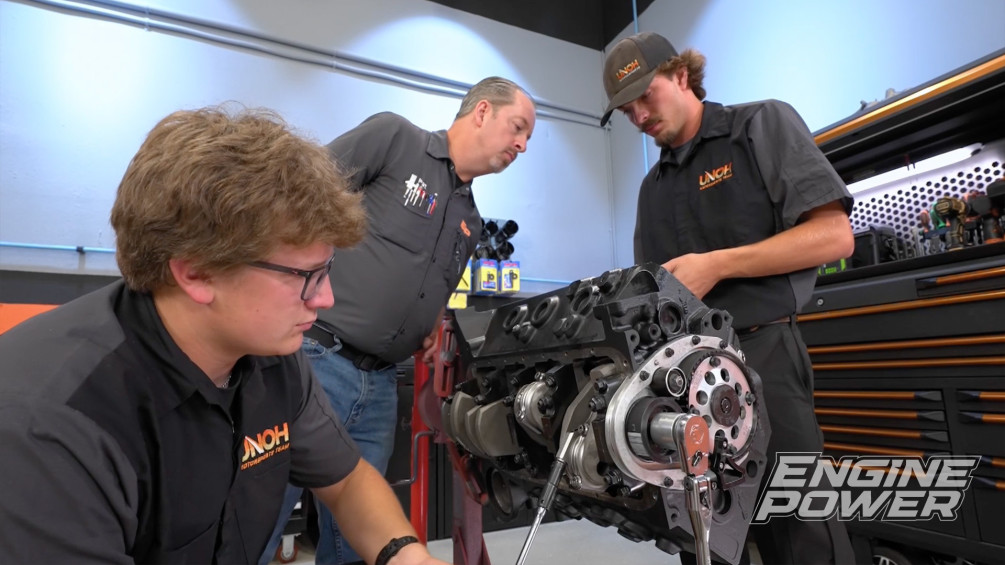
Welcome to Engine Power, and today is a great day because we're working on one of our favorite types of projects, an actual race engine here with the University of Northwestern Ohio and the UNOH motorsports team.
We built a couple different engines with them last year. We did a 434 cubic inch UMP mod engine.
The year before that, we did a 406 with cast iron heads for their stock car team.
And today we're gonna be building a brand new stock car bullet because they had a nice rule change that now allows aluminum 23 degrees.
Ahead, so we're gonna build a brand new combo.
We're gonna get to work on it shortly.
Last time we went to their house,
now they're in ours.
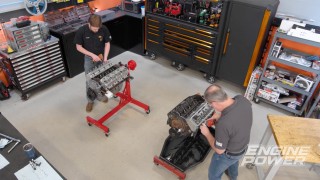
We brought two students in,
Aidan and Michael, and they're gonna be doing all the work. And the guy who runs it all,
Paul Higgins,
come on in.
Hey,
thank you for bringing these guys, and we're gonna do some cool stuff today.
Tell us about what we're gonna be doing.
Well,
first of all,
thank you for having us.
And
again, the stock car rules have changed again for our class.
It used to be that the
Chevrolet-based engine had to run a 23 degree cast iron head,
which is the one we did a couple of years ago, the 406,
and now they're allowing aluminum cylinder heads. So
with the advantage of having some different components,
should be able to make a nice new bullet with a lot of power.
We've actually got some really cool stuff on these 23 degrees. These are really great.
I love that it's aluminum headed.
Everyone's going to be elevated in this class.
The competition's going to be better,
but
obviously we got to get this thing done because we're going to be.
Inoing this,
so, uh,
let's get to work. What do you think?
Sure,
sounds great.
The University of Northwestern Ohio has a 200 acre campus in Lima, Ohio, and offers one of the top vocational programs in the country.
They offer in-depth, hands-on courses in fields like automotive,
diesel,
high performance motorsports, robotics, and more.
Students can gain real-world experience in the classroom and from the school's multiple clubs,
including drifting,
drag racing, and autocross, or the UNOH motorsports team.
Paul Higgins,
I am one of the 3 deans of the College of Applied Technologies as well as the head motor sports team coach.
I've been there 27 years now.
The university owns a quarter mile dirt track, and many years ago, the president of the board of directors thought, hey,
it would be great to have a student-run,
student-driven team that could compete there.
The students do every bit of it. The students prep the cars,
race the cars,
everything.
In the facility is taken care of and run by the students.
There's so many companies come to us because of our reputation.
They're always looking for our graduates.
Total array of different things there are to do,
everything from fabrication,
engine building,
driving.
There's all kinds of things people can do.
They get involved,
they figure out where their passion is, and we like to see their passion turn into a career for them.
My name's Michael Gonnerman,
and I'm from Milford, Iowa.
I got into racing with, uh, my dad's friend. He has a stock eliminator Nova, and I went to go racing with him when I was in high school, and ever since then I've been hooked.
Started getting into small engines on my own,
started to get into cars,
and found out about UNOH,
and I was like I need to do this,
and, uh,
here I am.
My name's Aidan Bauer. I'm from Maysville,
Kentucky.
I've always loved racing.
I've always wanted to go drag racing.
I worked at a small engine building shop.
The guy that actually
owned that business,
he mentioned you on LH,
and I looked into it,
really did like what I've seen,
and my interest has always been the engines.
All right, I hear no more ring grinding.
Tell me what you have.
So our top ring
is 23,000 on the gap,
and our second ring down is 25,000 gap. All right,
ready to go on the block.
Wonderful,
Aidan.
What do we have? I know the bearing clearances have been checked. What do you have?
Yeah,
all the mains have been checked.
Right now they're at 22 and 2-3
and the Rod's been checked they're at 220 to 23.
All right,
wonderful. So next thing,
get it cleaned up,
stick the cranking.
Sweet,
sweet, yeah.
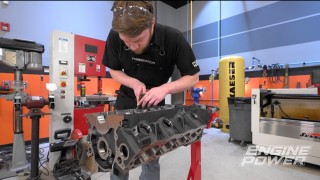
We're starting with a World Products Motown 2 block that the team used in a previous combination.
It was decked to 9 inches and rough board by our trusted local machine shop,
Shackle Automotive,
and then was final honed in-house to a boar size of 4155.
Once the new King racing bearings are laid into place with a semi loop and one half of the rear main seal is set,
this Eagle forged lightweight crank is put into place.
This is an extremely tough 4340 piece to survive the high RPM environment.
It has 350 mains,
a 4-inch stroke,
and 2-inch rod journals.
Once the be main caps are tapped into place,
ARP studs are threaded into the center holes and the splay bolts are threaded into the outers.
We're gonna start our first step.
We're gonna torque the inner mains first,
go to 35 pound feet,
and then we're gonna go our second step, and our final step be 70 pound feet.
The crankshaft thrust is checked at 5000 of an inch,
closer to 5.
Cool.
The camshaft for this build is built out of a billet solid core with big block Chevy journals and a standard firing order.
The lobes were specked by us and the cam was ground by our friends at Comp cams for a specialized application like this.
The lobes have durations at 50,000 lift of 273 degrees on the intake and 285 degrees on the exhaust.
They're set on a 110 degree lobe separation angle,
and net lift at the valve with lash is 718,000 on both.
To help dampen harmonic transfer and increase valvetrain accuracy,
this build is using a Jessel belt drive for this 134,000 raised cam block.
Once the main cover and crank pulley are sealed on,
the rear thrust washer,
cam adapter,
and front thrust washer are installed on the camshaft.
Then the thrust shims and the cam retaining plate are bolted on dry to check the camshaft end plate.
Our specs 8 to 12, so we're
good to go.
Once the cam plate is sealed up with some RTV,
the timing belt and upper cam pulley can be carefully slid into place.
The bolt that retains it is left hand threaded and gets torqued to 70 pounds.
To properly degree the cam,
the students will install the number 1 piston and rod assembly for real
and then verify the intake center line position,
which we decided should be set at 1 of 4.5we,
just where we want it.
The rest of the rod and piston assemblies are prepped for installation,
and for this build we have a set of Eagle H beam forged 6-inch long rods with ARP 2000 fasteners
2.
Rod journals and a 927 pin.
The pistons were custom made for us by DSS Racing with a 4155 final bore,
a 5 cc effective dome volume with our valve release, and a 1.2, 1.23 millimeter ring pack.
They also feature dual spiral lock retainers and upbraidable coating on the skirts with a thermal coating
on the crown.
Really?
The rings are a Summit Racing GPX set with a gas ported steel top ring,
Napier style second ring,
and a standard tension oil control ring.
All right.
To ensure the proper clamp load, we will check the ARP rod bolts for their physical stretch during torquing to make sure they fall within the spec of 64 to 68 10,000.
Coming up,
we take this engine from short block to long block as we get the bottom end seal up and our bed to the bone induction installed.
Nice hustle.
All right, we got our 434 fully in short block status.
Everything's torque,
so what are we putting on next?
So we got our mailing billet
circle track oil pump. We're gonna bolt this on next.
And as we get that on, we're gonna get the checker pan clearance and get the bottom in sewed up.
Heck yeah,
get to it.
For a high stress circle track environment like this engine is going to see,
they have an improved gear design for increased flow and have an integral pickup that can't fall out,
but it is biased towards the right side of the car.
Once it is torqued to 65 pound feet and the pickup to the pan clearance is checked at 3/8 of an inch,
we can lay down a new one piece oil pan gasket.
With RTV on the ends,
a steel eight-quart champ circle track pan from Summit can be carefully dropped on.
It has dual kickouts,
internal baffling with a right side bias,
removable windows tray,
and a full length right-hand kickout for improved oil control.
A set of stainless ARP oil pan bolts cinch it down tight.
This specialized dust cover that UNOH brought for the belt drive gets bolted on before we can install the 6.25 inch fluid damper harmonic damper.
These are great because they don't need to be rebuilt every season
and effectively dampen a wide range of frequencies.
Once the MSD timing pointer is set to true TDC,
we can start prepping for the heads.
This block has a Bush 904 lifter, so we have a set of
pro Type R lifters from Jessel
that are specifically for this setup.
So it's a 904 body. It's been DLC coated,
has an 820,000 tool steel roller
that has a needle.
Bearing in the end. So this thing is
gonna have an extremely long life. These are pretty much
the epitome of durability and valve drain, and that's exactly what we want. They also have an offset on both the intake and exhaust to help with clearance on our intake ports and the cooling jackets on the edge.
Thematic MLS head gaskets with a 4165 bore and a 30,000 compressed thickness give us a measured static compression ratio of 13.72 to 1.
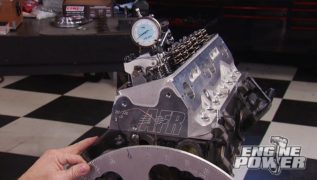
For cylinder heads, we're gonna be running a set of profiler all American 23 degree heads.
These are set up for our engines, so they have a dual spring with a tool steel retainer to keep the material out of the engine.
They have a 235 cc port.
They have a 2125 intake valve, 1600 exhaust,
and they're set up with a
nice
long lasting 45 degree seat for this combo.
So these things are
definitely gonna rock the house on the dyno.
Obviously fasteners are important.
The highest quality you can use,
the better.
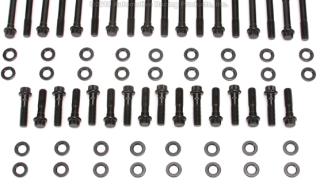
We are going with ARP fasteners on this. This is a 12.8740 fastener.
Great thing about these super strong rolled threads, 8740 material,
180,000 PSI of tensile strength.
Now these are going to be torqued in three equal increments up to a final value of £70 feet.
They also have a very specific torque procedure to be followed in order to get accurate and consistent clamp loads.
Next,
Aiden and Michael will install one of the most important parts of the engine,
the valve train.
Accuracy and longevity when controlling valve motion will make or break a race engine,
so we use the best Jessel valve train.
These shaft rocker stands are specifically designed for the profiler heads and are torqued in place to 48 pound feet.
This build is using a 7900 long, 3/8 diameter push rod with a 135,000 wall thickness with 5/16 ends.
This is a shaft rocker setup from Jessel's Pro Series and features a 1.7 ratio,
precision needle bearings,
hardened adjusters, and a 450,000 offset on the intake for increased pushrod clearance.
The stand location and rocker body are carefully designed to have the minimal amount of travel on the tip of the valve and live through extended high RPM with high spring pressures.
Once all of them are installed, the students will go through and set cold lash to 10,000.
You like it?
Yeah, it feels real good.
All right, now,
next thing,
induction just delivered overnight.
Sweet,
sweet.
All right,
now actually I gotta prep it and get it on.
Nice hustle.
Don't go away because up next,
we take this 434 and figure out how to keep it cool and get it fuel to get it ready for the dyno.
As we get closer to wrapping up this 4:34,
a new set of steel core intake gaskets get glued to the cylinder heads.
For the intake manifold, we went to the induction experts at Wilson manifolds,
so we're using their 23 degree intake manifold. We actually sent our heads to them
and they set this thing up perfectly for our engine. So it's not only beautiful, but it's actually scienced out
for our
engine RPM displacement and dirt racing application.
They've set it up for our deck height and everything, so
this is not only gonna have good response, wide open throttle, but also partial throttle.
This level of porting is a service they specialize in to maximize power and torque and equalize fuel distribution for easier tuning.
To get it right, it takes a fair amount of welding and grinding to tailor it to our application,
and these guys knocked it out of the park.
With the valve train Prelude, a set of dirt track specific valve covers that we added dash 12 fittings to seal up the engine.
In high cylinder pressure applications like this,
accurate ignition timing is a must,
and the best way to do that is with an MSD crank trigger system like this.
It specifically fits our damper and uses a non-magnetic pickup to precisely fire the coil based off the crankshaft's position.
Once it's bolted in place,
the pickup's position is set with the engine at 30 degrees before top dead center, and the gap is set at 50,000.
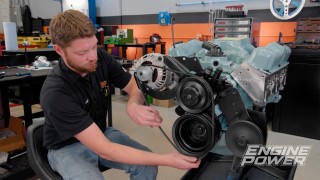
For precision belt alignment, this Jones Racing products crankshaft pulley assembly goes on next and is a part of their full water pump and power steering belt drive.
This high flow lightweight water pump is installed with their 38 spacers and tightened down with RTV.
Alright,
that's good to go.
The power steering brackets are securely mounted to the cylinder head and has a sliding adjustment for belt tension on the pump.
All the pulleys are correctly sized for the high RPM use and line up perfectly out of the box due to their extensive engineering.
For the water outlet,
this Summit Racing housing with a radiator cap for filling gets bolted down with ARP bolts.
Then this circle track bullet is ready to make its way to the dyno for the last bit of parts.
We have made it to our favorite place in the building,
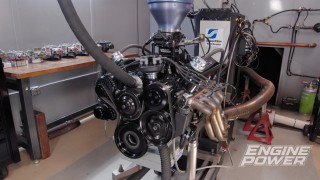
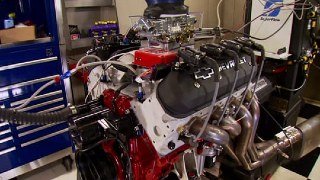
the dining room, where our 434 inch UNOH engine is ready to rock and roll.
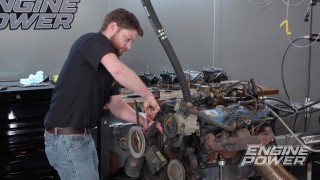
Everything is hooked up, so we are to the point where we have to put some oil in it.
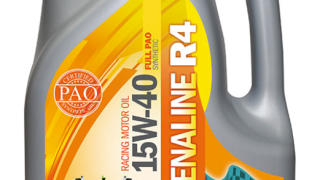
Our oil of choice is going to be from Hot Shot Secret,
the adrenaline R4 in 1540. That's what we're going with on this.
This is their oil. It's a full PAO based base oil which is great for high heat,
high stress,
high horsepower applications, and it is infused with their FR3 nanotechnology to keep it good for anything we're going to throw at it. So this goes in with 8 quarts total.
Once all the oil is in,
we use an air powered drill to prime the system at full pressure,
turning the engine over as we go to make sure there's proper oil flow throughout the engine.
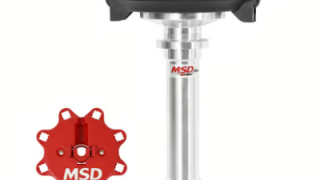
Then this MSD billet crank trigger distributor can be dropped into place,
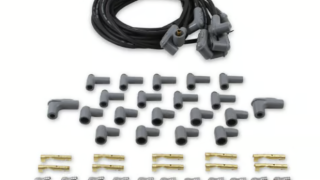
followed by the matching cap and MSD superconductor wires.
They are hooked to a set of NGK 5762-8 plugs with a 35,000 scap.
Because it's extremely critical,
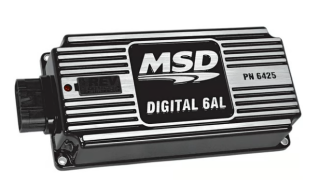
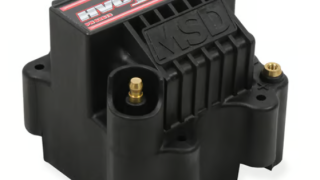
the entire ignition system is MSD including this class legal digital 6AL CDI box
and HVC2 coil that will stay with the engine.
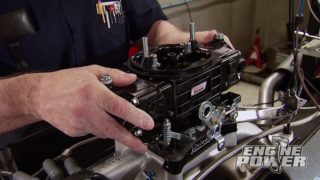
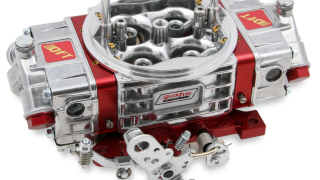
The Wilson intake is topped with one of their 2-inch 4 hole tapered spacers in the same card we used last time,
this QFT
1050 CFMQ series with annular boosters.
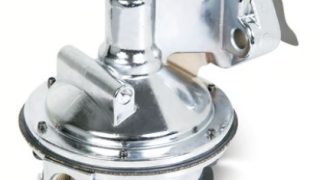
The class rules require a mechanical fuel pump, so we are using this Holly 170 gallon per hour unit,
and we'll actually hook it up and run it just like it would be in the car for accurate testing.
For ultimate reliability,
safety,
and flow, the entire engine is
pumped with Earl's Performance AM fittings and hose.
Once we get the engine started,
we'll run it for a little bit to get it up to temp,
burn the paint off some of the headers,
and pretty soon,
we'll be making dyno bulls.
Still to come,
we put the student's build to the test and get it ready
for race day.
What do you guys think?
Yeah,
pretty sweet.
It's awesome.
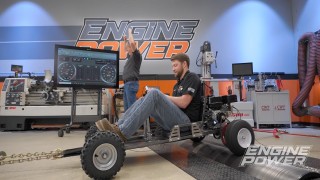
All right, so we got our 434 up and running
with stuff like this. We'd like to get it up to temp. We'll go through and set hot lash, and now we can start making power pools.
Uh,
so we're going to turn this thing from 4500 to 7000, and we're at what for timing? We are at 30 degrees of timing and why 30? We know it's a little bit short, but we have to get a baseline somewhere, right? So you know we can turn the thing higher,
but the You have a lot of things where
it's going to start wearing parts out faster, right? You guys want to race durability.
You don't want to be changing parts. So all right, let's let's give it,
give the first hit here and see where we're at.
So we're at full operating temp, 165 degrees. You guys said your stuff runs 170 or so down the track. OK, so everybody hold on.
All right.
That, that's pretty spicy for the first buller for what we're doing.
Let's see. Let's pull it up here.
All right,
5565.4 for torque,
and what do we got up there for power?
693.7 horse.
That's not bad for 30 degrees of tide.
That's not bad again, because, uh,
this is not gonna take a wide timing swing just because of what it is.
But, uh,
and this,
this is a really, I actually really like the way that torque looks.
We were hoping for something like that, nice and flat.
Yeah,
BSFCs are in a great range.
I mean, oil pressure looks good. It's got 97 peak.
Uh, through there and it's, it's holding right around there, so that's good.
All right,
so while you guys talk amongst yourselves,
oh, Dad's gonna go in there and put some timing.
OK,
all right,
you're gonna put 2 in.
Yeah.
a hit on that same temp and everything.
No, that's the great part about it because we got the same oil temp. We have the same water temp.
This is like we're making laps with the thing,
right?
So this,
this is nice and consistent. All right, here we go.
700.8 horsepower,
6800 right there,
I think, yeah.
And what's that say for 5569 56.
All right,
that is,
that is a spicy meatball right there.
That's a good pickup too. I mean,
I want to sneak one more in and see what it does. I mean,
I,
I can get it up.
I mean, I would feel
comfortable.
That's,
you know,
doing one or two.
Yeah, I would do one because it's that was still a pretty decent gain.
So,
so yeah,
all right, yeah,
go put one in it.
I'll be right back. We'll see what that does.
All right,
ready?
Everybody hold on.
Marginal
it looks like, but marginal. I didn't didn't fall off.
I mean 701.9,
uh, and what do we make for torque
570570's like, you know,
pick the torque up, pick up a little bit, yeah,
yeah,
it's,
but I,
that's probably it,
you know,
especially for a safe engine. It's kind of like we were talking about when we did the 13 degree last year, right?
You can run it at max timing, but you typically run it. A couple of degrees
back because you're going to get hot.
I'll tell you what, for a 23 degree headed,
you know, 434 making 701.9,
what do you guys think?
Yeah,
pretty sweet.
What was your favorite part of the build?
Oh, I don't know.
Probably, uh,
getting to learn about all the induction stuff that we're putting on it, so, and all the nice valve train parts we put in it.
What about you, Aidan? What do you think?
Same thing, just a learning experience.
It's a lot of cool stuff out there just get,
get,
get you,
get you pumped up to do this stuff.
I know you guys are gonna be looking forward to race season,
you know, because you got a lot of cool stuff,
yeah,
having good parts like,
you know,
everything from the, the camshaft ground by comp and the Jessel valve training belt drive.
Uh, and all the induction stuff to really come together like, you know,
Wilson doing the manifold for us specifically for your application,
everything,
all that stuff is critical to make this come together and actually make something that's not only gonna do this, but,
you know,
can go laps and laps at the track.
So,
no,
all the good stuff on, you know, the Jones front dive,
like you said, the Jones front drive,
the profiler heads, Wilson doing the manifold,
uh,
this is, this has got a bunch of good stuff in it.
You think, man?
Oh, I think, I think it's great.
You know, it's like I always tell everybody, you guys are a real deal.
You know, there's a lot, there's a lot of jokers out there that act
like, oh, I could do this, I could do that,
but you guys are a real deal,
you know, this, this really is, and,
and for them to experience it along,
along with you is just super great. It's all about education and,
and their experiences at school.
Absolutely. We, we,
that means a lot coming from the bar.
It does because we really appreciate it when it comes.
From a guy who's a,
he's the dean of applied technologies at at a respected, you know,
college,
that means a lot to us and we really appreciate it. So,
so thank you for coming by.
You guys did a great I appreciate everybody here and allowing us to come participate with the builds and stuff.
I mean,
it's, it's
definitely a great rewarding experience, and we'll get it off and you guys go take that back and get it in the car and for us another one in the books,
great success.
Show Full Transcript
You know, it's like I always tell everybody, you guys are a real deal.
It's dirt car mania and engine power as we put together a big inch class legal high compression race bullet with the UNOH motorsports team designed to keep them
ahead of the pack.
Welcome to Engine Power, and today is a great day because we're working on one of our favorite types of projects, an actual race engine here with the University of Northwestern Ohio and the UNOH motorsports team.
We built a couple different engines with them last year. We did a 434 cubic inch UMP mod engine.
The year before that, we did a 406 with cast iron heads for their stock car team.
And today we're gonna be building a brand new stock car bullet because they had a nice rule change that now allows aluminum 23 degrees.
Ahead, so we're gonna build a brand new combo.
We're gonna get to work on it shortly.
Last time we went to their house,
now they're in ours.
We brought two students in,
Aidan and Michael, and they're gonna be doing all the work. And the guy who runs it all,
Paul Higgins,
come on in.
Hey,
thank you for bringing these guys, and we're gonna do some cool stuff today.
Tell us about what we're gonna be doing.
Well,
first of all,
thank you for having us.
And
again, the stock car rules have changed again for our class.
It used to be that the
Chevrolet-based engine had to run a 23 degree cast iron head,
which is the one we did a couple of years ago, the 406,
and now they're allowing aluminum cylinder heads. So
with the advantage of having some different components,
should be able to make a nice new bullet with a lot of power.
We've actually got some really cool stuff on these 23 degrees. These are really great.
I love that it's aluminum headed.
Everyone's going to be elevated in this class.
The competition's going to be better,
but
obviously we got to get this thing done because we're going to be.
Inoing this,
so, uh,
let's get to work. What do you think?
Sure,
sounds great.
The University of Northwestern Ohio has a 200 acre campus in Lima, Ohio, and offers one of the top vocational programs in the country.
They offer in-depth, hands-on courses in fields like automotive,
diesel,
high performance motorsports, robotics, and more.
Students can gain real-world experience in the classroom and from the school's multiple clubs,
including drifting,
drag racing, and autocross, or the UNOH motorsports team.
Paul Higgins,
I am one of the 3 deans of the College of Applied Technologies as well as the head motor sports team coach.
I've been there 27 years now.
The university owns a quarter mile dirt track, and many years ago, the president of the board of directors thought, hey,
it would be great to have a student-run,
student-driven team that could compete there.
The students do every bit of it. The students prep the cars,
race the cars,
everything.
In the facility is taken care of and run by the students.
There's so many companies come to us because of our reputation.
They're always looking for our graduates.
Total array of different things there are to do,
everything from fabrication,
engine building,
driving.
There's all kinds of things people can do.
They get involved,
they figure out where their passion is, and we like to see their passion turn into a career for them.
My name's Michael Gonnerman,
and I'm from Milford, Iowa.
I got into racing with, uh, my dad's friend. He has a stock eliminator Nova, and I went to go racing with him when I was in high school, and ever since then I've been hooked.
Started getting into small engines on my own,
started to get into cars,
and found out about UNOH,
and I was like I need to do this,
and, uh,
here I am.
My name's Aidan Bauer. I'm from Maysville,
Kentucky.
I've always loved racing.
I've always wanted to go drag racing.
I worked at a small engine building shop.
The guy that actually
owned that business,
he mentioned you on LH,
and I looked into it,
really did like what I've seen,
and my interest has always been the engines.
All right, I hear no more ring grinding.
Tell me what you have.
So our top ring
is 23,000 on the gap,
and our second ring down is 25,000 gap. All right,
ready to go on the block.
Wonderful,
Aidan.
What do we have? I know the bearing clearances have been checked. What do you have?
Yeah,
all the mains have been checked.
Right now they're at 22 and 2-3
and the Rod's been checked they're at 220 to 23.
All right,
wonderful. So next thing,
get it cleaned up,
stick the cranking.
Sweet,
sweet, yeah.
We're starting with a World Products Motown 2 block that the team used in a previous combination.
It was decked to 9 inches and rough board by our trusted local machine shop,
Shackle Automotive,
and then was final honed in-house to a boar size of 4155.
Once the new King racing bearings are laid into place with a semi loop and one half of the rear main seal is set,
this Eagle forged lightweight crank is put into place.
This is an extremely tough 4340 piece to survive the high RPM environment.
It has 350 mains,
a 4-inch stroke,
and 2-inch rod journals.
Once the be main caps are tapped into place,
ARP studs are threaded into the center holes and the splay bolts are threaded into the outers.
We're gonna start our first step.
We're gonna torque the inner mains first,
go to 35 pound feet,
and then we're gonna go our second step, and our final step be 70 pound feet.
The crankshaft thrust is checked at 5000 of an inch,
closer to 5.
Cool.
The camshaft for this build is built out of a billet solid core with big block Chevy journals and a standard firing order.
The lobes were specked by us and the cam was ground by our friends at Comp cams for a specialized application like this.
The lobes have durations at 50,000 lift of 273 degrees on the intake and 285 degrees on the exhaust.
They're set on a 110 degree lobe separation angle,
and net lift at the valve with lash is 718,000 on both.
To help dampen harmonic transfer and increase valvetrain accuracy,
this build is using a Jessel belt drive for this 134,000 raised cam block.
Once the main cover and crank pulley are sealed on,
the rear thrust washer,
cam adapter,
and front thrust washer are installed on the camshaft.
Then the thrust shims and the cam retaining plate are bolted on dry to check the camshaft end plate.
Our specs 8 to 12, so we're
good to go.
Once the cam plate is sealed up with some RTV,
the timing belt and upper cam pulley can be carefully slid into place.
The bolt that retains it is left hand threaded and gets torqued to 70 pounds.
To properly degree the cam,
the students will install the number 1 piston and rod assembly for real
and then verify the intake center line position,
which we decided should be set at 1 of 4.5we,
just where we want it.
The rest of the rod and piston assemblies are prepped for installation,
and for this build we have a set of Eagle H beam forged 6-inch long rods with ARP 2000 fasteners
2.
Rod journals and a 927 pin.
The pistons were custom made for us by DSS Racing with a 4155 final bore,
a 5 cc effective dome volume with our valve release, and a 1.2, 1.23 millimeter ring pack.
They also feature dual spiral lock retainers and upbraidable coating on the skirts with a thermal coating
on the crown.
Really?
The rings are a Summit Racing GPX set with a gas ported steel top ring,
Napier style second ring,
and a standard tension oil control ring.
All right.
To ensure the proper clamp load, we will check the ARP rod bolts for their physical stretch during torquing to make sure they fall within the spec of 64 to 68 10,000.
Coming up,
we take this engine from short block to long block as we get the bottom end seal up and our bed to the bone induction installed.
Nice hustle.
All right, we got our 434 fully in short block status.
Everything's torque,
so what are we putting on next?
So we got our mailing billet
circle track oil pump. We're gonna bolt this on next.
And as we get that on, we're gonna get the checker pan clearance and get the bottom in sewed up.
Heck yeah,
get to it.
For a high stress circle track environment like this engine is going to see,
they have an improved gear design for increased flow and have an integral pickup that can't fall out,
but it is biased towards the right side of the car.
Once it is torqued to 65 pound feet and the pickup to the pan clearance is checked at 3/8 of an inch,
we can lay down a new one piece oil pan gasket.
With RTV on the ends,
a steel eight-quart champ circle track pan from Summit can be carefully dropped on.
It has dual kickouts,
internal baffling with a right side bias,
removable windows tray,
and a full length right-hand kickout for improved oil control.
A set of stainless ARP oil pan bolts cinch it down tight.
This specialized dust cover that UNOH brought for the belt drive gets bolted on before we can install the 6.25 inch fluid damper harmonic damper.
These are great because they don't need to be rebuilt every season
and effectively dampen a wide range of frequencies.
Once the MSD timing pointer is set to true TDC,
we can start prepping for the heads.
This block has a Bush 904 lifter, so we have a set of
pro Type R lifters from Jessel
that are specifically for this setup.
So it's a 904 body. It's been DLC coated,
has an 820,000 tool steel roller
that has a needle.
Bearing in the end. So this thing is
gonna have an extremely long life. These are pretty much
the epitome of durability and valve drain, and that's exactly what we want. They also have an offset on both the intake and exhaust to help with clearance on our intake ports and the cooling jackets on the edge.
Thematic MLS head gaskets with a 4165 bore and a 30,000 compressed thickness give us a measured static compression ratio of 13.72 to 1.
For cylinder heads, we're gonna be running a set of profiler all American 23 degree heads.
These are set up for our engines, so they have a dual spring with a tool steel retainer to keep the material out of the engine.
They have a 235 cc port.
They have a 2125 intake valve, 1600 exhaust,
and they're set up with a
nice
long lasting 45 degree seat for this combo.
So these things are
definitely gonna rock the house on the dyno.
Obviously fasteners are important.
The highest quality you can use,
the better.
We are going with ARP fasteners on this. This is a 12.8740 fastener.
Great thing about these super strong rolled threads, 8740 material,
180,000 PSI of tensile strength.
Now these are going to be torqued in three equal increments up to a final value of £70 feet.
They also have a very specific torque procedure to be followed in order to get accurate and consistent clamp loads.
Next,
Aiden and Michael will install one of the most important parts of the engine,
the valve train.
Accuracy and longevity when controlling valve motion will make or break a race engine,
so we use the best Jessel valve train.
These shaft rocker stands are specifically designed for the profiler heads and are torqued in place to 48 pound feet.
This build is using a 7900 long, 3/8 diameter push rod with a 135,000 wall thickness with 5/16 ends.
This is a shaft rocker setup from Jessel's Pro Series and features a 1.7 ratio,
precision needle bearings,
hardened adjusters, and a 450,000 offset on the intake for increased pushrod clearance.
The stand location and rocker body are carefully designed to have the minimal amount of travel on the tip of the valve and live through extended high RPM with high spring pressures.
Once all of them are installed, the students will go through and set cold lash to 10,000.
You like it?
Yeah, it feels real good.
All right, now,
next thing,
induction just delivered overnight.
Sweet,
sweet.
All right,
now actually I gotta prep it and get it on.
Nice hustle.
Don't go away because up next,
we take this 434 and figure out how to keep it cool and get it fuel to get it ready for the dyno.
As we get closer to wrapping up this 4:34,
a new set of steel core intake gaskets get glued to the cylinder heads.
For the intake manifold, we went to the induction experts at Wilson manifolds,
so we're using their 23 degree intake manifold. We actually sent our heads to them
and they set this thing up perfectly for our engine. So it's not only beautiful, but it's actually scienced out
for our
engine RPM displacement and dirt racing application.
They've set it up for our deck height and everything, so
this is not only gonna have good response, wide open throttle, but also partial throttle.
This level of porting is a service they specialize in to maximize power and torque and equalize fuel distribution for easier tuning.
To get it right, it takes a fair amount of welding and grinding to tailor it to our application,
and these guys knocked it out of the park.
With the valve train Prelude, a set of dirt track specific valve covers that we added dash 12 fittings to seal up the engine.
In high cylinder pressure applications like this,
accurate ignition timing is a must,
and the best way to do that is with an MSD crank trigger system like this.
It specifically fits our damper and uses a non-magnetic pickup to precisely fire the coil based off the crankshaft's position.
Once it's bolted in place,
the pickup's position is set with the engine at 30 degrees before top dead center, and the gap is set at 50,000.
For precision belt alignment, this Jones Racing products crankshaft pulley assembly goes on next and is a part of their full water pump and power steering belt drive.
This high flow lightweight water pump is installed with their 38 spacers and tightened down with RTV.
Alright,
that's good to go.
The power steering brackets are securely mounted to the cylinder head and has a sliding adjustment for belt tension on the pump.
All the pulleys are correctly sized for the high RPM use and line up perfectly out of the box due to their extensive engineering.
For the water outlet,
this Summit Racing housing with a radiator cap for filling gets bolted down with ARP bolts.
Then this circle track bullet is ready to make its way to the dyno for the last bit of parts.
We have made it to our favorite place in the building,
the dining room, where our 434 inch UNOH engine is ready to rock and roll.
Everything is hooked up, so we are to the point where we have to put some oil in it.
Our oil of choice is going to be from Hot Shot Secret,
the adrenaline R4 in 1540. That's what we're going with on this.
This is their oil. It's a full PAO based base oil which is great for high heat,
high stress,
high horsepower applications, and it is infused with their FR3 nanotechnology to keep it good for anything we're going to throw at it. So this goes in with 8 quarts total.
Once all the oil is in,
we use an air powered drill to prime the system at full pressure,
turning the engine over as we go to make sure there's proper oil flow throughout the engine.
Then this MSD billet crank trigger distributor can be dropped into place,
followed by the matching cap and MSD superconductor wires.
They are hooked to a set of NGK 5762-8 plugs with a 35,000 scap.
Because it's extremely critical,
the entire ignition system is MSD including this class legal digital 6AL CDI box
and HVC2 coil that will stay with the engine.
The Wilson intake is topped with one of their 2-inch 4 hole tapered spacers in the same card we used last time,
this QFT
1050 CFMQ series with annular boosters.
The class rules require a mechanical fuel pump, so we are using this Holly 170 gallon per hour unit,
and we'll actually hook it up and run it just like it would be in the car for accurate testing.
For ultimate reliability,
safety,
and flow, the entire engine is
pumped with Earl's Performance AM fittings and hose.
Once we get the engine started,
we'll run it for a little bit to get it up to temp,
burn the paint off some of the headers,
and pretty soon,
we'll be making dyno bulls.
Still to come,
we put the student's build to the test and get it ready
for race day.
What do you guys think?
Yeah,
pretty sweet.
It's awesome.
All right, so we got our 434 up and running
with stuff like this. We'd like to get it up to temp. We'll go through and set hot lash, and now we can start making power pools.
Uh,
so we're going to turn this thing from 4500 to 7000, and we're at what for timing? We are at 30 degrees of timing and why 30? We know it's a little bit short, but we have to get a baseline somewhere, right? So you know we can turn the thing higher,
but the You have a lot of things where
it's going to start wearing parts out faster, right? You guys want to race durability.
You don't want to be changing parts. So all right, let's let's give it,
give the first hit here and see where we're at.
So we're at full operating temp, 165 degrees. You guys said your stuff runs 170 or so down the track. OK, so everybody hold on.
All right.
That, that's pretty spicy for the first buller for what we're doing.
Let's see. Let's pull it up here.
All right,
5565.4 for torque,
and what do we got up there for power?
693.7 horse.
That's not bad for 30 degrees of tide.
That's not bad again, because, uh,
this is not gonna take a wide timing swing just because of what it is.
But, uh,
and this,
this is a really, I actually really like the way that torque looks.
We were hoping for something like that, nice and flat.
Yeah,
BSFCs are in a great range.
I mean, oil pressure looks good. It's got 97 peak.
Uh, through there and it's, it's holding right around there, so that's good.
All right,
so while you guys talk amongst yourselves,
oh, Dad's gonna go in there and put some timing.
OK,
all right,
you're gonna put 2 in.
Yeah.
a hit on that same temp and everything.
No, that's the great part about it because we got the same oil temp. We have the same water temp.
This is like we're making laps with the thing,
right?
So this,
this is nice and consistent. All right, here we go.
700.8 horsepower,
6800 right there,
I think, yeah.
And what's that say for 5569 56.
All right,
that is,
that is a spicy meatball right there.
That's a good pickup too. I mean,
I want to sneak one more in and see what it does. I mean,
I,
I can get it up.
I mean, I would feel
comfortable.
That's,
you know,
doing one or two.
Yeah, I would do one because it's that was still a pretty decent gain.
So,
so yeah,
all right, yeah,
go put one in it.
I'll be right back. We'll see what that does.
All right,
ready?
Everybody hold on.
Marginal
it looks like, but marginal. I didn't didn't fall off.
I mean 701.9,
uh, and what do we make for torque
570570's like, you know,
pick the torque up, pick up a little bit, yeah,
yeah,
it's,
but I,
that's probably it,
you know,
especially for a safe engine. It's kind of like we were talking about when we did the 13 degree last year, right?
You can run it at max timing, but you typically run it. A couple of degrees
back because you're going to get hot.
I'll tell you what, for a 23 degree headed,
you know, 434 making 701.9,
what do you guys think?
Yeah,
pretty sweet.
What was your favorite part of the build?
Oh, I don't know.
Probably, uh,
getting to learn about all the induction stuff that we're putting on it, so, and all the nice valve train parts we put in it.
What about you, Aidan? What do you think?
Same thing, just a learning experience.
It's a lot of cool stuff out there just get,
get,
get you,
get you pumped up to do this stuff.
I know you guys are gonna be looking forward to race season,
you know, because you got a lot of cool stuff,
yeah,
having good parts like,
you know,
everything from the, the camshaft ground by comp and the Jessel valve training belt drive.
Uh, and all the induction stuff to really come together like, you know,
Wilson doing the manifold for us specifically for your application,
everything,
all that stuff is critical to make this come together and actually make something that's not only gonna do this, but,
you know,
can go laps and laps at the track.
So,
no,
all the good stuff on, you know, the Jones front dive,
like you said, the Jones front drive,
the profiler heads, Wilson doing the manifold,
uh,
this is, this has got a bunch of good stuff in it.
You think, man?
Oh, I think, I think it's great.
You know, it's like I always tell everybody, you guys are a real deal.
You know, there's a lot, there's a lot of jokers out there that act
like, oh, I could do this, I could do that,
but you guys are a real deal,
you know, this, this really is, and,
and for them to experience it along,
along with you is just super great. It's all about education and,
and their experiences at school.
Absolutely. We, we,
that means a lot coming from the bar.
It does because we really appreciate it when it comes.
From a guy who's a,
he's the dean of applied technologies at at a respected, you know,
college,
that means a lot to us and we really appreciate it. So,
so thank you for coming by.
You guys did a great I appreciate everybody here and allowing us to come participate with the builds and stuff.
I mean,
it's, it's
definitely a great rewarding experience, and we'll get it off and you guys go take that back and get it in the car and for us another one in the books,
great success.
Engine Power Featured Projects
Engine Power Builds



Want more content like this?
Join the PowerNation Email NewsletterParts Used In This Episode

UNOH - University of Northwestern Ohio
UNOH Motorsports
Comp Cams
SBC Solid Roller Camshaft
DSS Racing
Small Block Chevy Pistons
Eagle Specialty Products
4340 H-Beam Connecting Rods
Eagle Specialty Products
Forged 4340 Steel Crankshaft
Jesel Inc.
Belt Drive
Jesel Inc.
Pro Series Rocker Arms
Jesel Inc.
Pro Tie-Bar Lifters
Jesel Inc.
Timing Belt
Jesel Inc.
Valvetrain
Jones Racing Products
Crankshaft Pulley System
Jones Racing Products
Water Pump
Jones Racing Products
Water Pump Pulley
Profiler Performance
All American Aluminum 23 Degree SBC Racing Heads
Shacklett Automotive Machine
Machine Work
WILSON MANIFOLDS
Wilson ProFiler SBC Intake Manifold
World Products
Motown II Engine Block