In This Episode
- 0:01 Introduction and Overview of the Video
- 1:27 History and Previous Upgrades of the Engines
- 2:48 Current Upgrades and Modifications
- 4:19 Discussion on Harmonic Dampers
- 5:49 Reassembly and Further Upgrades of the Engines
- 10:23 Visit to Sima Garage and Discussion on Advanced Technologies
- 15:04 Dyno Testing of the Upgraded Engines
- 21:19 Conclusion and Success of the Project
Video Transcript
You're watching Power Nation.
Yes,
we have them in stock.
Hey everyone,
today is gonna be a great day here at Engine Power.
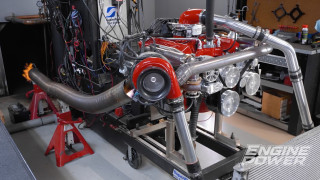
It's the return of the small block showdown, and we have more RPM, more flow, and more power.
Hey there everyone, and welcome to another action-packed episode of Engine Power.
Today we are bringing back one of our favorites and seems to be one of yours,
our 302 versus 305 horsepower battle.
Now we've done a lot of cool things with these engines, but now we're going to take them to the next level.
Yeah, this series has lit up the Internet for good reason,
and today we're gonna take it to the next stage because we have a big set of upgrades for both engines.
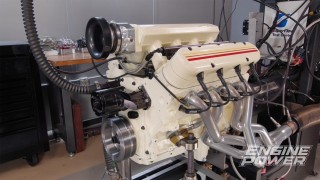
We are going solid roller and we are going aluminum cylinder heads to try and up the power on both of these bullets.
This started out as a friendly competition between the most economical and popular small displacement small blocks.
Starting with a junkyard 1984305 Chevy and a 199302 Ford,
our first round of upgrades was a simple hydraulic roller cam swap matching valve springs and torque to intake manifolds.
All the other stock componentry was reused and they were dyno with the same BTech ignition systems and an 850 CFM carburetor.
Both engines produced 302 horsepower and 328 pound of torque.
In round two, we decided to swap the cylinder heads on each for the highest recommended cast iron production heads for both.
The Ford received a set of GT40Ps and the 305 got a set of 059 vortex.
They also received higher ratio aluminum rockers and.
Matching Holly single plane intakes.
All the other components were kept the same,
and the Ford pumped out 339 horsepower and 344 pound feet,
while the Chevy lagged behind with lower compression at 327 horsepower and 317 pound feet.
Last round, to even the odds, we decided to up the compression on both engines with a 30,000 overboard and a set of domed pistons.
With some carefully chosen head gaskets, we were able to get the engines within one one-hundred of each other on the static compression ratio at 10.91 to 1 for the Ford and 10.92 to 1 for the Chevy.
This upped the power and leveled the playing field with the Ford making 364 horsepower and 352 pound feet,
and the Chevy making 359 horsepower and 351 pound feet.
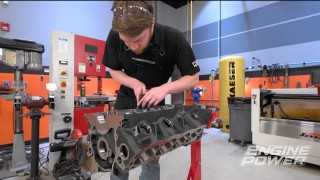
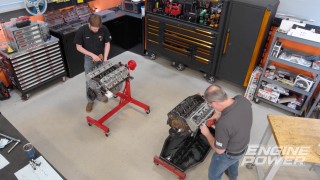
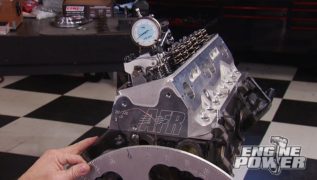
For today's solid roller conversions, we're going to be tearing the engines down to the short blocks and leaving the bottom ends untouched.
These are solid 360 horsepower components,
so we won't throw them away,
but we will put them on a shelf to possibly be used on builds in the future.
Once the intakes are off,
we can start removing the rocker arms in pairs at TDC compression stroke on each cylinder.
Now that those are out of the way,
we can break the head bolts loose and zip them out and pop off the cylinder heads.
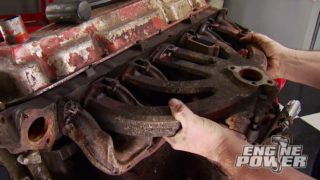
We'll use a removal tool to pull the stock dampers, which won't be reused with our new high RPM application.
Before pulling the timing covers, we will drop the oil pans on both, and given the abuse we put these engines through,
the insides look very clean and have zero debris.
Yeah,
very nice.
With the timing covers out of the way,
we can gain access to our double roller timing sets and slide out these commendable hydraulic roller camshafts.
Up next,
our small blocks get bigger bump sticks,
better flowing cylinder heads,
and bulletproof valve train.
One of the most important parts of your engine build is the harmonic damper,
so in today's Summit Racing tech tip we're gonna talk all about them.
A harmonic damper's job in an engine
is to help reduce and minimize harmful vibrations and harmonics that happen inside your engine while it's running,
and there's a couple different types. The first type is elastomer. The way they work is there is an internal hub,
and then there's an outer ring,
and the outer ring is suspended on basically a rubber band. This is a solid piece of rubber,
and this helps absorb the vibrations in your engine.
There's also aftermarket styles of these that are SFIA approved.
These work on the same exact concept,
but they usually have some sort of mechanical locking device that prevents the ring from being able to come off so you can use them in racing safely.
The next style is also an elastomer style, but it uses a different kind of elastomer.
These are commonly referred to as band or O-ring style elastomers. They're not bonded like the other ones.
They use effectively O-rings inside of the damper.
These get pressed together, but they do have bolts that go through them as.
Well,
so if you're going racing, they're SFI approved.
The last style is completely different from the rest.
It is a viscous fluid style damper, and the way this works is inside the ring,
it is a sealed chamber that's filled with a viscous fluid,
and then there is an inertia ring inside of that.
That inertia ring moves inside the fluid and actually helps take up those harmonics.
So these are all the different styles, and if you need help picking out which one is right for your build, you could talk to the experts at Summit Racing Equipment.
Both engines are cleaned,
so we'll start reassembling them with our new components.
These bullets are getting matching solid roller camshafts from comp cams with durations at 50,000 lift of 248 degrees on the intake and 254 degrees on the exhaust with a 110 degree lobe separation angle.
The net lift at the valve for both engines is 600,000 on the intake and 606,000 on the exhaust.
The timing sets are reinstalled and the camshafts are dereed with the 305 set at 105.5 and the 302 set at 105.25.
Then both engines are sealed up in the front with the original timing covers before flipping them over to reinstall the oil pans.
Both engines are reusing the original oil pumps,
pickups, and pans,
but they will receive a new one-piece oil pan gasket to keep them leak-free.
OK,
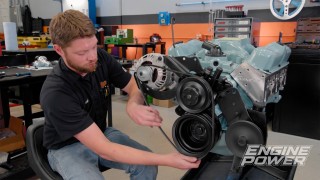
because we are planning on turning these engines a lot more RPM and producing a lot more power, we are finally gonna ditch our stock dampers because these have a tendency to degrade over time.
So we're gonna ditch those and get a set of fluid damper viscous harmonic dampers for both engines.
These are great because they use a viscous fluid with an inertia ring so they can't come apart and they don't degrade over time. The best part is that if the fluid is inside of the damper, it is. Still working just like it's brand new.
We have a small block Chevy one which is an internal balance.
These also are great because they have incremented balancer marks on them. So if you don't have a dial back timing light, you can set your timing accurately, and we have an external balance one for our Ford.
These are gonna be great because they're SFI approved.
They're gonna work for what we're doing, and they're gonna be primed for future upgrades if we want to go even further.
So we're gonna get these on
and keep moving.
Fluid ampers' machine work is very precise, so both units have the proper press fit and don't need any additional work.
On the short deck Ford, these comp EndureX solid roller lifters will have to go in before the cylinder heads, and the Chevy receives a matching set.
It's time now to bolt on some induction. We have a new set over there and a dyno proven one that's going to go on our Chevrolet.
These are a trick flow Super 23 175.
They have a 175 cc intake port,
a 56 cc combustion.
Chamber housing 1940 and 1500 swirl polish stainless valves, and the great thing about these heads is they specialize in small bore small blocks. So these are going to be great for our application.
Now for the Ford, we tried to get them as similar as possible, just like the entire theme of this build. So what we have is a set of Edelbrock performer heads for a small block Ford.
It is as close as we get them,
but they do vary a little bit. We have a
60 cc combustion chamber.
They have a 1900 intake valve,
a 1600 exhaust valve,
and they are set up for a solid roller, and both heads are using the same spring pack. So this is a pack
1422 spring. This is a single wound conical spring that's set up at 1810 with about 195 pounds of seat
and 545 pounds of open
at our lift.
So we're gonna get these on as well.
With a 27,000 stick head gasket on the Ford and a 36,000 stick head gasket on the Chevy,
we will have very close compression ratios at 10.99 to 1 for the bow tie and 11 to 1 for the blue oval.
We picked these heads because they are the most comparable options based off port volume,
valve size,
and most importantly,
flow with 245 CFM at 600,000 inch of lift.
This way,
one engine doesn't have the upper hand on the other,
and this is as fair as we can make it.
Both are held down with an ARP bolt kit that has torque to 70 pound feet.
New intake gaskets and beads of RT TV make way for matching Edelbrock Victor Junior intake manifolds.
Both engines will be utilizing 716 rocker studs and 5/16 guide plates that have to be properly aligned before they are torqued to 50 pound feet.
New 5/16 pushrods are required for proper length, with the Ford needing a 7100 long unit and the Chevy using 8 inch pieces.
After high pressure grease is applied,
these matching 1.6 to 1 ratio comp Ultra Pro Magnum rocker arms are installed with zero preload at TDC compression in pairs.
With them all in place, we'll go back through and set cold lash at 10,000 for both engines.
Once the valve train is fully lubricated,
the top end is sealed up, and the rest of the components are reinstalled and ready for some torture testing in the dyno room.
Still to come,
we check out the gearhead heaven in Detroit at the cleanest,
most technologically advanced and best equipped facility we've been to,
Sima Garage.
And engine power, you know we love technical data and accurate testing.
So today we are checking out a center of technology,
the Sema Garage here in Detroit.
This is an amazing facility, and we are lucky enough to check it out.
Yes, we're taking you behind the scenes to show you the tools and techniques and machinery it takes for aftermarket companies to design and build things for us gearheads.
This is a 45,000 square foot facility with 5 bays,
installation,
chassis dyno,
emissions dyno,
and two ADOS calibration centers.
It's an exclusive benefit for CEMA members.
So the CEMA garage started about 10 years ago actually in Diamond Bar.
California was our first facility. It was basically started to help our SEMA members develop products, so really
we're an automotive product development center, and many of our members were struggling to try to accelerate product development and and the quality of product development,
and we wanted to step in and fill that gap for them and help fill that void.
That evolved into about 8 years ago into the CMA Garage emissions lab and compliance program which started about 8 years ago in California.
So here in Detroit where we are today,
it's actually started about 3 years ago.
One of the biggest perks for members is full use of the state of the art installation and aftermarket product testing area.
It's stocked with general shop equipment and brand new specialized machines like a four-wheel alignment rack,
high resolution 3D scanners,
and multiple 3D printers.
The chassis dyno is an in-ground all-wheel drive unit from Superflow.
This is used not only to verify horsepower gains from new products,
but also can act as a road simulator with a variable speed fan.
This allows members to make sure that the vehicle's emissions.
Systems are functioning before moving on to
the emissions dyno.
This is a multi-million dollar laboratory with a complete testing setup from AVL.
This can fast track certification for manufacturers' new parts at federal and state levels.
The vehicles are tested before and after modifications following strict testing protocols.
The samples are taken from multiple points in the test,
then analyzed on numerous levels,
even weighing the particulate matter collected in the exhaust.
Se MGarage also completes testing for aftermarket companies like Summit Racing Equipment and their 1987 Monte Carlo SS.
They ripped out the original powertrain and installed a modern 450 horsepower, 5.3 L LS to drastically increase horsepower and reduce emissions.
Now we're here at the Cima Garage and we've been working with them hand in hand through this entire project
to test this car and really make it something spectacular.
Not only do you have the amazing styling of a 1980s automobile,
but it has a modern drivetrain that not only is more fuel efficient,
cleaner,
makes more power,
but really that's the basis is that it's. It's clean. Like it's, it's not,
you know,
your dirty old 1970s hot rod.
Um,
you gave this car a second chance, and you can daily drive it if you'd like.
So one of the things that we really see coming in the aftermarket
is kind of the next hill to climb after emissions is, is ADOS. ADOS is an
advanced driver assistance systems, so it's an acronym. We love them in engineering.
ADOS is really about like it's surround view cameras, it's lane keep assist, it's automatic emergency braking, so all those things are under the ADOS umbrella.
As more manufacturers adopt these systems,
the need will grow for technicians who can both recalibrate and repair this sensitive tech,
not only for OE replacement,
but also for any modification that alters the vehicle's stance like suspension kits,
bumpers,
and tires.
We're always looking forward.
ADOS is a good example of that. A lot of the FMVSS regulations from NHTSA haven't even been written yet,
and we're out trying to get in front of it.
And we learned a lot from the emissions program where,
honestly we're on the back foot with that a lot.
The program that we developed for emissions came out a lot after a lot of the emissions regulations were already cast.
Die was already cast.
ADOS, we're really trying to get ahead of that.
We're really trying to help shape that.
We both came away from our time at the Sea Garage impressed by the investment and dedication put in by CA for the aftermarket industry.
This is the industry that we all love, and the Sea garage is a key part of keeping it moving forward for future generations.
Coming after this,
you won an RPM and you've got it.
We'll see how these small blocks stack up as we push their stock components to the limit in the dyno.
OK,
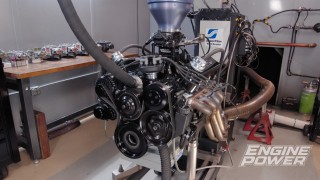
305 on the dyno and running.
We've been making some pulls on this thing, getting it tuned in. We have two engines of dyno, so we're gonna be a little bit abbreviated, trying to get both done.
We're gonna keep it as consistent as we can. So we are at 36 degrees of timing.
We are running it with an Edelbrock VR.
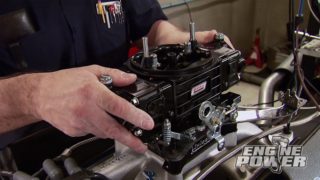
950 CFM because we're turning RPM. We want a big carb on there,
uh, we have 62 jets all the way around in this thing.
We're gonna be turning it from 4500 to 7200 at 300 a second. We're gonna do both engines
in that range and, uh,
hit both peaks.
Why 4500?
Because
solid roller life is why that's what I'm talking about. You'll see you in a second. All right,
here we go. Ready.
Silky.
Don't forget
that's a 305 in there that has a stock cast crank. It has stock rods,
stock bolts.
I'm going to put my glass off of this because it made
460.6 horsepower
and it made 378.8
pound feet of torque.
Now again, people are like,
well,
what does it make down low?
The answer to that.
I don't actually care because we've had this level at this level,
now we're going to make some sacrifices when you do that, but everyone wants a high RPM screamer.
Here you go.
Yeah,
and I mean that is 1.48 horsepower per cubic inch on a, I would say a relatively small head.
This absolutely crushes
old school DZs into the and just into the earth.
Let's do one more. Let's back it up real quick.
Oh,
it's,
it,
it sounds so good.
459.7. I think that's pretty close.
380.2 pound feet of torque.
So it's trading back and forth. That's a, that's a perfect overlay.
Everyone's like 305s are junk. They're made out of weird metals.
No.
They're not junk.
Yes, they can make lots of power.
It is still an engine. We've tried to,
you know,
do upgrades where they make sense and where they're necessary to do what we're trying to do,
but,
but yeah, we,
we're not going crazy.
Now all we have to do is swap it out,
see if that blue oval
can make it happen.
All right, we have that bow tie over in the corner.
The Ford is now on the pump. So now
we're going to do the exact same thing. I think now we're going to, uh, do the same range, 4500 to 7200, 300 a second.
It basically takes the same amount of timing.
Yeah, we're at 36 degrees.
It's the exact same carburetor,
same jets and everything, so all of that has been the same so far,
uh, as far as the tune-up.
Here we go.
That's very similar,
very close, dude.
Yeah,
that's pretty close right there.
So 459.4.
0 my goodness, 372.4
for torque.
You know what we're gonna do?
We're gonna turn it higher because everything else looks the same.
Manifold restriction looks the same.
BSFC looks the same.
What do you think, 7500.
Yeah,
yeah, I think definitely 7500. I don't want to go too much farther because it still has a stock rod bolt in it.
We don't need to be turning into 8000 on a stock rod,
you know,
not,
that's probably not the greatest idea.
So,
all right,
hold on to something, 4500 to 7500 and like they say, we're gonna
take her upstairs.
I, I can hear those rod bulls talking to me right there. No parts came flying out.
Whoa, whoa,
look at that.
So 467.5 at right at 7400, and then it's,
it crests right over, right there.
It is turning. It is rolling over though,
and it made what, 375.3.
Yeah,
so it made, it made almost the same torque.
Wow,
alright, I'm gonna shut it down
and let's,
let's overlay that with our
Chevrolet.
OK,
so that
is the comparison between the two.
So
the Chevy,
I would say from
5200 to about 6800 or so, 6900.
Is putting a hurting on the Ford and then they trade places pretty decent, right?
The Chevy is trending off at 7200 where the Ford,
uh,
she's still boogeying at 70, 7500.
Basically the only difference between these two is bore and stroke, right?
And stroke is going to be the biggest one.
What it boils down to is piston speed,
right?
Your piston speed on 7200 on a 3480 stroke, which is our 305,
it's roughly.
4,177.
That's mean. That's, that's average feet per minute. With a 3-inch stroke,
you're not getting anywhere close to 4000 till you're cresting 8000,
you know.
So the Chevy has that piston speed down low
to
basically have a higher VE, a little bit lower.
When things are making lower horsepower numbers,
none of this really matters a whole bunch.
Our 305 is making
the same power as like a 5.3, right?
I think we would all love to have a, a street ripper that turns 7000 or 7500.
I think that'd be awesome to drive.
This is higher level
horsepower than seventies muscle cars by,
by,
by a decent margin. We're talking about the DZ 302. Even the Boss 302 in stock form.
I mean, these things are killers compared to those,
so
I don't think anybody could go wrong with either of them right now. It is a
great success.
Show Full Transcript
Yes,
we have them in stock.
Hey everyone,
today is gonna be a great day here at Engine Power.
It's the return of the small block showdown, and we have more RPM, more flow, and more power.
Hey there everyone, and welcome to another action-packed episode of Engine Power.
Today we are bringing back one of our favorites and seems to be one of yours,
our 302 versus 305 horsepower battle.
Now we've done a lot of cool things with these engines, but now we're going to take them to the next level.
Yeah, this series has lit up the Internet for good reason,
and today we're gonna take it to the next stage because we have a big set of upgrades for both engines.
We are going solid roller and we are going aluminum cylinder heads to try and up the power on both of these bullets.
This started out as a friendly competition between the most economical and popular small displacement small blocks.
Starting with a junkyard 1984305 Chevy and a 199302 Ford,
our first round of upgrades was a simple hydraulic roller cam swap matching valve springs and torque to intake manifolds.
All the other stock componentry was reused and they were dyno with the same BTech ignition systems and an 850 CFM carburetor.
Both engines produced 302 horsepower and 328 pound of torque.
In round two, we decided to swap the cylinder heads on each for the highest recommended cast iron production heads for both.
The Ford received a set of GT40Ps and the 305 got a set of 059 vortex.
They also received higher ratio aluminum rockers and.
Matching Holly single plane intakes.
All the other components were kept the same,
and the Ford pumped out 339 horsepower and 344 pound feet,
while the Chevy lagged behind with lower compression at 327 horsepower and 317 pound feet.
Last round, to even the odds, we decided to up the compression on both engines with a 30,000 overboard and a set of domed pistons.
With some carefully chosen head gaskets, we were able to get the engines within one one-hundred of each other on the static compression ratio at 10.91 to 1 for the Ford and 10.92 to 1 for the Chevy.
This upped the power and leveled the playing field with the Ford making 364 horsepower and 352 pound feet,
and the Chevy making 359 horsepower and 351 pound feet.
For today's solid roller conversions, we're going to be tearing the engines down to the short blocks and leaving the bottom ends untouched.
These are solid 360 horsepower components,
so we won't throw them away,
but we will put them on a shelf to possibly be used on builds in the future.
Once the intakes are off,
we can start removing the rocker arms in pairs at TDC compression stroke on each cylinder.
Now that those are out of the way,
we can break the head bolts loose and zip them out and pop off the cylinder heads.
We'll use a removal tool to pull the stock dampers, which won't be reused with our new high RPM application.
Before pulling the timing covers, we will drop the oil pans on both, and given the abuse we put these engines through,
the insides look very clean and have zero debris.
Yeah,
very nice.
With the timing covers out of the way,
we can gain access to our double roller timing sets and slide out these commendable hydraulic roller camshafts.
Up next,
our small blocks get bigger bump sticks,
better flowing cylinder heads,
and bulletproof valve train.
One of the most important parts of your engine build is the harmonic damper,
so in today's Summit Racing tech tip we're gonna talk all about them.
A harmonic damper's job in an engine
is to help reduce and minimize harmful vibrations and harmonics that happen inside your engine while it's running,
and there's a couple different types. The first type is elastomer. The way they work is there is an internal hub,
and then there's an outer ring,
and the outer ring is suspended on basically a rubber band. This is a solid piece of rubber,
and this helps absorb the vibrations in your engine.
There's also aftermarket styles of these that are SFIA approved.
These work on the same exact concept,
but they usually have some sort of mechanical locking device that prevents the ring from being able to come off so you can use them in racing safely.
The next style is also an elastomer style, but it uses a different kind of elastomer.
These are commonly referred to as band or O-ring style elastomers. They're not bonded like the other ones.
They use effectively O-rings inside of the damper.
These get pressed together, but they do have bolts that go through them as.
Well,
so if you're going racing, they're SFI approved.
The last style is completely different from the rest.
It is a viscous fluid style damper, and the way this works is inside the ring,
it is a sealed chamber that's filled with a viscous fluid,
and then there is an inertia ring inside of that.
That inertia ring moves inside the fluid and actually helps take up those harmonics.
So these are all the different styles, and if you need help picking out which one is right for your build, you could talk to the experts at Summit Racing Equipment.
Both engines are cleaned,
so we'll start reassembling them with our new components.
These bullets are getting matching solid roller camshafts from comp cams with durations at 50,000 lift of 248 degrees on the intake and 254 degrees on the exhaust with a 110 degree lobe separation angle.
The net lift at the valve for both engines is 600,000 on the intake and 606,000 on the exhaust.
The timing sets are reinstalled and the camshafts are dereed with the 305 set at 105.5 and the 302 set at 105.25.
Then both engines are sealed up in the front with the original timing covers before flipping them over to reinstall the oil pans.
Both engines are reusing the original oil pumps,
pickups, and pans,
but they will receive a new one-piece oil pan gasket to keep them leak-free.
OK,
because we are planning on turning these engines a lot more RPM and producing a lot more power, we are finally gonna ditch our stock dampers because these have a tendency to degrade over time.
So we're gonna ditch those and get a set of fluid damper viscous harmonic dampers for both engines.
These are great because they use a viscous fluid with an inertia ring so they can't come apart and they don't degrade over time. The best part is that if the fluid is inside of the damper, it is. Still working just like it's brand new.
We have a small block Chevy one which is an internal balance.
These also are great because they have incremented balancer marks on them. So if you don't have a dial back timing light, you can set your timing accurately, and we have an external balance one for our Ford.
These are gonna be great because they're SFI approved.
They're gonna work for what we're doing, and they're gonna be primed for future upgrades if we want to go even further.
So we're gonna get these on
and keep moving.
Fluid ampers' machine work is very precise, so both units have the proper press fit and don't need any additional work.
On the short deck Ford, these comp EndureX solid roller lifters will have to go in before the cylinder heads, and the Chevy receives a matching set.
It's time now to bolt on some induction. We have a new set over there and a dyno proven one that's going to go on our Chevrolet.
These are a trick flow Super 23 175.
They have a 175 cc intake port,
a 56 cc combustion.
Chamber housing 1940 and 1500 swirl polish stainless valves, and the great thing about these heads is they specialize in small bore small blocks. So these are going to be great for our application.
Now for the Ford, we tried to get them as similar as possible, just like the entire theme of this build. So what we have is a set of Edelbrock performer heads for a small block Ford.
It is as close as we get them,
but they do vary a little bit. We have a
60 cc combustion chamber.
They have a 1900 intake valve,
a 1600 exhaust valve,
and they are set up for a solid roller, and both heads are using the same spring pack. So this is a pack
1422 spring. This is a single wound conical spring that's set up at 1810 with about 195 pounds of seat
and 545 pounds of open
at our lift.
So we're gonna get these on as well.
With a 27,000 stick head gasket on the Ford and a 36,000 stick head gasket on the Chevy,
we will have very close compression ratios at 10.99 to 1 for the bow tie and 11 to 1 for the blue oval.
We picked these heads because they are the most comparable options based off port volume,
valve size,
and most importantly,
flow with 245 CFM at 600,000 inch of lift.
This way,
one engine doesn't have the upper hand on the other,
and this is as fair as we can make it.
Both are held down with an ARP bolt kit that has torque to 70 pound feet.
New intake gaskets and beads of RT TV make way for matching Edelbrock Victor Junior intake manifolds.
Both engines will be utilizing 716 rocker studs and 5/16 guide plates that have to be properly aligned before they are torqued to 50 pound feet.
New 5/16 pushrods are required for proper length, with the Ford needing a 7100 long unit and the Chevy using 8 inch pieces.
After high pressure grease is applied,
these matching 1.6 to 1 ratio comp Ultra Pro Magnum rocker arms are installed with zero preload at TDC compression in pairs.
With them all in place, we'll go back through and set cold lash at 10,000 for both engines.
Once the valve train is fully lubricated,
the top end is sealed up, and the rest of the components are reinstalled and ready for some torture testing in the dyno room.
Still to come,
we check out the gearhead heaven in Detroit at the cleanest,
most technologically advanced and best equipped facility we've been to,
Sima Garage.
And engine power, you know we love technical data and accurate testing.
So today we are checking out a center of technology,
the Sema Garage here in Detroit.
This is an amazing facility, and we are lucky enough to check it out.
Yes, we're taking you behind the scenes to show you the tools and techniques and machinery it takes for aftermarket companies to design and build things for us gearheads.
This is a 45,000 square foot facility with 5 bays,
installation,
chassis dyno,
emissions dyno,
and two ADOS calibration centers.
It's an exclusive benefit for CEMA members.
So the CEMA garage started about 10 years ago actually in Diamond Bar.
California was our first facility. It was basically started to help our SEMA members develop products, so really
we're an automotive product development center, and many of our members were struggling to try to accelerate product development and and the quality of product development,
and we wanted to step in and fill that gap for them and help fill that void.
That evolved into about 8 years ago into the CMA Garage emissions lab and compliance program which started about 8 years ago in California.
So here in Detroit where we are today,
it's actually started about 3 years ago.
One of the biggest perks for members is full use of the state of the art installation and aftermarket product testing area.
It's stocked with general shop equipment and brand new specialized machines like a four-wheel alignment rack,
high resolution 3D scanners,
and multiple 3D printers.
The chassis dyno is an in-ground all-wheel drive unit from Superflow.
This is used not only to verify horsepower gains from new products,
but also can act as a road simulator with a variable speed fan.
This allows members to make sure that the vehicle's emissions.
Systems are functioning before moving on to
the emissions dyno.
This is a multi-million dollar laboratory with a complete testing setup from AVL.
This can fast track certification for manufacturers' new parts at federal and state levels.
The vehicles are tested before and after modifications following strict testing protocols.
The samples are taken from multiple points in the test,
then analyzed on numerous levels,
even weighing the particulate matter collected in the exhaust.
Se MGarage also completes testing for aftermarket companies like Summit Racing Equipment and their 1987 Monte Carlo SS.
They ripped out the original powertrain and installed a modern 450 horsepower, 5.3 L LS to drastically increase horsepower and reduce emissions.
Now we're here at the Cima Garage and we've been working with them hand in hand through this entire project
to test this car and really make it something spectacular.
Not only do you have the amazing styling of a 1980s automobile,
but it has a modern drivetrain that not only is more fuel efficient,
cleaner,
makes more power,
but really that's the basis is that it's. It's clean. Like it's, it's not,
you know,
your dirty old 1970s hot rod.
Um,
you gave this car a second chance, and you can daily drive it if you'd like.
So one of the things that we really see coming in the aftermarket
is kind of the next hill to climb after emissions is, is ADOS. ADOS is an
advanced driver assistance systems, so it's an acronym. We love them in engineering.
ADOS is really about like it's surround view cameras, it's lane keep assist, it's automatic emergency braking, so all those things are under the ADOS umbrella.
As more manufacturers adopt these systems,
the need will grow for technicians who can both recalibrate and repair this sensitive tech,
not only for OE replacement,
but also for any modification that alters the vehicle's stance like suspension kits,
bumpers,
and tires.
We're always looking forward.
ADOS is a good example of that. A lot of the FMVSS regulations from NHTSA haven't even been written yet,
and we're out trying to get in front of it.
And we learned a lot from the emissions program where,
honestly we're on the back foot with that a lot.
The program that we developed for emissions came out a lot after a lot of the emissions regulations were already cast.
Die was already cast.
ADOS, we're really trying to get ahead of that.
We're really trying to help shape that.
We both came away from our time at the Sea Garage impressed by the investment and dedication put in by CA for the aftermarket industry.
This is the industry that we all love, and the Sea garage is a key part of keeping it moving forward for future generations.
Coming after this,
you won an RPM and you've got it.
We'll see how these small blocks stack up as we push their stock components to the limit in the dyno.
OK,
305 on the dyno and running.
We've been making some pulls on this thing, getting it tuned in. We have two engines of dyno, so we're gonna be a little bit abbreviated, trying to get both done.
We're gonna keep it as consistent as we can. So we are at 36 degrees of timing.
We are running it with an Edelbrock VR.
950 CFM because we're turning RPM. We want a big carb on there,
uh, we have 62 jets all the way around in this thing.
We're gonna be turning it from 4500 to 7200 at 300 a second. We're gonna do both engines
in that range and, uh,
hit both peaks.
Why 4500?
Because
solid roller life is why that's what I'm talking about. You'll see you in a second. All right,
here we go. Ready.
Silky.
Don't forget
that's a 305 in there that has a stock cast crank. It has stock rods,
stock bolts.
I'm going to put my glass off of this because it made
460.6 horsepower
and it made 378.8
pound feet of torque.
Now again, people are like,
well,
what does it make down low?
The answer to that.
I don't actually care because we've had this level at this level,
now we're going to make some sacrifices when you do that, but everyone wants a high RPM screamer.
Here you go.
Yeah,
and I mean that is 1.48 horsepower per cubic inch on a, I would say a relatively small head.
This absolutely crushes
old school DZs into the and just into the earth.
Let's do one more. Let's back it up real quick.
Oh,
it's,
it,
it sounds so good.
459.7. I think that's pretty close.
380.2 pound feet of torque.
So it's trading back and forth. That's a, that's a perfect overlay.
Everyone's like 305s are junk. They're made out of weird metals.
No.
They're not junk.
Yes, they can make lots of power.
It is still an engine. We've tried to,
you know,
do upgrades where they make sense and where they're necessary to do what we're trying to do,
but,
but yeah, we,
we're not going crazy.
Now all we have to do is swap it out,
see if that blue oval
can make it happen.
All right, we have that bow tie over in the corner.
The Ford is now on the pump. So now
we're going to do the exact same thing. I think now we're going to, uh, do the same range, 4500 to 7200, 300 a second.
It basically takes the same amount of timing.
Yeah, we're at 36 degrees.
It's the exact same carburetor,
same jets and everything, so all of that has been the same so far,
uh, as far as the tune-up.
Here we go.
That's very similar,
very close, dude.
Yeah,
that's pretty close right there.
So 459.4.
0 my goodness, 372.4
for torque.
You know what we're gonna do?
We're gonna turn it higher because everything else looks the same.
Manifold restriction looks the same.
BSFC looks the same.
What do you think, 7500.
Yeah,
yeah, I think definitely 7500. I don't want to go too much farther because it still has a stock rod bolt in it.
We don't need to be turning into 8000 on a stock rod,
you know,
not,
that's probably not the greatest idea.
So,
all right,
hold on to something, 4500 to 7500 and like they say, we're gonna
take her upstairs.
I, I can hear those rod bulls talking to me right there. No parts came flying out.
Whoa, whoa,
look at that.
So 467.5 at right at 7400, and then it's,
it crests right over, right there.
It is turning. It is rolling over though,
and it made what, 375.3.
Yeah,
so it made, it made almost the same torque.
Wow,
alright, I'm gonna shut it down
and let's,
let's overlay that with our
Chevrolet.
OK,
so that
is the comparison between the two.
So
the Chevy,
I would say from
5200 to about 6800 or so, 6900.
Is putting a hurting on the Ford and then they trade places pretty decent, right?
The Chevy is trending off at 7200 where the Ford,
uh,
she's still boogeying at 70, 7500.
Basically the only difference between these two is bore and stroke, right?
And stroke is going to be the biggest one.
What it boils down to is piston speed,
right?
Your piston speed on 7200 on a 3480 stroke, which is our 305,
it's roughly.
4,177.
That's mean. That's, that's average feet per minute. With a 3-inch stroke,
you're not getting anywhere close to 4000 till you're cresting 8000,
you know.
So the Chevy has that piston speed down low
to
basically have a higher VE, a little bit lower.
When things are making lower horsepower numbers,
none of this really matters a whole bunch.
Our 305 is making
the same power as like a 5.3, right?
I think we would all love to have a, a street ripper that turns 7000 or 7500.
I think that'd be awesome to drive.
This is higher level
horsepower than seventies muscle cars by,
by,
by a decent margin. We're talking about the DZ 302. Even the Boss 302 in stock form.
I mean, these things are killers compared to those,
so
I don't think anybody could go wrong with either of them right now. It is a
great success.
Engine Power Featured Projects
Engine Power Builds

Want more content like this?
Join the PowerNation Email NewsletterParts Used In This Episode


Summit Racing
Trick Flow Super 23 175 Cylinder Heads for Small Block Chevrolet
Edelbrock
Endure-X Solid Roller Lifter Set for Chevrolet Small Block
Edelbrock
Endure-X Solid Roller Lifter Set for Ford
Edelbrock
Performer Small Block Ford Cylinder Head Hydraulic Flat Tappet
Edelbrock
Ultra Pro Magnum Roller Rocker Arms for Chevy
Edelbrock
Victor Jr. 23 Degree Intake Manifold Small Block Chevy
Edelbrock
Victor Jr. 302 Intake Manifold Small Block Ford
Edelbrock
Xtreme Energy 248/254 Solid Roller Cam for Chevrolet Small Block
Edelbrock
Xtreme Energy 248/254 Solid Roller Cam for Ford