Video Transcript
You're watching Power Nation.
Today on Engine Power,
we take our 318 Mopark to the next level in the search for more power and more
RPM.
Hey everybody, welcome back to Engine Power.
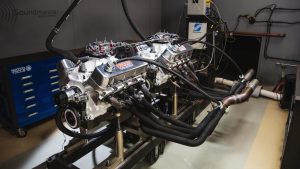
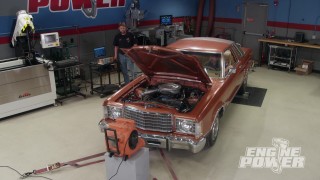
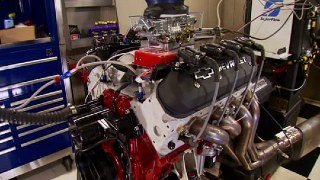
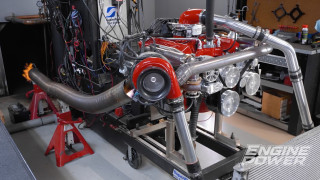
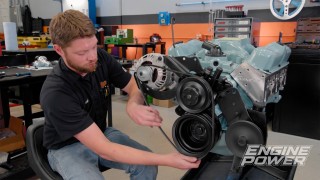
Obviously, we have our 318 LA on the dyno,
and that's because we have some big upgrades planned for this thing today.
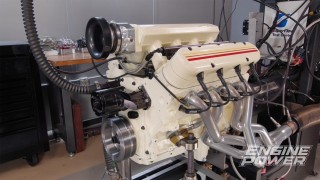
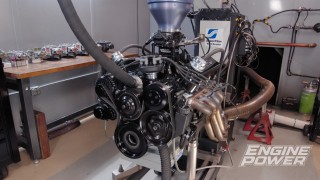
We are going solid roller and we are going single plane,
so we're gonna up the RPM, squeeze a little bit more power out of our 318, and that means we're gonna start on the dyno and finish on the dyno today.
All right,
so
where we are in our current configuration,
our 323 inch 318 is a 30 over. It's got a forge piston in it. It is 11.4 to 1.
This thing has a 220s at 50 hydraulic roller cam in it,
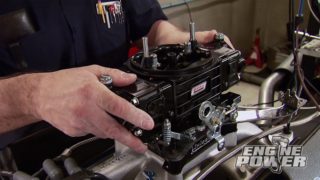
950 carburetor with a spacer,
dual plane intake.
It is making right now over 450 horsepower and over 410 pounds of torque.
That's where we left off.
Now, what we're going to do is make a baseline pull before we do any changes.
Different day,
different conditions.
Just going to get a good baseline before we start
adding new parts. OK,
sounding good,
looking good. Here we go.
Go for it.
That's gonna be pretty close.
I mean,
we have different gas and we have different,
completely different days. So we got
451.5 and 407.8.
So I mean, yeah, like
last time we did this thing, it was like 100 degrees. Now it's completely different humidity, temperature.
I think for what we're doing for a baseline, that's gonna be perfect. Now we have somewhere to start. We can make our changes,
see what we get.
I like it, yeah.
This engine is a great combination and runs spectacular,
but the idea of this 318 series was to show different variations depending on your intentions.
This one is great for the street,
but the next upgrade is geared for a more spirited performance.
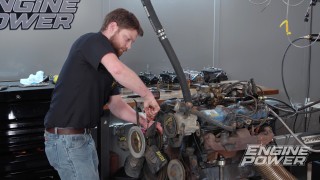
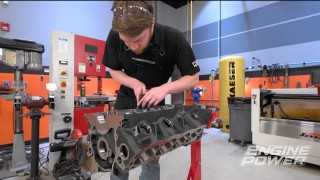
You've already seen this engine come apart and go together a couple of different times, so we're going to spare you that time.
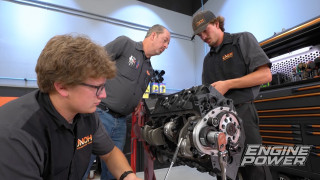
What we are going to do is get it down to where we can start putting in our new parts.
A couple of things we're going to have to do.
We might have to drop the pan off completely or just tip it down in the front to get that front timing cover off. Either way,
no big deal.
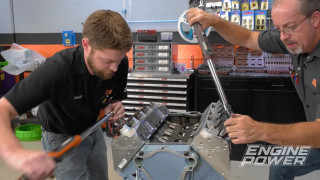
Another thing, we're going to have to actually pull the cylinder heads off the engine,
not only to set up for our new solid roller springs,
but we can't get the hydraulic roller lifters out without pulling the heads.
So we're going to go ahead and get that done and go from there.
Wow, that was fast.
Yeah,
got it all apart,
so
everything looks good.
I mean, this thing was running really good, so now we just have to make it better.
Yeah,
now we can get our cam in there, get it degreed,
get our new lifters in, make sure everything is cool, and basically just get it cleaned up and sew back together and, uh, rock and roll,
yeah.
We'll spend a little bit of time scraping off silicone and gasket material,
being very careful to not drop it inside the engine.
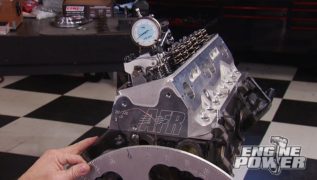
The first upgrade to go in is our new solid roller camshaft.
It is an off the shelf comp cam with durations at 50,000 lift of 242 degrees on the intake and 248 degrees on the exhaust.
The net lift of the valve with our 1.6 ratio rockers is 594,000 on the intake and 600,000 on the exhaust
with a lobe separation angle of 110 degrees.
The thrust plate and billet timing set get reinstalled.
And the camshaft is degreed in at 108 degrees of intake center line, which is 2 degrees advanced.
We're putting in our brand new solid rollers. Now these have a body on that has no oil band on them,
so they're going to go right in and basically act like a bush lifter.
You might have actually noticed as well these ground marks in the block.
Why grind them? Why not just take the link bar and put it towards. The insides this link bar is designed to work on both these and the magnum blocks.
The angle of the push rod is so extreme that no matter what push rod you would use,
the push rod would actually hit the top part of the lifter body, so we can't use it. They are specifically designed to go in this way.
Up next,
our induction system goes back on as we prep this engine to go past 7000 RPM.
All right, we're getting our
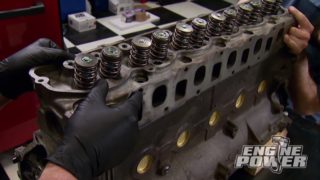
heads swapped over here with our spring pack because we're switching from a hydraulic roller to a solid roller. We need to change the springs on our 190 heads. We gotta get the old ones off. First we need to.
Compress our spring
and the big thing here is we don't want to lose those two valve locks because those once the pressure's off,
they're gonna come right out so what we found.
Because the best way to do this is actually using
a magnetic finger. It says a magnet right on the end there.
You can grab both of them. It'll hold on to both, and then you can put them on a table or something like that.
But if you're doing a spring swap in your car,
you do not
wanna be dropping
valve locks down inside the engine into the oil pan or into the valley or something like that. So
it's gonna grab both
and
come right off and then. Then
you can use your thumb and your middle finger to take them off,
set them on the table somewhere safe,
and then
you can even do the same thing with the retainer and the spring as well.
So
this is not only obviously just for valve spring stuff, but these are actually really handy for anything on an engine,
anywhere where you really do not wanna be
dropping things or losing things like valve cover,
washers and nuts,
carburetor nuts and washers,
anything like that.
So they have a couple different kinds as well. This is the original,
but they also have a stronger one called the heavyweight. So if you're doing something with large bolts or something like that or need a little bit more grabbing power, and then they have
a front one as well, the frontal assault, which has a magnet on the fingertip if you're trying to get inside the head or inside.
Anything really trying to come at it at an angle
so these are not only, you know, useful for engine stuff, but if you're working under the dash of your car or you're working somewhere in a tight space,
these things in our shop
by far have saved us the most time doing valve springs so
we can get these things off of here.
And get the rest of these off,
get them swapped out.
Our new valve springs are increasing in both seat and open pressure for our updated cams.
At our 1950 installed height, the springs have around 260 pounds of seat pressure,
and at our valve lift, they have around 545 pounds of open pressure.
We also switched to a titanium retainer and installed new 10 degree keepers.
After that, we put new silicone on our oil pan gasket and timing cover surface along with a new Velpro gasket.
Then the timing cover can be snaked on and a couple of bolts are loosely installed to hold it in place.
A brand new fluid damper gets installed with the correct installation tool.
It goes on smoothly and that will align the cover so the rest of the bolts can be cinched down for good.
A 27,000 MLS head gasket goes onto the decks surfaces, followed by our freshly re-sprung trick flow 190 cylinder heads.
The ARP head bolts require sealant because the majority of the head bolts go into the water jackets.
The bolts are gently ran down with an electric impact and then torqued in three steps to a final value of £100 feet.
So
because we have new lifters for our solid roller cam, they have a different seat height, and we need a new push rod.
So Manton made the last set for a hydraulic roller version, and we called him for this set as well.
So these are from their Series 5, which is their top of the line.
We went to a 3/8 body. It is 4135 in the center section, and they do. This in a three piece design so they can heat treat that center section
pass what you could do with a one piece, and then they press in the tips for your application,
whatever you need. So we have a 5/16 ball on the bottom and a 5/16 cup on the top,
and these are 7 430 long effective length for our application with no oil hole.
High pressure lube is applied to both ends to eliminate dry startup.
Our Harlan Sharp rocker setup is reused and carefully reinstalled.
A little bit different doing something with 260 seat versus 140 something seat.
Yeah,
almost twice as much.
Because of the increased spring pressure.
Extra care is given to get it tightened down evenly before it is torqued to 30 pound feet.
Cold lash is set at 10,000 on both the intake and exhaust and will be reset hot in the dyno room to 16,000.
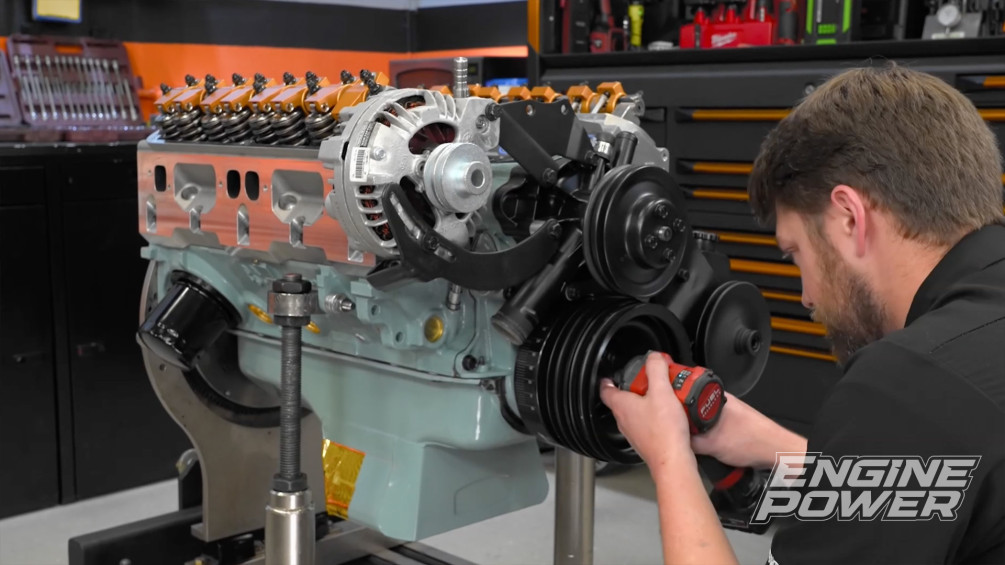
The rest of the front drive assembly goes on easily because it's all been scienced out before.
After some crisp silicone application,
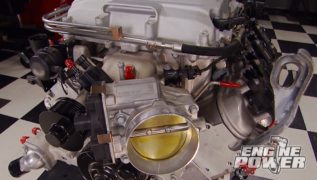
the new Victor 340 single plane intake manifold nestles in place.
New matching ARP fasteners lock it down.
It is sized comparatively to the ones that we put on our 302 and 305 projects, plus it will change the engine's operating range and characteristics.
The reworked vintage 1983 stock valve covers seal up the valve train,
and then it goes into the Truth cave to get hooked up to our Superflow Power Mark dyno,
to see if we improved the performance.
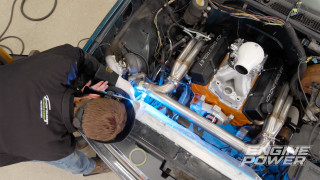
So what we're actually doing right now is we're going to be building a new base for our engine stand, and we got some 2x 4 steel tubing, 3/16 wall.
To weld this together, what we're gonna be using is our 40 190 ACDC MP.
So this is a multi-process machine.
And
honestly, it's the best all-around welder. If you're gonna have one in the garage that you're gonna use for almost everything, it's gonna be this.
We're gonna be using it on 120.
So a 120 you can do up to quarter-inch material on two.
40, it can do up to 3/8 material,
but we've been doing everything with 120 just like you'd have in the garage.
So as you go through the settings here,
it not only has, you know, all your
adjustability for your tig functions, but when we get to midi,
you can set it manually if you want, if you know what your settings are or you're used to that.
But also,
when you're welding multiple materials or you're just starting out with welding,
you can use the true set functions. And then, so we can go through
and tell it what type of gas we're using. So we got 75, 25.
And then
you can actually just set it to the material that you're using. So we've got 3/16 thickness on our stuff,
and it has a gain function as well.
So say you start on zero,
you decide you need a little bit more, you can actually
turn it up or turn it down.
If you're jumping between materials
or you just want to be able to set it and get right to welding, this is a great way to do that.
Really impressed with the 40 190 here because for a 120 machine this thing was kicking butt on this thicker material. I mean we're basically running it nonstop here and it didn't skip a beat, so
gonna be excited to use it for some AC tig and some DC tig stuff in the future as well, but that's everything fully welded on this thing. It's probably the most rigid engine stand we have now.
We'll get some paint on it and it'll be done.
Coming after this,
we head to one of the hardest diesel competitions in the country to see some of the world's fastest trucks pushed to the limit.
If you want to be out here and stand out,
you have to be ahead of everybody else.
Hey
In one of the rare instances, Frankie and I get out of the shop, we are up here in Indianapolis,
Indiana
at IRP Indianapolis Raceway Park at a drag strip for something very special. Yeah, we are here for one of the biggest diesel events in the country,
the ultimate callout challenge, and there's also Outlaw Diesel Super Series drag racing happening,
including a new class 72 fast, and we're gonna be checking out here all weekend, and we're just happy to be here.
Yeah, we got a lot of stuff to check out. We're burning daylight,
so
let's get to it.
I think I'm gonna like it.
Yeah.
Diesel performance has got to an insane level now and
if you would have asked me if our brand would be where it's at today 5 years ago, I wouldn't even have known that we've thrown this much.
With an event like this, you have 2 runs. You have to be tested
and you have to be ready to be on kill.
Justin Ziegler
from Louisville, Ohio,
uh, own Ziegler Diesel Performance out of Canton.
So the current setup,
obviously Waggler Bullet Cummins engine.
this is what they call their CX 400.
All XG injectors, extrag pumps, their Bosch system,
everything we run a stainless diesel GT 5598 mil on the manifold turbo smart e-gates.
That combination
we've proven over 3200 horsepower to the track with that setup,
you know.
So we use hotshot Secrets oil and every single component in this vehicle has their oils.
There is no better protection than that.
Been with them for years, they've taken great care of us.
Nothing touches their products,
anything on the market,
we've tried it all.
So we work a little bit differently when we sponsor. It's not just to get our name out there, and that's great, you know, have your name on top of stuff, but it's really the interaction with the drivers and the race teams and
really putting our products to the test so that we know that the stuff we put on the shelf to the everyday driver
is solid.
Hey man.
So chassis dyno modes kind of simple. We swap out rear tires,
run a drag radio on the rear,
put some bump stops in. We actually hang some weights on the rear,
about 1000 pounds,
just pushing down on the axle,
and then swap out our turbo setup.
So we'll have a big compound set up on this thing for tomorrow.
It's got an 88 mil GT 55 from stainless diesel and then a Weimer 5.3 inch out front.
The dyno is a rush every time.
Just all the emotions,
everything leading up to it, you know,
you're on the super flow,
so you're 8 ft up and you can't see anything, you're looking around and there's just
a whole lot of stress
when you finally make a whack at it, it's a completely different feeling.
I'm, uh, Michael Brown.
I'm from Dixon, Tennessee. I'm with Postal Performance.
Postal Performance is my kind of home shop.
Me and some buddies, uh,
I work for the post office is my day job.
This is our 2006 Dodge 2500 truck. We're out here at UCC competing and
trying to have a good time.
I've had really good luck out of it.
It's, uh,
still a deck plate. It is a filled head,
a dry block, so the sleeves are serviceable where we can change them in and out at the track if needed to be.
It is a stock Cummins crank.
Stock Cummins rockers.
Pretty much everything else though is aftermarket big valve head.
It's got a tater built.
Uh, it's a 115 currently in a 484 on the manifold.
Uh, it's a G50 or G57 and then S400 base,
uh,
run dual 45 millimeter waist gates.
Uh, we got XG 14 millimeter dual pumps,
flux
450% injectors
out of Charlotte, Tennessee.
Mike Brown.
We went a 5:31 earlier at 136,
you know, of course it is a points race
hopefully turning power a little better. We swapped a set of tires on last night.
We couldn't do it without everybody, uh,
you know, my wife's here,
dogs,
you know, it's great having everybody here and get to hang out.
I see these guys out here at the races.
I cruise the pits.
We find problems,
and then it goes into R&D and development. And then once they've come up with a solution,
this is where we test that solution
and get them back on the track and running well. And then if we can protect these 3,
4000 horsepower machines, then
it's good, good testing ground to get the rest of our R&D together.
We got involved with Hot Shots in 2022.
We run their fluids front to rear on it. We've never had any type of bearing failure,
whether engine,
you know, gearing,
transmission.
Everything's been great.
They're out here every event supporting racers,
you know, they're making sure we have everything we need to be successful, and it's, you know,
couldn't do without them.
We just found out that, uh, we are one of USA Today's
2026 most trusted brands in America and
we've built up
a consumer base that trusts us so much that we take it very seriously and we won't put out a product until
we know it's the best on the market.
Work with the right people,
not just my teammates, but our sponsors.
If you wanna be out here and stand out you have to be ahead of everybody else.
You have to have the best.
We've
done our homework. How it shakes out it's gonna be how it shakes out, but
we're sure it's all gonna give him a fight.
Still to come,
will our 318 hang tough on the dyno,
or will we push it past its limits
again?
Yeah,
look at that.
All right,
so we're about 30 pulls in right now getting this thing tuned up, running very, very well. We've been making some much higher RVM pulls here,
um,
but as it should, yeah, as it should. I mean, we switched to a solid roller single plane, right?
So, but as far as tune up, we are at
34 degrees of timing right now.
So,
OK,
yep,
and, uh, I know we,
we put
some air bleed in it and we have 2 1-inch spacers under our 950 car.
What we're gonna do is we're gonna make one pool at the same RPM range as before.
Now this is not really.
Designed to do that anymore. Well,
here's the deal. When you switch things over from a hydraulic roller dual plane to a solid roller single plane,
there's going to be some changes in RPM range,
sacrificing a little bit of torque and power down low to carry it higher up top.
Everything in engine building is kind of compromised to get other things, right? So we'll make a pull from 33,500 to 6600 just like last time,
and then we'll step up the RPM and see what it really does.
That's what we're here to do.
Yeah.
Ready?
Oh, I'm ready.
Here we go.
395.6 I see for torque at 5400.
Yeah,
see that raised that up a few 100 RPM, yep,
and then 6600, 471.7, obviously just
like an arrow going up there we're gonna have to turn this thing a lot higher, but so that's our two runs there. So we've got, you know, our old one was 407 and 451,
but right about was that 6000
just right there 5900. That that's where they cross over and at 6600, this thing is,
it's about 21, you know, 22 horse,
right? Yeah, 22 horse there.
So by no means is this thing going to be lazy on the street.
Give her a blast here at
4500 to 7200.
Yep,
same,
same as our 305. Pretty much we're at 170 degrees still. Let's
see what it does up top here.
Solid roll of life, man. Yeah.
Like it was made to do it,
you know.
Oh,
I love that. Oh,
see, that's a, that's a, that's a nice number right there.
OK,
so it made 396.3,
very similar on torque, and it made, what does that say, 475, 475.5.
It's actually carrying power really nicely.
OK,
so now
it's, it's the same thing. We're doing the same methodology as we did.
On the hydraulic roller dual plane version,
we are going to hero run this thing. That means we're going to cool it down and we have a nice hot oil temp and we have a very cool water temp,
and we're going to see what this thing cranks out.
We're at 118,
you know,
so let's let's make a pool right there and just let's just see what it does.
Still same oil temp and everything.
That
might have squeaked up that might have squeaked in 80.
Yeah,
look at that, yeah,
480.
Yeah,
I think it made 400 pound feet too.
Yeah, yeah,
so we're talking $399 and some change. It's making peak power, you know, right around 68, 6900,
6800 carries it all the way out,
so it drops basically one horsepower from 68 to 7200.
The big takeaway, I think, for anybody who's watching this is that,
you know, we built two completely different engines. We have a hydraulic roller.
Little Plane and then we switched to all row single plane and
one is not
better than the other. We're not saying you have to do this. We're not saying you have to do the hydraulic roller.
Uh, there's,
there's
really good elements of both of those, I would say.
Because of what we do here,
we're
afforded the luxury of trying a bunch of parts
and putting together a combination. So when people
want to do this at home,
they have different levels, different, uh,
you know, things that like, OK.
I want to make my power in this range, and here's the fuel I want to use.
That's what it's all about. We can provide data for that and maybe if we get some time in the future, we can, you know, swap it to a bigger manifold and just see what,
see what it changes.
Lots we could do in the future, but I, I'm really happy with what we got here. I mean this is,
I'm happy with it. We have shown two completely different engines that are both very,
very good,
and people can choose between what they want.
I think it's a win all the way around,
right,
great success.
Show Full Transcript
Today on Engine Power,
we take our 318 Mopark to the next level in the search for more power and more
RPM.
Hey everybody, welcome back to Engine Power.
Obviously, we have our 318 LA on the dyno,
and that's because we have some big upgrades planned for this thing today.
We are going solid roller and we are going single plane,
so we're gonna up the RPM, squeeze a little bit more power out of our 318, and that means we're gonna start on the dyno and finish on the dyno today.
All right,
so
where we are in our current configuration,
our 323 inch 318 is a 30 over. It's got a forge piston in it. It is 11.4 to 1.
This thing has a 220s at 50 hydraulic roller cam in it,
950 carburetor with a spacer,
dual plane intake.
It is making right now over 450 horsepower and over 410 pounds of torque.
That's where we left off.
Now, what we're going to do is make a baseline pull before we do any changes.
Different day,
different conditions.
Just going to get a good baseline before we start
adding new parts. OK,
sounding good,
looking good. Here we go.
Go for it.
That's gonna be pretty close.
I mean,
we have different gas and we have different,
completely different days. So we got
451.5 and 407.8.
So I mean, yeah, like
last time we did this thing, it was like 100 degrees. Now it's completely different humidity, temperature.
I think for what we're doing for a baseline, that's gonna be perfect. Now we have somewhere to start. We can make our changes,
see what we get.
I like it, yeah.
This engine is a great combination and runs spectacular,
but the idea of this 318 series was to show different variations depending on your intentions.
This one is great for the street,
but the next upgrade is geared for a more spirited performance.
You've already seen this engine come apart and go together a couple of different times, so we're going to spare you that time.
What we are going to do is get it down to where we can start putting in our new parts.
A couple of things we're going to have to do.
We might have to drop the pan off completely or just tip it down in the front to get that front timing cover off. Either way,
no big deal.
Another thing, we're going to have to actually pull the cylinder heads off the engine,
not only to set up for our new solid roller springs,
but we can't get the hydraulic roller lifters out without pulling the heads.
So we're going to go ahead and get that done and go from there.
Wow, that was fast.
Yeah,
got it all apart,
so
everything looks good.
I mean, this thing was running really good, so now we just have to make it better.
Yeah,
now we can get our cam in there, get it degreed,
get our new lifters in, make sure everything is cool, and basically just get it cleaned up and sew back together and, uh, rock and roll,
yeah.
We'll spend a little bit of time scraping off silicone and gasket material,
being very careful to not drop it inside the engine.
The first upgrade to go in is our new solid roller camshaft.
It is an off the shelf comp cam with durations at 50,000 lift of 242 degrees on the intake and 248 degrees on the exhaust.
The net lift of the valve with our 1.6 ratio rockers is 594,000 on the intake and 600,000 on the exhaust
with a lobe separation angle of 110 degrees.
The thrust plate and billet timing set get reinstalled.
And the camshaft is degreed in at 108 degrees of intake center line, which is 2 degrees advanced.
We're putting in our brand new solid rollers. Now these have a body on that has no oil band on them,
so they're going to go right in and basically act like a bush lifter.
You might have actually noticed as well these ground marks in the block.
Why grind them? Why not just take the link bar and put it towards. The insides this link bar is designed to work on both these and the magnum blocks.
The angle of the push rod is so extreme that no matter what push rod you would use,
the push rod would actually hit the top part of the lifter body, so we can't use it. They are specifically designed to go in this way.
Up next,
our induction system goes back on as we prep this engine to go past 7000 RPM.
All right, we're getting our
heads swapped over here with our spring pack because we're switching from a hydraulic roller to a solid roller. We need to change the springs on our 190 heads. We gotta get the old ones off. First we need to.
Compress our spring
and the big thing here is we don't want to lose those two valve locks because those once the pressure's off,
they're gonna come right out so what we found.
Because the best way to do this is actually using
a magnetic finger. It says a magnet right on the end there.
You can grab both of them. It'll hold on to both, and then you can put them on a table or something like that.
But if you're doing a spring swap in your car,
you do not
wanna be dropping
valve locks down inside the engine into the oil pan or into the valley or something like that. So
it's gonna grab both
and
come right off and then. Then
you can use your thumb and your middle finger to take them off,
set them on the table somewhere safe,
and then
you can even do the same thing with the retainer and the spring as well.
So
this is not only obviously just for valve spring stuff, but these are actually really handy for anything on an engine,
anywhere where you really do not wanna be
dropping things or losing things like valve cover,
washers and nuts,
carburetor nuts and washers,
anything like that.
So they have a couple different kinds as well. This is the original,
but they also have a stronger one called the heavyweight. So if you're doing something with large bolts or something like that or need a little bit more grabbing power, and then they have
a front one as well, the frontal assault, which has a magnet on the fingertip if you're trying to get inside the head or inside.
Anything really trying to come at it at an angle
so these are not only, you know, useful for engine stuff, but if you're working under the dash of your car or you're working somewhere in a tight space,
these things in our shop
by far have saved us the most time doing valve springs so
we can get these things off of here.
And get the rest of these off,
get them swapped out.
Our new valve springs are increasing in both seat and open pressure for our updated cams.
At our 1950 installed height, the springs have around 260 pounds of seat pressure,
and at our valve lift, they have around 545 pounds of open pressure.
We also switched to a titanium retainer and installed new 10 degree keepers.
After that, we put new silicone on our oil pan gasket and timing cover surface along with a new Velpro gasket.
Then the timing cover can be snaked on and a couple of bolts are loosely installed to hold it in place.
A brand new fluid damper gets installed with the correct installation tool.
It goes on smoothly and that will align the cover so the rest of the bolts can be cinched down for good.
A 27,000 MLS head gasket goes onto the decks surfaces, followed by our freshly re-sprung trick flow 190 cylinder heads.
The ARP head bolts require sealant because the majority of the head bolts go into the water jackets.
The bolts are gently ran down with an electric impact and then torqued in three steps to a final value of £100 feet.
So
because we have new lifters for our solid roller cam, they have a different seat height, and we need a new push rod.
So Manton made the last set for a hydraulic roller version, and we called him for this set as well.
So these are from their Series 5, which is their top of the line.
We went to a 3/8 body. It is 4135 in the center section, and they do. This in a three piece design so they can heat treat that center section
pass what you could do with a one piece, and then they press in the tips for your application,
whatever you need. So we have a 5/16 ball on the bottom and a 5/16 cup on the top,
and these are 7 430 long effective length for our application with no oil hole.
High pressure lube is applied to both ends to eliminate dry startup.
Our Harlan Sharp rocker setup is reused and carefully reinstalled.
A little bit different doing something with 260 seat versus 140 something seat.
Yeah,
almost twice as much.
Because of the increased spring pressure.
Extra care is given to get it tightened down evenly before it is torqued to 30 pound feet.
Cold lash is set at 10,000 on both the intake and exhaust and will be reset hot in the dyno room to 16,000.
The rest of the front drive assembly goes on easily because it's all been scienced out before.
After some crisp silicone application,
the new Victor 340 single plane intake manifold nestles in place.
New matching ARP fasteners lock it down.
It is sized comparatively to the ones that we put on our 302 and 305 projects, plus it will change the engine's operating range and characteristics.
The reworked vintage 1983 stock valve covers seal up the valve train,
and then it goes into the Truth cave to get hooked up to our Superflow Power Mark dyno,
to see if we improved the performance.
So what we're actually doing right now is we're going to be building a new base for our engine stand, and we got some 2x 4 steel tubing, 3/16 wall.
To weld this together, what we're gonna be using is our 40 190 ACDC MP.
So this is a multi-process machine.
And
honestly, it's the best all-around welder. If you're gonna have one in the garage that you're gonna use for almost everything, it's gonna be this.
We're gonna be using it on 120.
So a 120 you can do up to quarter-inch material on two.
40, it can do up to 3/8 material,
but we've been doing everything with 120 just like you'd have in the garage.
So as you go through the settings here,
it not only has, you know, all your
adjustability for your tig functions, but when we get to midi,
you can set it manually if you want, if you know what your settings are or you're used to that.
But also,
when you're welding multiple materials or you're just starting out with welding,
you can use the true set functions. And then, so we can go through
and tell it what type of gas we're using. So we got 75, 25.
And then
you can actually just set it to the material that you're using. So we've got 3/16 thickness on our stuff,
and it has a gain function as well.
So say you start on zero,
you decide you need a little bit more, you can actually
turn it up or turn it down.
If you're jumping between materials
or you just want to be able to set it and get right to welding, this is a great way to do that.
Really impressed with the 40 190 here because for a 120 machine this thing was kicking butt on this thicker material. I mean we're basically running it nonstop here and it didn't skip a beat, so
gonna be excited to use it for some AC tig and some DC tig stuff in the future as well, but that's everything fully welded on this thing. It's probably the most rigid engine stand we have now.
We'll get some paint on it and it'll be done.
Coming after this,
we head to one of the hardest diesel competitions in the country to see some of the world's fastest trucks pushed to the limit.
If you want to be out here and stand out,
you have to be ahead of everybody else.
Hey
In one of the rare instances, Frankie and I get out of the shop, we are up here in Indianapolis,
Indiana
at IRP Indianapolis Raceway Park at a drag strip for something very special. Yeah, we are here for one of the biggest diesel events in the country,
the ultimate callout challenge, and there's also Outlaw Diesel Super Series drag racing happening,
including a new class 72 fast, and we're gonna be checking out here all weekend, and we're just happy to be here.
Yeah, we got a lot of stuff to check out. We're burning daylight,
so
let's get to it.
I think I'm gonna like it.
Yeah.
Diesel performance has got to an insane level now and
if you would have asked me if our brand would be where it's at today 5 years ago, I wouldn't even have known that we've thrown this much.
With an event like this, you have 2 runs. You have to be tested
and you have to be ready to be on kill.
Justin Ziegler
from Louisville, Ohio,
uh, own Ziegler Diesel Performance out of Canton.
So the current setup,
obviously Waggler Bullet Cummins engine.
this is what they call their CX 400.
All XG injectors, extrag pumps, their Bosch system,
everything we run a stainless diesel GT 5598 mil on the manifold turbo smart e-gates.
That combination
we've proven over 3200 horsepower to the track with that setup,
you know.
So we use hotshot Secrets oil and every single component in this vehicle has their oils.
There is no better protection than that.
Been with them for years, they've taken great care of us.
Nothing touches their products,
anything on the market,
we've tried it all.
So we work a little bit differently when we sponsor. It's not just to get our name out there, and that's great, you know, have your name on top of stuff, but it's really the interaction with the drivers and the race teams and
really putting our products to the test so that we know that the stuff we put on the shelf to the everyday driver
is solid.
Hey man.
So chassis dyno modes kind of simple. We swap out rear tires,
run a drag radio on the rear,
put some bump stops in. We actually hang some weights on the rear,
about 1000 pounds,
just pushing down on the axle,
and then swap out our turbo setup.
So we'll have a big compound set up on this thing for tomorrow.
It's got an 88 mil GT 55 from stainless diesel and then a Weimer 5.3 inch out front.
The dyno is a rush every time.
Just all the emotions,
everything leading up to it, you know,
you're on the super flow,
so you're 8 ft up and you can't see anything, you're looking around and there's just
a whole lot of stress
when you finally make a whack at it, it's a completely different feeling.
I'm, uh, Michael Brown.
I'm from Dixon, Tennessee. I'm with Postal Performance.
Postal Performance is my kind of home shop.
Me and some buddies, uh,
I work for the post office is my day job.
This is our 2006 Dodge 2500 truck. We're out here at UCC competing and
trying to have a good time.
I've had really good luck out of it.
It's, uh,
still a deck plate. It is a filled head,
a dry block, so the sleeves are serviceable where we can change them in and out at the track if needed to be.
It is a stock Cummins crank.
Stock Cummins rockers.
Pretty much everything else though is aftermarket big valve head.
It's got a tater built.
Uh, it's a 115 currently in a 484 on the manifold.
Uh, it's a G50 or G57 and then S400 base,
uh,
run dual 45 millimeter waist gates.
Uh, we got XG 14 millimeter dual pumps,
flux
450% injectors
out of Charlotte, Tennessee.
Mike Brown.
We went a 5:31 earlier at 136,
you know, of course it is a points race
hopefully turning power a little better. We swapped a set of tires on last night.
We couldn't do it without everybody, uh,
you know, my wife's here,
dogs,
you know, it's great having everybody here and get to hang out.
I see these guys out here at the races.
I cruise the pits.
We find problems,
and then it goes into R&D and development. And then once they've come up with a solution,
this is where we test that solution
and get them back on the track and running well. And then if we can protect these 3,
4000 horsepower machines, then
it's good, good testing ground to get the rest of our R&D together.
We got involved with Hot Shots in 2022.
We run their fluids front to rear on it. We've never had any type of bearing failure,
whether engine,
you know, gearing,
transmission.
Everything's been great.
They're out here every event supporting racers,
you know, they're making sure we have everything we need to be successful, and it's, you know,
couldn't do without them.
We just found out that, uh, we are one of USA Today's
2026 most trusted brands in America and
we've built up
a consumer base that trusts us so much that we take it very seriously and we won't put out a product until
we know it's the best on the market.
Work with the right people,
not just my teammates, but our sponsors.
If you wanna be out here and stand out you have to be ahead of everybody else.
You have to have the best.
We've
done our homework. How it shakes out it's gonna be how it shakes out, but
we're sure it's all gonna give him a fight.
Still to come,
will our 318 hang tough on the dyno,
or will we push it past its limits
again?
Yeah,
look at that.
All right,
so we're about 30 pulls in right now getting this thing tuned up, running very, very well. We've been making some much higher RVM pulls here,
um,
but as it should, yeah, as it should. I mean, we switched to a solid roller single plane, right?
So, but as far as tune up, we are at
34 degrees of timing right now.
So,
OK,
yep,
and, uh, I know we,
we put
some air bleed in it and we have 2 1-inch spacers under our 950 car.
What we're gonna do is we're gonna make one pool at the same RPM range as before.
Now this is not really.
Designed to do that anymore. Well,
here's the deal. When you switch things over from a hydraulic roller dual plane to a solid roller single plane,
there's going to be some changes in RPM range,
sacrificing a little bit of torque and power down low to carry it higher up top.
Everything in engine building is kind of compromised to get other things, right? So we'll make a pull from 33,500 to 6600 just like last time,
and then we'll step up the RPM and see what it really does.
That's what we're here to do.
Yeah.
Ready?
Oh, I'm ready.
Here we go.
395.6 I see for torque at 5400.
Yeah,
see that raised that up a few 100 RPM, yep,
and then 6600, 471.7, obviously just
like an arrow going up there we're gonna have to turn this thing a lot higher, but so that's our two runs there. So we've got, you know, our old one was 407 and 451,
but right about was that 6000
just right there 5900. That that's where they cross over and at 6600, this thing is,
it's about 21, you know, 22 horse,
right? Yeah, 22 horse there.
So by no means is this thing going to be lazy on the street.
Give her a blast here at
4500 to 7200.
Yep,
same,
same as our 305. Pretty much we're at 170 degrees still. Let's
see what it does up top here.
Solid roll of life, man. Yeah.
Like it was made to do it,
you know.
Oh,
I love that. Oh,
see, that's a, that's a, that's a nice number right there.
OK,
so it made 396.3,
very similar on torque, and it made, what does that say, 475, 475.5.
It's actually carrying power really nicely.
OK,
so now
it's, it's the same thing. We're doing the same methodology as we did.
On the hydraulic roller dual plane version,
we are going to hero run this thing. That means we're going to cool it down and we have a nice hot oil temp and we have a very cool water temp,
and we're going to see what this thing cranks out.
We're at 118,
you know,
so let's let's make a pool right there and just let's just see what it does.
Still same oil temp and everything.
That
might have squeaked up that might have squeaked in 80.
Yeah,
look at that, yeah,
480.
Yeah,
I think it made 400 pound feet too.
Yeah, yeah,
so we're talking $399 and some change. It's making peak power, you know, right around 68, 6900,
6800 carries it all the way out,
so it drops basically one horsepower from 68 to 7200.
The big takeaway, I think, for anybody who's watching this is that,
you know, we built two completely different engines. We have a hydraulic roller.
Little Plane and then we switched to all row single plane and
one is not
better than the other. We're not saying you have to do this. We're not saying you have to do the hydraulic roller.
Uh, there's,
there's
really good elements of both of those, I would say.
Because of what we do here,
we're
afforded the luxury of trying a bunch of parts
and putting together a combination. So when people
want to do this at home,
they have different levels, different, uh,
you know, things that like, OK.
I want to make my power in this range, and here's the fuel I want to use.
That's what it's all about. We can provide data for that and maybe if we get some time in the future, we can, you know, swap it to a bigger manifold and just see what,
see what it changes.
Lots we could do in the future, but I, I'm really happy with what we got here. I mean this is,
I'm happy with it. We have shown two completely different engines that are both very,
very good,
and people can choose between what they want.
I think it's a win all the way around,
right,
great success.