Video Transcript
[Pat] You're watching Powernation!
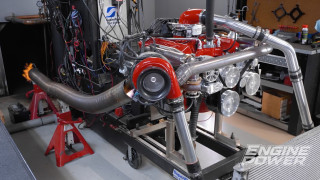
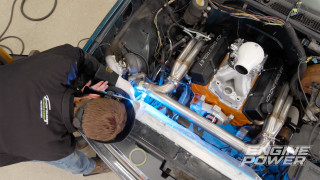
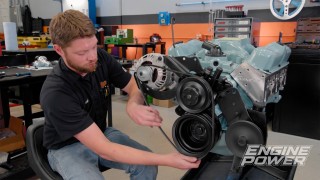
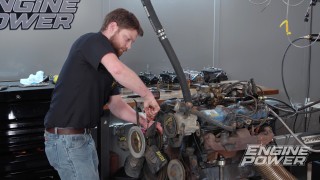
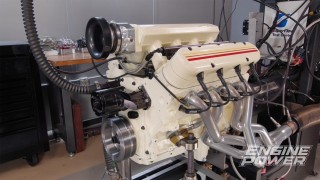
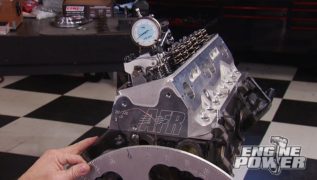
[Frankie] Today on Engine Power it is round three of the shootout between our 302 small block Ford and our 305 small block Chevy. Now everything is gonna stay the same for round two except for one major change. [Pat] And that is compression. Last time there was a discrepancy between the two and you guys went bananas. So we got them back to a level playing field to see how it affects both engines. [Frankie] It's gonna be big. [ Music ] Hey everyone, welcome to another extremely fun day here in Engine Power because this is round three of our 302 versus 305 shootout. Now this has been a multi-stage process of comparing a small block Chevy 305 and a small block Ford 302. Quite honestly this has lit you guys up. [Pat] Last time, just because of the way it worked out on parts there was a discrepancy on compression ratios. So today we're gonna get them back to a level playing field. We've got pistons that are for it and they're gonna get in there and bringing them back to exactly the same as close as we can get it in compression ratio. [Frankie] Because we've got a lot of work to do we've already gone ahead and torn both engines down. So while we get the rest of this stuff cleaned up here's a look at rounds one and two and everything that has already gone into these power plants. This multi-part series has been all about comparing the two most popular and readily available small displacement small block to see how they stack up as budget minded upgrades are installed in stages. [Pat] For the first set of upgrades we kept the heads and bottom end intact and kept the mods as close as humanly possible to keep it fair. These included aftermarket hydraulic roller cam shafts using the same lobes and virtually identical specs, new timing sets, roller lifters, valve springs, the same style intakes, the same carburetor, new matching ignition systems, and the same style and size of header. Given similar displacements and upgrades the engines made the same power numbers at 302 horsepower and 328 pound feet of torque. [Frankie] Round two was by request from you, our viewers, and for this set of upgrades we swapped the original cylinder heads. The 305 received a set of later model 059 casting 305 Vortec heads and the 302 received the famous GT-40-P heads. Both engines also got aftermarket roller rockers. And since the Vortec heads use a different intake style both intakes were swapped again to make sure they stayed similar. [Pat] All the other parts remained the same and were reused on both engines, and the results showed in the dyno. The 302 jumped up to 344 horsepower and 339 pound feet while the 305 still had gains but lagged behind at 326 horsepower and 318 pound feet of torque. [Frankie] Like we said, we're gonna be changing the pistons. So the first thing we're gonna do is remove the pistons from the rods and they use a press fit wrist pin. What that means is the wrist pin actually has about a thousandths or 15 ten thousandths of an interference with the rod bore, and that is what captures the pin and captures the rod inside the piston. It doesn't use spiral locks, or circlips, or anything like that. For what we do we usually use a very dedicated tool to remove piston pins. This is one made by Goodson and this is actually really really nice because the way it works is it actually uses this little U-slot here to support the rod itself. So none of the force is actually exerted onto the piston. You can press the piston off without damaging it and reuse it if you need to. So we have all of our old pistons pressed off. Now it's time to show you the new stuff we're gonna be putting on. If you didn't know, it is a little tricky to get two completely different engines very close on compression ratio but we reached out to UEM because they have an extremely wide line card and a couple of different lines of pistons. So we were able to do some picking and hunting and actually find two pistons, one for each, that will get us extremely close. So we have an Icon piston and we have a KB piston. These are two different lines that UEM offers. For the Ford we're gonna be using an Icon piston. So this is a forged 26-18 piston. It has a 1.608 stock compression height but it has a 6.8cc effective dome, which compared to our flat top is gonna give us a big bump in compression. For ring pack it has a sixteenth, sixteenth, three-sixteenths ring pack. It has a nice coating on the skirts. Very nice, very well machined forged piston and we are gonna use it with our press fit rods again. For the Chevy this is a KB hypereutectic piston specifically for a 305 application. This too has a slight dome to it. It is a .5cc dome with some pretty hefty valve reliefs if you're running big cam stuff. For this one it has a five sixty-fourths, five sixty-fourths, three-sixteenths ring pack. So very close, very similar. It's a very nice casting. Very well machined just like the Icon. So we have these ready to go but we need to prep the block. So when we come back we're gonna hone both blocks and balance both cranks to get these engines ready for assembly. [Pat] Coming up we get our five liters honed to size, balanced to perfection, and then these projects start heating up.
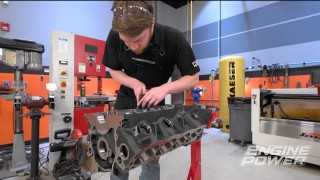
[Pat] Now it's time to get these engines out to their final bore size, which is 30 thousandths over on both of them. We don't need a boring bar to do this. Our Sunnen SV-15, we have accurate and rigid diamond abrasives that will keep the engine's bore in check very well. This in fact is gonna take about 22 to 24 minutes per cylinder to get it out to the size it needs to be. So 16 cylinders means I've got a lot of work to do. We are starting with the 305 block and are using a 150 grit roughing abrasive from Sunnen to remove the large amount of material as quick as possible and make sure the final product is round and straight. Tackling one side at a time we run the bores out almost to final size with a torque plate installed before switching the abrasives for a set of 600 grit to set out final surface finish. After verifying the work and documenting our measurements the Chevy is finished up and we can get it out of the hone and get ready for the 302. [Frankie] For the crankshafts we are going to check the balance on our Multi-Bal 5500 from CWT. We're probably gonna have to make some small adjustments to both but we have cleaned both cranks and the first one to go in is gonna be the Ford because it's a little more involved because it's externally balanced on the rear and the front. So we have a 50 ounce flywheel on the back. We have our damper installed on the front. We have bob weights already made and we know our piston is a little bit lighter than the old one. So we're gonna spin it and see what we get. This process should be pretty straightforward on this crank, and after determining our initial imbalance was under four ounce inch for each side we were able to use a variety of drill bits to remove the material needed from the counterweights. Soon we have the crank dialed in with a very low imbalance at .099 ounce inch on the rear and .129 ounce inch on the front. [Pat] Back at the hone we have our 302 block in place and are starting the roughing process on the first bank to get the cylinders out to size. The process is very similar to the Chevy but since we are using a forged piston for this engine the piston to cylinder wall clearance has to be significantly larger to accommodate the increased thermal expansion of the piston. It is to be noted that both engines received the same cross hatch angle at 39 degrees and the exact same surface finish profile. [Frankie] We have our 305 crank in the balancer now and this is internally balanced. So we don't need the flywheel or the damper when it's in the balancer. Now the weird thing about this one is it wants us to remove the weight from the rod journal itself. Normally we would remove the weight from the counterweight side. This one is inverted. So normally you would have to add weight to the counterweight and then remove it again but because it is such a low amount of weight what we're actually gonna do is something a little bit different. We are going to drill holes into the rod throw itself. So this one doesn't have it from the factory but that will be a quick and easy way to get our six grams out, and holes aren't gonna have to be that big. So at this power level and this r-p-m it's gonna be just fine. We'll get this one tuned in just like that Ford. This little casting boss on the front crank throw is removed first and the surface smoothed out to make the drilling easier. After getting a small starter hole made we can incrementally step up the drill size until we have removed the mass that's causing our imbalance, checking our work as we go. The process is repeated on the rear most crank pin and the crank is checked until we reach our balance target. That is gonna be plenty good. We are .153 ounce inch on the left, .146 ounce inch on the right. That is well within our tolerance. We've got them nicely matched, nicely separated, and I'll save that as our last spin. It sounds like Pat is almost done with that block. [Pat] That's right. I just finished up the 302 block and now we have fully machined blocks and cranks that are ready to hit the cleaners. In the meantime we are gonna do our last machine shop process installing the new pins on our press fit rods, which we can do in house with our Goodson propane rod heater and pin setting fixture. The small end of the rod is heated up for about 20 to 30 seconds in the flame until it just starts to change color. Then there's a short amount of time to install it with the pin and piston before it cools and regains its interference fit. [Frankie] The process is relatively simple but needs to be done correctly or you can improperly install the pin and potentially damage the rod end and/or piston. No matter what you've seen on the internet it's probably an operation best left to a machine shop. Up next, our small blocks go back together on the cheap and get ready to duke it out in the dyno.
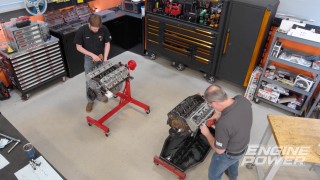
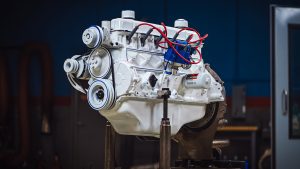
[Pat] We are diving into the reassembly process on both engines starting out with the crankshafts, which are laid into our bearings coated with Hot Shot's Secret assembly lube. Both engines receive new rod and main bearings while they were apart and we already have measured all of the oil clearances. With the thrust faces properly aligned in the forward position the main fasteners on both are torqued to 65 pound feet. [Frankie] The camshaft bearings on these engines were in surprisingly good condition. So the Comp Cams Extreme Energy camshafts can be reinstalled. Both cams use the same series of lobe and they have durations at 50 thousandths lift of 218 on the intake and 224 on the exhaust with a 110 degree lobe separation angle. They vary slightly on lift with the Ford having 546 thousandths of an inch of valve lift on the intake and exhaust and the Chevy having 528 thousandths on the intake and 536 thousandths on the exhaust. [Pat] The Summit Racing adjustable timing sets are reinstalled in the exact same positions and torqued in place but we will still verify the cam shaft's position by installing the number one piston in each engine and degreeing the cam. The Ford is set on a 105 and one quarter degree intake centerline and the Chevy is set at 105 and a half degrees. [Frankie] The remaining seven piston and rod assemblies are installed next. For the Chevy's smaller 3-7-66 inch bore we'll use an adjustable ring compressor that will square up against the decks that have been freshly cut to nine inch by Shacklett Automotive Machine and each of the pistons and rods are temporarily tightened down during installation until they're all in. Then we can go through and torque each rod bolt to 45 pound feet. This Summit Racing 4-0-30 piston ring compressor and dead blow piston hammer ensures a smooth installation with the Ford. The five-sixteenths rod bolts are torqued to the factory spec of 24 pound feet. [Pat] Since both engines got new front seals in round one we only need to replace the timing cover gaskets. And since both the Ford and the Chevy use factory doweled timing covers they can be cinched down with a film of silicone. Because budget is the name of the game we will also reuse the factory dampers and have verified their timing marks. They are installed with the proper damper installer. Next is sealing up the bottom end. Both oil pumps have been inspected. Since they had very good oil pressure the Chevy's pump can be put back in with the factory driveshaft and torqued down to 65 pound feet. A new one piece basket is placed on the engine and the oil pan is dropped on and tightened down with the stock hardware. The Ford follows with the factory pump and driveshaft going in before the pump and pickup are torqued in place with thread retaining compound. It also gets a one piece oil pan gasket before the pan is dropped on and cinched down tight. [Frankie] Since the Ford's lifters have to be installed before the cylinder heads we can lubricate and reinstall them now with the factory dog bone retainers. Once they are all in the lifter tray is dropped on and torqued in place. The Chevy lifters will also be installed but since they are a retro fit link bar style they can just be lubed and slid in. We are ready to put our cylinder heads on but you've probably noticed a slight change in the top of the piston. Because we are using the GT-40-P heads this is a very unique design and basically the spark plug boss is moved. It has a different angle and is moved towards the center of the chamber. So it protrudes much deeper than a normal conventional Ford head would. We actually had to do a slight clearancing to the spark plug boss itself inside the cylinder head, and on the piston we had to cut a relief. It looks like a big cut but actually this is not that much. It's about 2cc. We had a really great piston fixture from Summit Racing. So we were able to do a very accurate, consistent cut. This is something that is very specific to these cylinder heads. If you were doing a conventional Ford head with an open chamber or an aftermarket head this really wouldn't be an issue but we also had to do something similar to the Chevy. [Pat] We had a similar situation on the Chevy, not quite to the extent as the Ford. We had this little boss in the cylinder head that protruded into the dome. So what we did is made is made a smaller cut but still pretty significant. We had to do rights and lefts because remember, Chevy has different looking chambers. It didn't affect the effective dome that much but it did reduce its volume a little bit. So we have a clearance cut on there. We didn't have to do anything to the cylinder head but we got them all scienced out and they're gonna work great. [Frankie] Affordable head gaskets were used on both engines, and the blue oval is using a 4-100 bore 38 thousandths compressed thickness composite that puts the measured static compression ratio at 10.91 to 1 with its 58cc chambers. The head bolts are installed with thread sealer on the threads since some of them protrude into the water jacket and they are all torqued to 65 pound feet. [Pat] The 305 head gaskets are Chevrolet Performance composites with a 4-100 bore and a 28 thousandths compressed thickness. Since we had our best local machine shop, Shacklett Automotive, cut the deck straight to nine inch that combines with a 58cc chamber for a measured static compression ratio of 10.92 to 1. So both engines will be within 1/100th of a point of compression from each other. That is close! The head bolts also receive thread sealer and are torqued to 65 pound feet. [Frankie] All of the valvetrain for both engines remains exactly the same. So the Ford bolt down 1.7-ratio rockers are installed at TDC on each cylinder with high pressure lube on the load points. The Chevy 1.6-ratio rocker arms and push rods are installed in a similar manner with each cylinder's lifter being pre-loaded one half turn past zero lash. [Pat] We were able to save some money and reuse the intake gaskets on both engines. So a bead of sealer on the China walls of the 305 is followed by the Vortec specific 41-50 intake that gets torqued in an X-pattern in increments to 30 pound feet. The 302 gets a matching r-t-v bead and its matching intake, which is tightened down in a similar fashion and also torqued to 30 pound feet. Coming up, we're gonna see if this bow tie has anything for that blue oval.
[ engine starting ] [ Music ] [Frankie] Okay, it is round three of the 302 versus 305 showdown. We have our 302 Ford on first. We got this thing basically ready to go on the dyno. Like we said before, all the other components on this engine are the exact same. I do think on this one we should step up the r-p-m a little bit. I changed it to 2,500 to 6,200 r-p-m at 300 per second. [Pat] I agree with all that. Let her buck and see what it does here. It's gonna be pretty good. [ engine revving ] [ Music ]
[Pat] Carried it out really nicely. [Frankie] Definitely made more. 348.7 pound feet right at 4,700. What is that 362.4 at 6,100. It just starts to peak over. That is solid. Last time we made 344 to 361.9. That is a sizeable gain for just one part change basically. [Pat] The one part change is 1.35 points of compression. Let's make another pull. [Frankie] We'll back it up real quick. [ engine revving ]
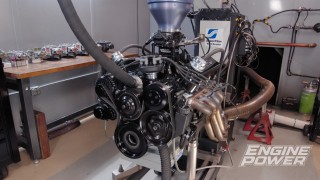
[Pat] That's pretty good. [Frankie] 352.4. [Pat] 364.2 horse pressures. [Frankie] It's making over 300 pound feet from 2,600 on. [Pat] How do you think the Chevy's gonna stack up to it now? [Frankie] That's gonna be the interesting part. Let's get this one off, get that one on. See if we can do same day testing and see what happens. [Pat] It's always better to do it on the same day. We got the engines swapped out. We have our 305 on the pump and our 302 did extremely well. It did pretty much what we thought it should do. The whole idea with this is to get these back to the same level on compression. We have done that. So let's heat this baby up and see what it does. [Frankie] So this one is jumping basically two point three points of compression, which is a huge swing. The cylinder heads and induction package on this one is a little bit better. [Pat] Slightly better. People always think this has a tiny bore. It's not exactly tiny. It is within a very, very small amount of what a 4.8 or a 5.3-LS is right? Let's let her eat here and see what happens. I already see similar torque numbers. [ engine revving ]
[Frankie] That was very close. [Pat] This one is pretty spicy. 345 pound feet of torque and 359 horse. [Frankie] That's just huge gains. Let's say 4,200, pick one, that's 30 pound feet and it's carrying that extremely well everywhere. That's what I want to see. That's pretty cool. [Pat] Let's make another rip on it here. [ engine revving ] [Pat] Little bit better. [ engine revving ]
[Frankie] That was a little better yeah. [Pat] How can anybody say this engine is a boat anchor. 359.9. I'm gonna go ahead and call that 360. [Frankie] 351.6 for torque. [Pat] Let's compare that to the Ford. [Frankie] See that's pretty cool. That is basically a direct overlay. From 4,300 on they are almost a direct overlay. Same engine but from 4,300 below the Chevy is killing it. [Pat] So what have we learned here? We learned that science doesn't lie. The engine doesn't know what brand it is. It knows its displacement. [Frankie] We're not building F1 engines. These are hot rod engines. [Pat] Here's something that's gonna really anger anyone about the legendary DZ-302. They make around 360 in the horsepower range but they only make 330s for torque. [Frankie] You could call this the budget DZ-302 right. A couple of grand all in and you could have an engine that will basically stomp one of those on torque and make similar power. [Pat] Suffice to say we did what we're trying to do. We got the engines back on level playing field with similar parts, very similar compression, similar inductions. They make virtually the same power. [Frankie] And really sets the stage for maybe future upgrades. We've got to figure out what we're gonna do next. [Pat] Great success!
Show Full Transcript
[Frankie] Today on Engine Power it is round three of the shootout between our 302 small block Ford and our 305 small block Chevy. Now everything is gonna stay the same for round two except for one major change. [Pat] And that is compression. Last time there was a discrepancy between the two and you guys went bananas. So we got them back to a level playing field to see how it affects both engines. [Frankie] It's gonna be big. [ Music ] Hey everyone, welcome to another extremely fun day here in Engine Power because this is round three of our 302 versus 305 shootout. Now this has been a multi-stage process of comparing a small block Chevy 305 and a small block Ford 302. Quite honestly this has lit you guys up. [Pat] Last time, just because of the way it worked out on parts there was a discrepancy on compression ratios. So today we're gonna get them back to a level playing field. We've got pistons that are for it and they're gonna get in there and bringing them back to exactly the same as close as we can get it in compression ratio. [Frankie] Because we've got a lot of work to do we've already gone ahead and torn both engines down. So while we get the rest of this stuff cleaned up here's a look at rounds one and two and everything that has already gone into these power plants. This multi-part series has been all about comparing the two most popular and readily available small displacement small block to see how they stack up as budget minded upgrades are installed in stages. [Pat] For the first set of upgrades we kept the heads and bottom end intact and kept the mods as close as humanly possible to keep it fair. These included aftermarket hydraulic roller cam shafts using the same lobes and virtually identical specs, new timing sets, roller lifters, valve springs, the same style intakes, the same carburetor, new matching ignition systems, and the same style and size of header. Given similar displacements and upgrades the engines made the same power numbers at 302 horsepower and 328 pound feet of torque. [Frankie] Round two was by request from you, our viewers, and for this set of upgrades we swapped the original cylinder heads. The 305 received a set of later model 059 casting 305 Vortec heads and the 302 received the famous GT-40-P heads. Both engines also got aftermarket roller rockers. And since the Vortec heads use a different intake style both intakes were swapped again to make sure they stayed similar. [Pat] All the other parts remained the same and were reused on both engines, and the results showed in the dyno. The 302 jumped up to 344 horsepower and 339 pound feet while the 305 still had gains but lagged behind at 326 horsepower and 318 pound feet of torque. [Frankie] Like we said, we're gonna be changing the pistons. So the first thing we're gonna do is remove the pistons from the rods and they use a press fit wrist pin. What that means is the wrist pin actually has about a thousandths or 15 ten thousandths of an interference with the rod bore, and that is what captures the pin and captures the rod inside the piston. It doesn't use spiral locks, or circlips, or anything like that. For what we do we usually use a very dedicated tool to remove piston pins. This is one made by Goodson and this is actually really really nice because the way it works is it actually uses this little U-slot here to support the rod itself. So none of the force is actually exerted onto the piston. You can press the piston off without damaging it and reuse it if you need to. So we have all of our old pistons pressed off. Now it's time to show you the new stuff we're gonna be putting on. If you didn't know, it is a little tricky to get two completely different engines very close on compression ratio but we reached out to UEM because they have an extremely wide line card and a couple of different lines of pistons. So we were able to do some picking and hunting and actually find two pistons, one for each, that will get us extremely close. So we have an Icon piston and we have a KB piston. These are two different lines that UEM offers. For the Ford we're gonna be using an Icon piston. So this is a forged 26-18 piston. It has a 1.608 stock compression height but it has a 6.8cc effective dome, which compared to our flat top is gonna give us a big bump in compression. For ring pack it has a sixteenth, sixteenth, three-sixteenths ring pack. It has a nice coating on the skirts. Very nice, very well machined forged piston and we are gonna use it with our press fit rods again. For the Chevy this is a KB hypereutectic piston specifically for a 305 application. This too has a slight dome to it. It is a .5cc dome with some pretty hefty valve reliefs if you're running big cam stuff. For this one it has a five sixty-fourths, five sixty-fourths, three-sixteenths ring pack. So very close, very similar. It's a very nice casting. Very well machined just like the Icon. So we have these ready to go but we need to prep the block. So when we come back we're gonna hone both blocks and balance both cranks to get these engines ready for assembly. [Pat] Coming up we get our five liters honed to size, balanced to perfection, and then these projects start heating up.
[Pat] Now it's time to get these engines out to their final bore size, which is 30 thousandths over on both of them. We don't need a boring bar to do this. Our Sunnen SV-15, we have accurate and rigid diamond abrasives that will keep the engine's bore in check very well. This in fact is gonna take about 22 to 24 minutes per cylinder to get it out to the size it needs to be. So 16 cylinders means I've got a lot of work to do. We are starting with the 305 block and are using a 150 grit roughing abrasive from Sunnen to remove the large amount of material as quick as possible and make sure the final product is round and straight. Tackling one side at a time we run the bores out almost to final size with a torque plate installed before switching the abrasives for a set of 600 grit to set out final surface finish. After verifying the work and documenting our measurements the Chevy is finished up and we can get it out of the hone and get ready for the 302. [Frankie] For the crankshafts we are going to check the balance on our Multi-Bal 5500 from CWT. We're probably gonna have to make some small adjustments to both but we have cleaned both cranks and the first one to go in is gonna be the Ford because it's a little more involved because it's externally balanced on the rear and the front. So we have a 50 ounce flywheel on the back. We have our damper installed on the front. We have bob weights already made and we know our piston is a little bit lighter than the old one. So we're gonna spin it and see what we get. This process should be pretty straightforward on this crank, and after determining our initial imbalance was under four ounce inch for each side we were able to use a variety of drill bits to remove the material needed from the counterweights. Soon we have the crank dialed in with a very low imbalance at .099 ounce inch on the rear and .129 ounce inch on the front. [Pat] Back at the hone we have our 302 block in place and are starting the roughing process on the first bank to get the cylinders out to size. The process is very similar to the Chevy but since we are using a forged piston for this engine the piston to cylinder wall clearance has to be significantly larger to accommodate the increased thermal expansion of the piston. It is to be noted that both engines received the same cross hatch angle at 39 degrees and the exact same surface finish profile. [Frankie] We have our 305 crank in the balancer now and this is internally balanced. So we don't need the flywheel or the damper when it's in the balancer. Now the weird thing about this one is it wants us to remove the weight from the rod journal itself. Normally we would remove the weight from the counterweight side. This one is inverted. So normally you would have to add weight to the counterweight and then remove it again but because it is such a low amount of weight what we're actually gonna do is something a little bit different. We are going to drill holes into the rod throw itself. So this one doesn't have it from the factory but that will be a quick and easy way to get our six grams out, and holes aren't gonna have to be that big. So at this power level and this r-p-m it's gonna be just fine. We'll get this one tuned in just like that Ford. This little casting boss on the front crank throw is removed first and the surface smoothed out to make the drilling easier. After getting a small starter hole made we can incrementally step up the drill size until we have removed the mass that's causing our imbalance, checking our work as we go. The process is repeated on the rear most crank pin and the crank is checked until we reach our balance target. That is gonna be plenty good. We are .153 ounce inch on the left, .146 ounce inch on the right. That is well within our tolerance. We've got them nicely matched, nicely separated, and I'll save that as our last spin. It sounds like Pat is almost done with that block. [Pat] That's right. I just finished up the 302 block and now we have fully machined blocks and cranks that are ready to hit the cleaners. In the meantime we are gonna do our last machine shop process installing the new pins on our press fit rods, which we can do in house with our Goodson propane rod heater and pin setting fixture. The small end of the rod is heated up for about 20 to 30 seconds in the flame until it just starts to change color. Then there's a short amount of time to install it with the pin and piston before it cools and regains its interference fit. [Frankie] The process is relatively simple but needs to be done correctly or you can improperly install the pin and potentially damage the rod end and/or piston. No matter what you've seen on the internet it's probably an operation best left to a machine shop. Up next, our small blocks go back together on the cheap and get ready to duke it out in the dyno.
[Pat] We are diving into the reassembly process on both engines starting out with the crankshafts, which are laid into our bearings coated with Hot Shot's Secret assembly lube. Both engines receive new rod and main bearings while they were apart and we already have measured all of the oil clearances. With the thrust faces properly aligned in the forward position the main fasteners on both are torqued to 65 pound feet. [Frankie] The camshaft bearings on these engines were in surprisingly good condition. So the Comp Cams Extreme Energy camshafts can be reinstalled. Both cams use the same series of lobe and they have durations at 50 thousandths lift of 218 on the intake and 224 on the exhaust with a 110 degree lobe separation angle. They vary slightly on lift with the Ford having 546 thousandths of an inch of valve lift on the intake and exhaust and the Chevy having 528 thousandths on the intake and 536 thousandths on the exhaust. [Pat] The Summit Racing adjustable timing sets are reinstalled in the exact same positions and torqued in place but we will still verify the cam shaft's position by installing the number one piston in each engine and degreeing the cam. The Ford is set on a 105 and one quarter degree intake centerline and the Chevy is set at 105 and a half degrees. [Frankie] The remaining seven piston and rod assemblies are installed next. For the Chevy's smaller 3-7-66 inch bore we'll use an adjustable ring compressor that will square up against the decks that have been freshly cut to nine inch by Shacklett Automotive Machine and each of the pistons and rods are temporarily tightened down during installation until they're all in. Then we can go through and torque each rod bolt to 45 pound feet. This Summit Racing 4-0-30 piston ring compressor and dead blow piston hammer ensures a smooth installation with the Ford. The five-sixteenths rod bolts are torqued to the factory spec of 24 pound feet. [Pat] Since both engines got new front seals in round one we only need to replace the timing cover gaskets. And since both the Ford and the Chevy use factory doweled timing covers they can be cinched down with a film of silicone. Because budget is the name of the game we will also reuse the factory dampers and have verified their timing marks. They are installed with the proper damper installer. Next is sealing up the bottom end. Both oil pumps have been inspected. Since they had very good oil pressure the Chevy's pump can be put back in with the factory driveshaft and torqued down to 65 pound feet. A new one piece basket is placed on the engine and the oil pan is dropped on and tightened down with the stock hardware. The Ford follows with the factory pump and driveshaft going in before the pump and pickup are torqued in place with thread retaining compound. It also gets a one piece oil pan gasket before the pan is dropped on and cinched down tight. [Frankie] Since the Ford's lifters have to be installed before the cylinder heads we can lubricate and reinstall them now with the factory dog bone retainers. Once they are all in the lifter tray is dropped on and torqued in place. The Chevy lifters will also be installed but since they are a retro fit link bar style they can just be lubed and slid in. We are ready to put our cylinder heads on but you've probably noticed a slight change in the top of the piston. Because we are using the GT-40-P heads this is a very unique design and basically the spark plug boss is moved. It has a different angle and is moved towards the center of the chamber. So it protrudes much deeper than a normal conventional Ford head would. We actually had to do a slight clearancing to the spark plug boss itself inside the cylinder head, and on the piston we had to cut a relief. It looks like a big cut but actually this is not that much. It's about 2cc. We had a really great piston fixture from Summit Racing. So we were able to do a very accurate, consistent cut. This is something that is very specific to these cylinder heads. If you were doing a conventional Ford head with an open chamber or an aftermarket head this really wouldn't be an issue but we also had to do something similar to the Chevy. [Pat] We had a similar situation on the Chevy, not quite to the extent as the Ford. We had this little boss in the cylinder head that protruded into the dome. So what we did is made is made a smaller cut but still pretty significant. We had to do rights and lefts because remember, Chevy has different looking chambers. It didn't affect the effective dome that much but it did reduce its volume a little bit. So we have a clearance cut on there. We didn't have to do anything to the cylinder head but we got them all scienced out and they're gonna work great. [Frankie] Affordable head gaskets were used on both engines, and the blue oval is using a 4-100 bore 38 thousandths compressed thickness composite that puts the measured static compression ratio at 10.91 to 1 with its 58cc chambers. The head bolts are installed with thread sealer on the threads since some of them protrude into the water jacket and they are all torqued to 65 pound feet. [Pat] The 305 head gaskets are Chevrolet Performance composites with a 4-100 bore and a 28 thousandths compressed thickness. Since we had our best local machine shop, Shacklett Automotive, cut the deck straight to nine inch that combines with a 58cc chamber for a measured static compression ratio of 10.92 to 1. So both engines will be within 1/100th of a point of compression from each other. That is close! The head bolts also receive thread sealer and are torqued to 65 pound feet. [Frankie] All of the valvetrain for both engines remains exactly the same. So the Ford bolt down 1.7-ratio rockers are installed at TDC on each cylinder with high pressure lube on the load points. The Chevy 1.6-ratio rocker arms and push rods are installed in a similar manner with each cylinder's lifter being pre-loaded one half turn past zero lash. [Pat] We were able to save some money and reuse the intake gaskets on both engines. So a bead of sealer on the China walls of the 305 is followed by the Vortec specific 41-50 intake that gets torqued in an X-pattern in increments to 30 pound feet. The 302 gets a matching r-t-v bead and its matching intake, which is tightened down in a similar fashion and also torqued to 30 pound feet. Coming up, we're gonna see if this bow tie has anything for that blue oval.
[ engine starting ] [ Music ] [Frankie] Okay, it is round three of the 302 versus 305 showdown. We have our 302 Ford on first. We got this thing basically ready to go on the dyno. Like we said before, all the other components on this engine are the exact same. I do think on this one we should step up the r-p-m a little bit. I changed it to 2,500 to 6,200 r-p-m at 300 per second. [Pat] I agree with all that. Let her buck and see what it does here. It's gonna be pretty good. [ engine revving ] [ Music ]
[Pat] Carried it out really nicely. [Frankie] Definitely made more. 348.7 pound feet right at 4,700. What is that 362.4 at 6,100. It just starts to peak over. That is solid. Last time we made 344 to 361.9. That is a sizeable gain for just one part change basically. [Pat] The one part change is 1.35 points of compression. Let's make another pull. [Frankie] We'll back it up real quick. [ engine revving ]
[Pat] That's pretty good. [Frankie] 352.4. [Pat] 364.2 horse pressures. [Frankie] It's making over 300 pound feet from 2,600 on. [Pat] How do you think the Chevy's gonna stack up to it now? [Frankie] That's gonna be the interesting part. Let's get this one off, get that one on. See if we can do same day testing and see what happens. [Pat] It's always better to do it on the same day. We got the engines swapped out. We have our 305 on the pump and our 302 did extremely well. It did pretty much what we thought it should do. The whole idea with this is to get these back to the same level on compression. We have done that. So let's heat this baby up and see what it does. [Frankie] So this one is jumping basically two point three points of compression, which is a huge swing. The cylinder heads and induction package on this one is a little bit better. [Pat] Slightly better. People always think this has a tiny bore. It's not exactly tiny. It is within a very, very small amount of what a 4.8 or a 5.3-LS is right? Let's let her eat here and see what happens. I already see similar torque numbers. [ engine revving ]
[Frankie] That was very close. [Pat] This one is pretty spicy. 345 pound feet of torque and 359 horse. [Frankie] That's just huge gains. Let's say 4,200, pick one, that's 30 pound feet and it's carrying that extremely well everywhere. That's what I want to see. That's pretty cool. [Pat] Let's make another rip on it here. [ engine revving ] [Pat] Little bit better. [ engine revving ]
[Frankie] That was a little better yeah. [Pat] How can anybody say this engine is a boat anchor. 359.9. I'm gonna go ahead and call that 360. [Frankie] 351.6 for torque. [Pat] Let's compare that to the Ford. [Frankie] See that's pretty cool. That is basically a direct overlay. From 4,300 on they are almost a direct overlay. Same engine but from 4,300 below the Chevy is killing it. [Pat] So what have we learned here? We learned that science doesn't lie. The engine doesn't know what brand it is. It knows its displacement. [Frankie] We're not building F1 engines. These are hot rod engines. [Pat] Here's something that's gonna really anger anyone about the legendary DZ-302. They make around 360 in the horsepower range but they only make 330s for torque. [Frankie] You could call this the budget DZ-302 right. A couple of grand all in and you could have an engine that will basically stomp one of those on torque and make similar power. [Pat] Suffice to say we did what we're trying to do. We got the engines back on level playing field with similar parts, very similar compression, similar inductions. They make virtually the same power. [Frankie] And really sets the stage for maybe future upgrades. We've got to figure out what we're gonna do next. [Pat] Great success!
Engine Power Featured Projects
Engine Power Builds

Want more content like this?
Join the PowerNation Email NewsletterParts Used In This Episode


Comp Cams
COMP Cams Extreme Energy Hydraulic Roller Cam & Lifter Kit Chevrolet Small Block
CWT Industries
Multi-Bal 5500
Goodson Shop Supplies
Piston Pin Removal Fixture
Goodson Shop Supplies
Propane Rod Heater & Piston Assembly
Shacklett Automotive Machine
Shacklett Automotive Machine
Sunnen Products Company
Sunnen SV-15 Honing Machine