In This Episode
- 0:01 Introduction and Overview
- 1:15 Recap of Previous Episodes
- 1:52 Engine Modifications and Build Process
- 4:07 Discussing Duralast Sensors
- 5:00 Installing Critical Sensors
- 6:01 Engine Dyno Testing - Naturally Aspirated
- 8:20 Switching to Turbo Mode
- 11:43 Turbo Manifold Installation
- 14:53 Engine Dyno Testing - Turbocharged
Video Transcript
[Frankie] You're watching Powernation!
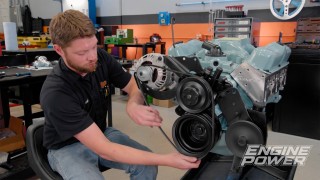
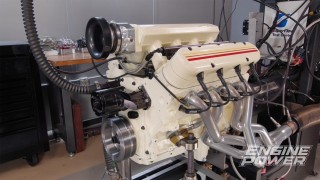
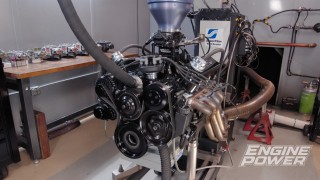
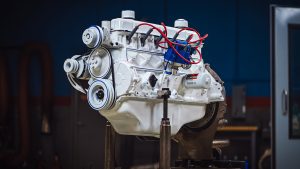
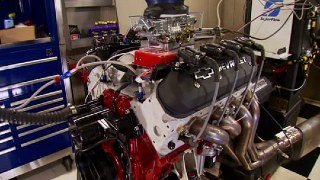
[Frankie] Our Ultimate Ford 300 Project gets wrapped up and heads to the engine dyno after a long and in depth build. With all kinds of upgrades, custom pieces, and a brand new combination we can't wait to see what this thing is gonna put down. [Pat] It's dyno mania because today we are going to run this engine naturally aspirated, gather out data, tear it down, switch it over to turbocharged, and put down some big numbers for this inline six. [ Music ] [Frankie] Alright everyone, today is the day. Here in Engine Power our Ultimate Ford 300 build is hitting the dyno. We are gonna get this baby wrapped up. We're gonna get it into the dyno cell and we are gonna be dynoing this both naturally aspirated and under big boost. [Pat] This is big stuff for us because we're gonna gather a lot of data. We've got O-2 sensors, we've got egt's. We're gonna use a lot of that data and get this thing tuned in naturally aspirated because that's gonna determine what it's gonna make under boost. Now this is episode three of our Ultimate Ford 300 trilogy. So to get it to this point here's what happened in episodes one and two. [Frankie] The previous version of this engine was extremely good and cranked out some great power, but since then we have been planning the next iteration to make even more. We jumped right into the disassembly process and even at our stout power level with a lot of factory components the parts all looked great. The first modifications happened on the block as we ground down the casting for a hydraulic roller lifter mod, ported all the oil galleries, and deburred the entire block. [Pat] After a quick wash in the cleaner we prepped and filled the coolant passageway upside down to help increase the strength and rigidity of the deck and the cylinders before later opening up the coolant ports to retain coolant flow. The block was torque plate honed in our Sunnen SV-15 for our new pistons and higher cylinder pressure. Our forged crankshaft got balanced in our CWT Multi-Bal 5500, and the entire engine received a new but classic paint job with POR-15 engine enamel. [Frankie] With the bearing clearances set the assembly process started with our factory forged crank and a custom ground billet hydraulic roller cam from Comp Cams. What followed was a set of Molnar forged 6-800 long H-beam rods and a set of custom made DSS Racing pistons that have a 1-2-10 compression height, 10cc dish, and a modern 1.2, 1.2, 3 millimeter ring pack. The cylinder head is a c-n-c ported new e-f-i casting from ProMAXX Performance was set up with a Comp conical spring set and is held down with ARP studs. [Pat] We sealed it up with a Fel Pro severe duty head gasket with a 4-180 bore and a 39 thousandths compressed thickness, which combined with our 83.4cc chamber gives us a static compression ratio of 9.21 to 1. The cam gear and timing cover were modified for a Holley cam sync sensor. A modified fluid damper small block Ford damper was installed. Then the critical 36 minus 1 crank trigger setup from Holley went on with our front drive. [Frankie] This is a CVF Racing serpentine system for the 300 platform that has all the accessories and clears this Offenhauser C-series intake that was converted to e-f-i by Wilson Manifolds. We installed our dyno header for the N/A dyno session and then used a plethora of Holley e-f-i parts to build a fully custom sequential fuel injection and coil near plug ignition e-f-i system for our Ford inline six. We are wasting no time today. So we already have our 300 on a dyno cart. We've rolled it into the dyno and gone through most of the basic hookup. We've got water lines, fuel lines, and even hooked up the alternator so this thing will charge the dyno. The last thing we need to do is install a few critical sensor for our e-f-i system before we can actually run this engine. For those we're gonna be using Duralast sensors because like we said, this is not just a dyno queen. This is a street engine that's gonna go in a vehicle later on. So we want sensors that are gonna be durable, be accurate, and last a long time. We've been using Duralast sensors in all of our builds. So they're ones that we trust. For this application we need a TPS and idle air control motor for our 102 millimeter throttle body. The TPS has the correct spacing, the correct clocking, and the correct connector for our application. This is gonna give the e-c-u critical data on the throttle position when we are running it on the dyno. Duralast sensors are designed to be an OE replacement. So they have the correct function, fit, and form but they are actually reverse engineered from the OE sensors so that if Duralast finds any common problems or even potential problems they actually go through and reverse engineer the sensor to fix them and keep that from happening in the future. For the other sensor we need an idle air control motor. For this one we're actually using a Duralast Gold sensor. The reason we like using these is because it not only comes with the high quality sensor but it comes with the matching pigtail and a splice kit. This means that if you are working with a damaged harness or potentially someone broke it before you you have a brand new connector that you can splice in and fix the harness before you get going. What we're gonna do is get these two installed. We got our harnesses all finished up, loomed, and verified. So we're gonna get our sub-harnesses installed and then we'll get the main harness hooked up and connected to the dyno. [Pat] Starting off we will hook up our custom fuel injector harness followed closely by the coil harness. We mounted our Holley HP Series e-c-u to the dyno and finished up hooking up the fuel pressure sensor, coolant temp sensor, and made sure the main harness is securely fastened into the e-c-u. Up next is the first fire up on our high tech vintage iron. [ engine starting ]
[Pat] You think you know where you are now and all that. [Frankie] We have a base file in there. Go ahead and give her fuel and start her up. [Pat] No leaks. This is the exciting part. Here we go! [ engine starting ] [Pat] The wiring harness is correct. [Frankie] We didn't show that. It's very tedious and takes a little bit of time. So we didn't show a lot of it but when you get it done we don't just throw it on there and hope it works. We actually go through, do system output checks, continuity checks, and basically verify our harness is right before it ever tries to function. [Pat] All of the 6 egt's. We have six O-2s on it. Seems like overkill, not protesting. That's why we have these. We are acquiring data. We are showing people. So when anyone wants to build an engine at any level, carbureted, injected, we already have some experience at it and people can look at what we've done. We are gonna do the quintessential keep its guts run. We're gonna go from 2,000 to 4,500 at 600 a second on acceleration rate. [Frankie] I'd like to make a run and then we can go through and double check everything, data logs, engine, all of it. Check all of it and then we can start tuning on it. [Pat] This is my favorite part. [Frankie] Nice and smooth, good. [Pat] All the O-2s look good. [ engine revving ] [Frankie] Not bad on the groupings. It has great negative crankcase pressure. [Pat] Good suckulation. Is that a word? [ Pat laughing ] [Frankie] Already and this is shutting her down early it's obviously trending up. 275 for power, 321 for torque. So we're already over what our previous build was for N/A power. Don't forget we're down seven tenths of a point of compression. [Pat] Everything looks great. [Frankie] Oil pressure looks great. Fuel looks great. AFRs are tracking right where they're supposed to be. I'd like to check some stuff on the engine and go through some of this and then we'll make some real runs. [Pat] Let's do that. [ Music ]
Everything seems to still be attached. [Frankie] Checked everything. Went through and made some corrections on the fueling, and the base table, and cylinders. Hoping to bring those together a little bit. I think we're ready to make a real pull, an actual pull. [Pat] I have made the executive decision to pull it from 2,500 to 5,500. [Frankie] I don't like that decision at all. [Pat] That's too bad. [Frankie] No, that's perfect! [Pat] What I was impressed with is the Delta on the head where the filler is. It was like a 20 degree difference, right? [Frankie] That's pretty good for solidifying around the top of the cylinder. [Pat] There's water going through it. [Frankie] So far that is a success. [Pat] Alright, here we go! [ engine revving ] [Pat] Oh wow! [ engine revving ]
[Pat] I'm gonna go ahead and say nice job on the fuel and timing maps. [Frankie] That was killer. [Pat] You are to be commended. Look at that operation eh? [Frankie] 296.6 and 334 pound feet. Again, still shallow on timing but we are up almost 30 horse. [Pat] First comment someone's gonna make is, all that money for 30 horse. [Frankie] But you have to look at the bigger picture. I mean power under the curve. 15 pound feet at 4,500. [Pat] And it's up a bunch of power. Let's put some timing in it and make some runs. [Pat] Let's see what it does. [Frankie] It's a montage! [ Music ]
[ engine revving ] [ Music ] [Frankie] Let's key it up, make a run, and see if we can get some good numbers here. [Pat] It starts so nice! Silky! [ engine revving ]
[Frankie] Oh yeah! [Pat] It's at least a number right. [Frankie] 300.5, which is 300. [ bleep ] [Frankie] I like that we have not killed any torque basically and we are seven tenths down on compression and we have picked up 30 horsepower on this thing. Percentage wise it's huge. That's awesome! I'm extremely happy with that. [Pat] Now we have a number that naturally aspirated and it's pretty easy to calculate because we're using atmosphere. So however much we put. Say we use a round number, 15 psi, should it make 600? [Frankie] Theoretically we should have a direct correlation. Only thing left now is to tear down. [Pat] We're gonna find out. [Frankie] Up next, we ditch the headah and get with something bettah as we set this engine up to make big boost and big power.
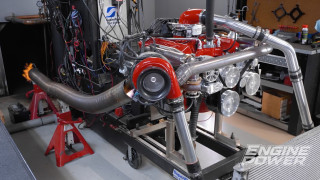
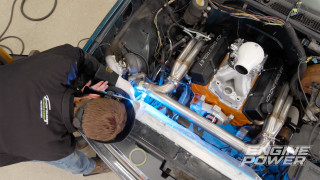
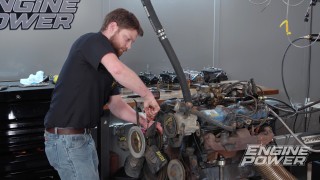
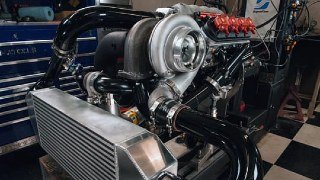
[Frankie] That is a successful naturally aspirated dyno session with our 300. Now it's time to switch it to its turbo mode. I'm gonna work on getting this thing disassembled and one of the partners we had on this build is ARP. This is a company that we love working with. They have a great history and to tell you a little bit about it we have a special guest with Pat. [Pat] We use a lot of ARP in the shop and it's always great to have the person that can tell us a whole lot more about it here as well, Chris Rashke from ARP. Now Chris you guys obviously are an integral part of not only our stuff but racing in the racing industry. I know that covers a broad scope. Tell us a little bit about the evolution of how ARP's fasteners were created because it's a cool story. [Chris] Well Gary Holzapfel started out in the aerospace industry and was a machinist by trade. He started a little bolt business making bolts in his garage at home. That expanded into a little shop in Chancellors, California, which happened to be across the street from Don Prudhomme's drag racing shop. He saw a need for some better fasteners and he approached Don about doing that and that got us into the drag racing world. [Pat] Tell me a little bit about where you came from, how you started at ARP, and how you ended up with a black hat. [Chris] I started at a shop called Duttweiler Performance in 1983. I got involved in racing a dirt mini stock Pinto. One day my tool dealer came by and said hey, you outta go over to Santa Paula and talk to these guys at ARP. They make studs and get a set of head studs for your Pinto. So I took a 12-pack of Coors Light over there on a Saturday and talked to this gentleman named Mike Holzapfel and we became buddies. Several years later he asked if I wanted to come to work for him. It's been 30 years now and further down the road I got involved with some land speed racing. I was fortunate enough to get involved with a car called The Speed Demon with George Poteet. One day George asked if I'd like to drive that car and I said sure. My last pass in the car went 459 miles an hour and set a record. I got this black hat. The black hat is for any records that are over 400 miles an hour plus and I'm only the 13th person to do it with a wheel driven car. [Pat] So I track everything from Formula-1 all the way down and you guys have been heavily involved with that, and we appreciate all that. You guys have been great and you do a lot for us and really appreciate it. [Chris] Thank you. [Frankie] We've got our header off and our intake off and everything is clean. So we are ready to install our turbo manifold. This is from Stainless Header Manufacturing. This is specific for the 300. It is their back exit style. They have a couple of different configurations depending on your application, but for this one we have added twin 45 millimeter waste gate ports, an EGT bung, and wrapped it with some header wrap to try and conserve heat and keep it out of the intake manifold. So we're gonna get this on and then we'll get our intake sealed back up. We are replacing the intake slash exhaust gasket and we're using some high temp sealant to prevent leaks. The turbo manifold has a three-eighths of an inch thick stainless flange to prevent warping under high heat, and once the intake is set back in place they are both rigorously tightened in place with ARP stainless bolts. [Pat] The rest of the turbo system we found at Summit Racing Equipment including twin Turbosmart Hypergate 45 millimeter waste gates and our Turbonetics Silvia 72-68 turbo from last time. The oil drain and feed lines are made with Earl's fittings and hose, and then our Holley three port boost solenoid is plumbed into the waste gates using pressure rated quarter inch hose and secured with zip ties because of the smaller diameter. [Frankie] Crazy enough we can reuse our down pipe from the last version and we made twin down pipes for the waste gates out of one and three quarter inch stainless tubing. Old reliable, our stock Duramax Charge air cooler is set into place and hooked to the engine with an assortment of tubing and adapters for dyno purposes only before the Turbosmart blow off valve we welded is connected to manifold pressure. [Pat] Finally everything is reconnected and double checked and we are ready to go. [Frankie] Turbo time! Coming up, it's turbo time and we're gonna push our 300 for big pump gas power.
[Frankie] Okay Ford 300 with a turbo running very beautifully in the dyno. [Pat] Everything looks great and I am very, very excited about this. [Frankie] Me as well. We've already put 12 pounds of waste gate spring into the waste gate. So that is where we're gonna start and ramp up. [Pat] For whatever reason you somehow took the bookmark out for all my cat videos. [Frankie] Why do you want to watch cat videos when you have this in front of you? Here we go! [Pat] Let her buck. [ Music ] [Frankie] Boost! [Pat] Already got the boosty. [ engine revving ]
[Pat] Oh boy, oh boy, oh boy. [Frankie] We got 555 horsepower already. It peaks at 623 pound feet. EGTs look good. Fuel looks good. [Pat] The big thing when you're making power on pump gas the big wild card is the pump gas. [Frankie] You're tune-up could be solid and you just get a bad batch. [Pat] This curve looks crazy. It's by design right because we don't want to let her bake at 600 pound feet at 2,000 rpm. [Frankie] We actually have a ramp in. I put a ramp in. So at 2,500 its not trying to add a bunch of boost, and then as it goes from 2,500 to 3,000 or 3,500 it starts to ramp in. [Pat] Holley does an excellent job in all the software and all the controls for this. [Frankie] Hit the keys there. 14? [Pat] This is 14 psi. [Frankie] At operating temp, 169. Ready? [Pat] We're logging. [Frankie] Ok here we go. [ engine revving ]
[Pat] Oh man! [ engine revving ] [ Frankie laughing ] [Frankie] Did you see that? [Pat] Pull that up. That is mean right there. [Frankie] This is super fun. Think about this. We have an engine that was originally designed to make 80 horsepower, and it's making 648.2 pound feet and 573 horsepower. [Pat] Alright, spicy pump gas stuff. I would like to go 16, 16.5 psi. [Frankie] I was thinking 16.5 because that should put us at 600 horsepower. [Pat] Mathematically that's what it should put us at right. I don't think we're gonna have any problems. [Frankie] I've set everything up to be extremely safe on fueling and timing. Look at you. You're getting the hang of this. You're doing turbo stuff man. [Pat] Usually I do a vacuum line and a typewriter on my carburetor. This is very similar. It's gonna be good or not so good. [Frankie] Hold on to your chair there. Here we go. [ engine revving ] [Pat] I can see where that ramps in. [ engine revving ] [Pat] It did it, it did it! [Frankie] Holy moly! [Pat] 702.7 pound feet and the magic number, 601.8. That is unbelievably good right there. [Frankie] We'll shut her down cause I think that's probably where we're gonna stop. Just looking at crankcase pressure, looking at EGTs. That's looking like the limit for pump gas stuff. [Pat] Here's what we have learned. On our particular setup at this boost level with this amount of fuel and this type of fuel going in it I think we are done. [Frankie] Here's the number that starts to concern me. EGT's getting real close to 1,700. Now it is in one central point and it's pre-turbo. We're still in vacuum in the crankcase but it's starting to come up. That tells me we're getting to a cylinder pressure level for this fuel that is too much. This will live up to this power level absolutely in a street car. It will get 20 plus miles a gallon with the right trans and rear end combo and stuff. I think this is a win all the way around. [Pat] One of the great things is our block fill. Our grout fill on the top where the deck is we didn't see any crazy tempered differential on where the grout was versus the top of the block wasn't hot. My favorite thing about the comments. We do this thing and a lot of people look at it. The cam is too big. The cam is too small. The turbo's too big. The turbo's too small. We have a split duration instead of a single pattern cam. There's all these things that people say a lot of stuff but we have an actual dyno verified 600 horsepower, 700 pound feet inline six on pump gas. [Frankie] We're not trying to break world records but I think this is the ultimate 300. It has the coolest of parts. It's got the baddest of stuff in it and it makes killer power on pump gas. [Pat] It is the ultimate pump gas 300 in my opinion. [Frankie] Good job!
Show Full Transcript
[Frankie] Our Ultimate Ford 300 Project gets wrapped up and heads to the engine dyno after a long and in depth build. With all kinds of upgrades, custom pieces, and a brand new combination we can't wait to see what this thing is gonna put down. [Pat] It's dyno mania because today we are going to run this engine naturally aspirated, gather out data, tear it down, switch it over to turbocharged, and put down some big numbers for this inline six. [ Music ] [Frankie] Alright everyone, today is the day. Here in Engine Power our Ultimate Ford 300 build is hitting the dyno. We are gonna get this baby wrapped up. We're gonna get it into the dyno cell and we are gonna be dynoing this both naturally aspirated and under big boost. [Pat] This is big stuff for us because we're gonna gather a lot of data. We've got O-2 sensors, we've got egt's. We're gonna use a lot of that data and get this thing tuned in naturally aspirated because that's gonna determine what it's gonna make under boost. Now this is episode three of our Ultimate Ford 300 trilogy. So to get it to this point here's what happened in episodes one and two. [Frankie] The previous version of this engine was extremely good and cranked out some great power, but since then we have been planning the next iteration to make even more. We jumped right into the disassembly process and even at our stout power level with a lot of factory components the parts all looked great. The first modifications happened on the block as we ground down the casting for a hydraulic roller lifter mod, ported all the oil galleries, and deburred the entire block. [Pat] After a quick wash in the cleaner we prepped and filled the coolant passageway upside down to help increase the strength and rigidity of the deck and the cylinders before later opening up the coolant ports to retain coolant flow. The block was torque plate honed in our Sunnen SV-15 for our new pistons and higher cylinder pressure. Our forged crankshaft got balanced in our CWT Multi-Bal 5500, and the entire engine received a new but classic paint job with POR-15 engine enamel. [Frankie] With the bearing clearances set the assembly process started with our factory forged crank and a custom ground billet hydraulic roller cam from Comp Cams. What followed was a set of Molnar forged 6-800 long H-beam rods and a set of custom made DSS Racing pistons that have a 1-2-10 compression height, 10cc dish, and a modern 1.2, 1.2, 3 millimeter ring pack. The cylinder head is a c-n-c ported new e-f-i casting from ProMAXX Performance was set up with a Comp conical spring set and is held down with ARP studs. [Pat] We sealed it up with a Fel Pro severe duty head gasket with a 4-180 bore and a 39 thousandths compressed thickness, which combined with our 83.4cc chamber gives us a static compression ratio of 9.21 to 1. The cam gear and timing cover were modified for a Holley cam sync sensor. A modified fluid damper small block Ford damper was installed. Then the critical 36 minus 1 crank trigger setup from Holley went on with our front drive. [Frankie] This is a CVF Racing serpentine system for the 300 platform that has all the accessories and clears this Offenhauser C-series intake that was converted to e-f-i by Wilson Manifolds. We installed our dyno header for the N/A dyno session and then used a plethora of Holley e-f-i parts to build a fully custom sequential fuel injection and coil near plug ignition e-f-i system for our Ford inline six. We are wasting no time today. So we already have our 300 on a dyno cart. We've rolled it into the dyno and gone through most of the basic hookup. We've got water lines, fuel lines, and even hooked up the alternator so this thing will charge the dyno. The last thing we need to do is install a few critical sensor for our e-f-i system before we can actually run this engine. For those we're gonna be using Duralast sensors because like we said, this is not just a dyno queen. This is a street engine that's gonna go in a vehicle later on. So we want sensors that are gonna be durable, be accurate, and last a long time. We've been using Duralast sensors in all of our builds. So they're ones that we trust. For this application we need a TPS and idle air control motor for our 102 millimeter throttle body. The TPS has the correct spacing, the correct clocking, and the correct connector for our application. This is gonna give the e-c-u critical data on the throttle position when we are running it on the dyno. Duralast sensors are designed to be an OE replacement. So they have the correct function, fit, and form but they are actually reverse engineered from the OE sensors so that if Duralast finds any common problems or even potential problems they actually go through and reverse engineer the sensor to fix them and keep that from happening in the future. For the other sensor we need an idle air control motor. For this one we're actually using a Duralast Gold sensor. The reason we like using these is because it not only comes with the high quality sensor but it comes with the matching pigtail and a splice kit. This means that if you are working with a damaged harness or potentially someone broke it before you you have a brand new connector that you can splice in and fix the harness before you get going. What we're gonna do is get these two installed. We got our harnesses all finished up, loomed, and verified. So we're gonna get our sub-harnesses installed and then we'll get the main harness hooked up and connected to the dyno. [Pat] Starting off we will hook up our custom fuel injector harness followed closely by the coil harness. We mounted our Holley HP Series e-c-u to the dyno and finished up hooking up the fuel pressure sensor, coolant temp sensor, and made sure the main harness is securely fastened into the e-c-u. Up next is the first fire up on our high tech vintage iron. [ engine starting ]
[Pat] You think you know where you are now and all that. [Frankie] We have a base file in there. Go ahead and give her fuel and start her up. [Pat] No leaks. This is the exciting part. Here we go! [ engine starting ] [Pat] The wiring harness is correct. [Frankie] We didn't show that. It's very tedious and takes a little bit of time. So we didn't show a lot of it but when you get it done we don't just throw it on there and hope it works. We actually go through, do system output checks, continuity checks, and basically verify our harness is right before it ever tries to function. [Pat] All of the 6 egt's. We have six O-2s on it. Seems like overkill, not protesting. That's why we have these. We are acquiring data. We are showing people. So when anyone wants to build an engine at any level, carbureted, injected, we already have some experience at it and people can look at what we've done. We are gonna do the quintessential keep its guts run. We're gonna go from 2,000 to 4,500 at 600 a second on acceleration rate. [Frankie] I'd like to make a run and then we can go through and double check everything, data logs, engine, all of it. Check all of it and then we can start tuning on it. [Pat] This is my favorite part. [Frankie] Nice and smooth, good. [Pat] All the O-2s look good. [ engine revving ] [Frankie] Not bad on the groupings. It has great negative crankcase pressure. [Pat] Good suckulation. Is that a word? [ Pat laughing ] [Frankie] Already and this is shutting her down early it's obviously trending up. 275 for power, 321 for torque. So we're already over what our previous build was for N/A power. Don't forget we're down seven tenths of a point of compression. [Pat] Everything looks great. [Frankie] Oil pressure looks great. Fuel looks great. AFRs are tracking right where they're supposed to be. I'd like to check some stuff on the engine and go through some of this and then we'll make some real runs. [Pat] Let's do that. [ Music ]
Everything seems to still be attached. [Frankie] Checked everything. Went through and made some corrections on the fueling, and the base table, and cylinders. Hoping to bring those together a little bit. I think we're ready to make a real pull, an actual pull. [Pat] I have made the executive decision to pull it from 2,500 to 5,500. [Frankie] I don't like that decision at all. [Pat] That's too bad. [Frankie] No, that's perfect! [Pat] What I was impressed with is the Delta on the head where the filler is. It was like a 20 degree difference, right? [Frankie] That's pretty good for solidifying around the top of the cylinder. [Pat] There's water going through it. [Frankie] So far that is a success. [Pat] Alright, here we go! [ engine revving ] [Pat] Oh wow! [ engine revving ]
[Pat] I'm gonna go ahead and say nice job on the fuel and timing maps. [Frankie] That was killer. [Pat] You are to be commended. Look at that operation eh? [Frankie] 296.6 and 334 pound feet. Again, still shallow on timing but we are up almost 30 horse. [Pat] First comment someone's gonna make is, all that money for 30 horse. [Frankie] But you have to look at the bigger picture. I mean power under the curve. 15 pound feet at 4,500. [Pat] And it's up a bunch of power. Let's put some timing in it and make some runs. [Pat] Let's see what it does. [Frankie] It's a montage! [ Music ]
[ engine revving ] [ Music ] [Frankie] Let's key it up, make a run, and see if we can get some good numbers here. [Pat] It starts so nice! Silky! [ engine revving ]
[Frankie] Oh yeah! [Pat] It's at least a number right. [Frankie] 300.5, which is 300. [ bleep ] [Frankie] I like that we have not killed any torque basically and we are seven tenths down on compression and we have picked up 30 horsepower on this thing. Percentage wise it's huge. That's awesome! I'm extremely happy with that. [Pat] Now we have a number that naturally aspirated and it's pretty easy to calculate because we're using atmosphere. So however much we put. Say we use a round number, 15 psi, should it make 600? [Frankie] Theoretically we should have a direct correlation. Only thing left now is to tear down. [Pat] We're gonna find out. [Frankie] Up next, we ditch the headah and get with something bettah as we set this engine up to make big boost and big power.
[Frankie] That is a successful naturally aspirated dyno session with our 300. Now it's time to switch it to its turbo mode. I'm gonna work on getting this thing disassembled and one of the partners we had on this build is ARP. This is a company that we love working with. They have a great history and to tell you a little bit about it we have a special guest with Pat. [Pat] We use a lot of ARP in the shop and it's always great to have the person that can tell us a whole lot more about it here as well, Chris Rashke from ARP. Now Chris you guys obviously are an integral part of not only our stuff but racing in the racing industry. I know that covers a broad scope. Tell us a little bit about the evolution of how ARP's fasteners were created because it's a cool story. [Chris] Well Gary Holzapfel started out in the aerospace industry and was a machinist by trade. He started a little bolt business making bolts in his garage at home. That expanded into a little shop in Chancellors, California, which happened to be across the street from Don Prudhomme's drag racing shop. He saw a need for some better fasteners and he approached Don about doing that and that got us into the drag racing world. [Pat] Tell me a little bit about where you came from, how you started at ARP, and how you ended up with a black hat. [Chris] I started at a shop called Duttweiler Performance in 1983. I got involved in racing a dirt mini stock Pinto. One day my tool dealer came by and said hey, you outta go over to Santa Paula and talk to these guys at ARP. They make studs and get a set of head studs for your Pinto. So I took a 12-pack of Coors Light over there on a Saturday and talked to this gentleman named Mike Holzapfel and we became buddies. Several years later he asked if I wanted to come to work for him. It's been 30 years now and further down the road I got involved with some land speed racing. I was fortunate enough to get involved with a car called The Speed Demon with George Poteet. One day George asked if I'd like to drive that car and I said sure. My last pass in the car went 459 miles an hour and set a record. I got this black hat. The black hat is for any records that are over 400 miles an hour plus and I'm only the 13th person to do it with a wheel driven car. [Pat] So I track everything from Formula-1 all the way down and you guys have been heavily involved with that, and we appreciate all that. You guys have been great and you do a lot for us and really appreciate it. [Chris] Thank you. [Frankie] We've got our header off and our intake off and everything is clean. So we are ready to install our turbo manifold. This is from Stainless Header Manufacturing. This is specific for the 300. It is their back exit style. They have a couple of different configurations depending on your application, but for this one we have added twin 45 millimeter waste gate ports, an EGT bung, and wrapped it with some header wrap to try and conserve heat and keep it out of the intake manifold. So we're gonna get this on and then we'll get our intake sealed back up. We are replacing the intake slash exhaust gasket and we're using some high temp sealant to prevent leaks. The turbo manifold has a three-eighths of an inch thick stainless flange to prevent warping under high heat, and once the intake is set back in place they are both rigorously tightened in place with ARP stainless bolts. [Pat] The rest of the turbo system we found at Summit Racing Equipment including twin Turbosmart Hypergate 45 millimeter waste gates and our Turbonetics Silvia 72-68 turbo from last time. The oil drain and feed lines are made with Earl's fittings and hose, and then our Holley three port boost solenoid is plumbed into the waste gates using pressure rated quarter inch hose and secured with zip ties because of the smaller diameter. [Frankie] Crazy enough we can reuse our down pipe from the last version and we made twin down pipes for the waste gates out of one and three quarter inch stainless tubing. Old reliable, our stock Duramax Charge air cooler is set into place and hooked to the engine with an assortment of tubing and adapters for dyno purposes only before the Turbosmart blow off valve we welded is connected to manifold pressure. [Pat] Finally everything is reconnected and double checked and we are ready to go. [Frankie] Turbo time! Coming up, it's turbo time and we're gonna push our 300 for big pump gas power.
[Frankie] Okay Ford 300 with a turbo running very beautifully in the dyno. [Pat] Everything looks great and I am very, very excited about this. [Frankie] Me as well. We've already put 12 pounds of waste gate spring into the waste gate. So that is where we're gonna start and ramp up. [Pat] For whatever reason you somehow took the bookmark out for all my cat videos. [Frankie] Why do you want to watch cat videos when you have this in front of you? Here we go! [Pat] Let her buck. [ Music ] [Frankie] Boost! [Pat] Already got the boosty. [ engine revving ]
[Pat] Oh boy, oh boy, oh boy. [Frankie] We got 555 horsepower already. It peaks at 623 pound feet. EGTs look good. Fuel looks good. [Pat] The big thing when you're making power on pump gas the big wild card is the pump gas. [Frankie] You're tune-up could be solid and you just get a bad batch. [Pat] This curve looks crazy. It's by design right because we don't want to let her bake at 600 pound feet at 2,000 rpm. [Frankie] We actually have a ramp in. I put a ramp in. So at 2,500 its not trying to add a bunch of boost, and then as it goes from 2,500 to 3,000 or 3,500 it starts to ramp in. [Pat] Holley does an excellent job in all the software and all the controls for this. [Frankie] Hit the keys there. 14? [Pat] This is 14 psi. [Frankie] At operating temp, 169. Ready? [Pat] We're logging. [Frankie] Ok here we go. [ engine revving ]
[Pat] Oh man! [ engine revving ] [ Frankie laughing ] [Frankie] Did you see that? [Pat] Pull that up. That is mean right there. [Frankie] This is super fun. Think about this. We have an engine that was originally designed to make 80 horsepower, and it's making 648.2 pound feet and 573 horsepower. [Pat] Alright, spicy pump gas stuff. I would like to go 16, 16.5 psi. [Frankie] I was thinking 16.5 because that should put us at 600 horsepower. [Pat] Mathematically that's what it should put us at right. I don't think we're gonna have any problems. [Frankie] I've set everything up to be extremely safe on fueling and timing. Look at you. You're getting the hang of this. You're doing turbo stuff man. [Pat] Usually I do a vacuum line and a typewriter on my carburetor. This is very similar. It's gonna be good or not so good. [Frankie] Hold on to your chair there. Here we go. [ engine revving ] [Pat] I can see where that ramps in. [ engine revving ] [Pat] It did it, it did it! [Frankie] Holy moly! [Pat] 702.7 pound feet and the magic number, 601.8. That is unbelievably good right there. [Frankie] We'll shut her down cause I think that's probably where we're gonna stop. Just looking at crankcase pressure, looking at EGTs. That's looking like the limit for pump gas stuff. [Pat] Here's what we have learned. On our particular setup at this boost level with this amount of fuel and this type of fuel going in it I think we are done. [Frankie] Here's the number that starts to concern me. EGT's getting real close to 1,700. Now it is in one central point and it's pre-turbo. We're still in vacuum in the crankcase but it's starting to come up. That tells me we're getting to a cylinder pressure level for this fuel that is too much. This will live up to this power level absolutely in a street car. It will get 20 plus miles a gallon with the right trans and rear end combo and stuff. I think this is a win all the way around. [Pat] One of the great things is our block fill. Our grout fill on the top where the deck is we didn't see any crazy tempered differential on where the grout was versus the top of the block wasn't hot. My favorite thing about the comments. We do this thing and a lot of people look at it. The cam is too big. The cam is too small. The turbo's too big. The turbo's too small. We have a split duration instead of a single pattern cam. There's all these things that people say a lot of stuff but we have an actual dyno verified 600 horsepower, 700 pound feet inline six on pump gas. [Frankie] We're not trying to break world records but I think this is the ultimate 300. It has the coolest of parts. It's got the baddest of stuff in it and it makes killer power on pump gas. [Pat] It is the ultimate pump gas 300 in my opinion. [Frankie] Good job!
Engine Power Featured Projects
Engine Power Builds




Want more content like this?
Join the PowerNation Email NewsletterParts Used In This Episode


Comp Cams
COMP Cams Custom Grind Camshaft
Comp Cams
COMP Cams OD Conical Springs
CVF Racing
Ford Straight Six All Inclusive Serpentine System
CWT Industries
Multi-Bal 5500
DSS Racing
DSS 3FX Series Inline Forged Piston Set
Molnar Rods
Molnar 240 Ford Inline 6 H-Beam Connecting Rods
Offenhauser
Offenhauser Ford L6 Intake Manifold
ProMaxx Performance
ProMaxx CNC Ported Cylinder Heads
Stainless Headers MFG
Ford 300 Inline 6 Turbo Header
Sunnen Products Company
Sunnen SV-15 Honing Machine
WILSON MANIFOLDS
2-IN Open Spacer